
Accountability is the Scarce Asset
September 17, 2026
The short version. AI is rapidly lowering the cost of producing many kinds of knowledge work. As output becomes cheap and plentiful, value shifts toward the ability to rely on it: knowing which work can advance automatically, where human judgment is required, who owns the outcome, and whether you can prove the process ran correctly. Accountable execution becomes more valuable, not less. And accountability is a design problem, not a discipline problem.
The tell: faster output, heavier review
Here is a pattern I keep seeing in teams that adopted AI early.
The volume of work goes up. Drafts, summaries, replies, analyses, and first passes appear faster and in greater numbers than they did a year ago.
Then something else increases that rarely gets included in the productivity calculation: the effort required to decide which outputs are safe to act on.
The work got cheaper to produce and more expensive to trust.
At first, that usually means more checking. Someone rereads the draft, verifies the analysis, compares extracted data against the source, or asks a colleague to confirm that the recommendation makes sense.
A finished looking output is not the same as a decision the organization is prepared to stand behind. Someone still has to determine whether the work is correct, whether it is complete, and what should happen next.
AI did not remove that work. In many teams, it distributed the burden across more outputs and more informal coordination.
These costs are easy to overlook because they are scattered across everyone’s day. AI made the task faster. It did not necessarily improve the system around the task.
If the process holds together only because people continually check the work, route the outputs, and remind one another what comes next, the organization does not have a reliable system. It has capable people compensating for the absence of one.
The bottleneck moved
For most of the history of workplace software, producing the work was one of the main constraints.
Someone had to write the draft, summarize the information, complete the analysis, prepare the report, or move the process one step forward. Tools competed, reasonably, on helping people produce more with less effort.
Productivity meant output.
AI is rapidly reducing the cost of producing many common forms of knowledge work. A credible first draft, initial analysis, structured summary, or recommended response can now appear in seconds.
When one constraint falls that dramatically, the constraint does not disappear. It moves.
The important question is where does it move to?
What became scarce is assurance
When production becomes abundant, value moves toward the capabilities that remain difficult.
Can the organization rely on the result? Does the work require approval, or can it advance automatically? Who is accountable for the outcome? Can the team explain what happened if the result is challenged later?
Those questions have always existed. They were often easier to answer when one person performed the work from beginning to end. That person understood the context, made the judgment calls, completed the handoffs, and could explain why the final result looked the way it did.
AI separates those functions.
A model may produce the output while a person supplies the context. Another person may review it. An automation may initiate the next action, and an agent may complete several additional steps. By the time the outcome is reached, execution may be distributed across people, systems, and AI.
What becomes scarce is assurance: the ability to decide what can be trusted, preserve human judgment where it matters, keep someone accountable as execution is delegated, and show that the process reached the correct outcome.
Trust is the decision to rely on the work. Assurance is the structure that makes that decision defensible.
Adoption is widespread. Operational redesign is not.
McKinsey’s 2025 global survey found that 88% of respondents said their organizations used AI in at least one business function. Only 39% reported any enterprise-level EBIT impact, and most of those respondents estimated the impact at less than 5%.
A separate McKinsey survey found that only 21% of respondents whose organizations used generative AI said their organizations had fundamentally redesigned at least some workflows. Among the organizational practices McKinsey tested, workflow redesign had the strongest relationship with reported EBIT impact from generative AI.
The gap between “we use AI” and “AI has changed our results” is not simply a shortage of model capability. It is also a shortage of redesigned work.
Useful output does not move a business by itself. It must enter a process that can evaluate it, assign what happens next, handle uncertainty, and carry the work through to completion.
AI did not create the execution gap
Most companies had an execution problem before AI arrived.
The standard operating procedure existed, but no one ran it consistently. The meeting produced a decision, but the decision never became an assignment with a deadline. The dashboard revealed a problem, but there was no escalation path. The process was documented, yet managers still had to chase status because the work itself could not show where it stood.
A documented process and a running process are not the same thing.
AI entered those same operating systems. It made the draft faster, the analysis easier, and the first pass cheaper. But it did not automatically create ownership, define review, resolve exceptions, or prove completion.
Consider employee onboarding.
AI might draft the welcome email, summarize an employee’s forms, prepare an equipment request, or recommend which systems they need access to. Those outputs can save time. But they do not confirm that the right accounts were created, that access matches the employee’s role, that an exception reached IT, or that every required step was completed before the employee’s first day.
The output is useful. The completed onboarding process is the outcome.
Point a capable model at a process that was already disorganized and you do not get reliability. You get more output moving through the same informal structure.
The result may look impressive while remaining operationally fragile.
The obvious fixes improve the wrong part
When AI impact disappoints, companies often reach for more of what they already have.
They try a different AI model. They refine the prompts. They write more documentation, create another reminder, or connect the AI to more systems.
Each of those may improve part of the process. None creates accountable execution by itself.
A better model may produce a better recommendation, but the recommendation still does not assign itself. Better documentation can explain what should happen, but it does not start the work, route an exception, or create evidence as the process runs. A reminder may prompt someone to act, but it does not establish who owns the outcome or what “complete” means.
Connectivity does not solve the problem either. An integration can move an output from one system to another without determining whether the work was appropriate, who should review it, or what happens when the normal path breaks.
The common mistake is trying to improve the AI when the real problem is what happens after the AI produces something.
Better AI improves the output. It does not establish how the organization should act on it.
The answer is not reviewing everything forever
If AI increases the volume of work, the organization cannot respond by placing a person behind every output indefinitely.
That simply replaces a production bottleneck with a review bottleneck.
The better response is to allocate trust deliberately.
Some work should require approval before anything happens because the consequences are financial, legal, operational, or personal. Other work can proceed automatically when it stays within defined limits, with unusual or low-confidence cases routed to a person. Processes that have earned greater trust may require only periodic sampling and monitoring.
The goal is not to eliminate human oversight. It is to direct human attention toward the places where uncertainty and consequences are highest.
A reliable system knows which work must stop for a person, which work can proceed inside defined boundaries, and which signals should bring a person back into the process.
That is progressive delegation.
An organization does not decide to trust “the AI” in the abstract. It decides how much authority a specific AI-supported step has earned based on the cost of an error, the judgment required, the ease of verification, the quality of exception detection, and evidence from previous runs.
Trust is assigned one step at a time.
Authority can change. Accountability cannot disappear.
The AI era makes an important distinction unavoidable.
A person or AI system can be given access to a process. It can be assigned a step. It can be granted authority to act within defined boundaries.
None of those is the same as accountability.
Accountability means a named human role answers for the outcome, including the rules under which work was delegated, the risks the organization accepted, and the response when something went wrong.
An AI agent may detect changing conditions, recognize exceptions, and adjust its actions. Those capabilities will continue to improve. But the durable question is not whether the AI can behave intelligently enough to appear responsible.
The question is who the organization can hold answerable for the result.
An AI system can perform the work. It cannot become the organizationally accountable party.
That does not mean a person must manually approve every action. It means the process must retain a clear owner even when that owner handles only exceptions, judgment calls, or overall performance.
Who performs the step can change. Who answers for the outcome cannot disappear.
Accountable execution is a system
Accountability is often treated as a personal quality.
Find disciplined people. Tell them to take ownership. Remind them to follow through.
That approach works until the workload increases, someone is absent, or the process encounters an unusual case. Then the same step slips again, and the organization asks who dropped the ball.
The more useful question is what allowed it to drop.
Recurring failures are usually the result of a system behaving exactly as its design permits. You cannot expect people to remember what the process never made visible or own an outcome that the system never clearly assigned.
Accountability names who answers for the result.
Accountable execution is the structure that makes that responsibility operational.
The work begins from a defined trigger instead of someone’s memory. Each run has a named owner. The relevant context travels with the work. AI outputs land on defined steps instead of remaining in private chats. Review happens at deliberate checkpoints or through explicit exception rules. The current state remains visible, and completion creates a durable record.
That structure does not add bureaucracy around the value.
It is what turns useful output into a reliable outcome.
The execution record should build while the work runs
As execution becomes distributed, organizations need more than a model activity log.
A log can show that the AI generated a response, changed a field, or completed an action. It does not necessarily show whether the broader business outcome was correct.
A defensible execution record connects the entire run.
It shows when the process began, who owned it, what context applied, what AI produced, where human judgment occurred, which exceptions appeared, what actions followed, and whether the required outcome was reached.
The best time to create that record is while the work is happening.
Trying to reconstruct it later means searching through chat histories, email threads, application logs, meeting notes, and personal memory. By then, the record is incomplete and the people reconstructing it are often under pressure.
Assurance should be produced as the work runs, not assembled afterward as an administrative project.
Where Manifestly fits
This is where Manifestly fits in AI-supported work.
Manifestly is not the model performing every task, and it is not a replacement for the automations and business systems already involved in the process.
It is the accountability and execution layer around them.
A Manifestly workflow defines when recurring work begins, who owns each run, which steps belong to people or AI, where review is required, what happens when an exception appears, and how completion is recorded.
Manifestly’s MCP server allows AI agents to act inside those workflows. AI can perform designated tasks, update workflow information, complete steps, or help move the process forward while the workflow retains ownership, state, review points, and history.
This distinction is important.
The chat does not become the operating system. The AI operates inside an accountable process.
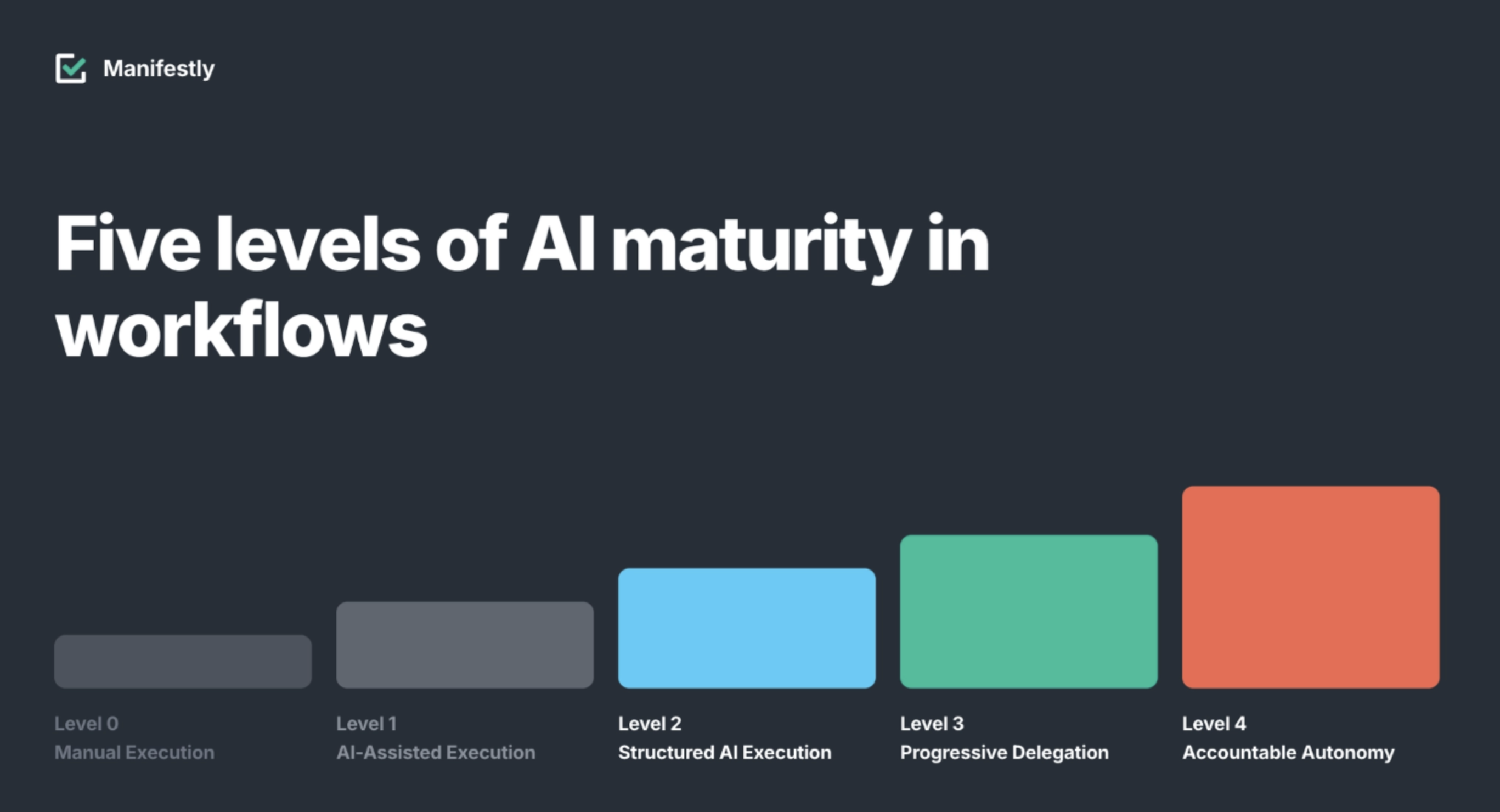
Manifestly gives AI-supported work somewhere reliable to land. It allows authority to vary from one step to another while accountability remains stable. As a process earns greater trust, more execution can happen automatically without losing the owner, exception path, or record of what happened.
Manifestly does not decide that the entire process should be automated.
It provides the structure in which trust can increase selectively without allowing accountability to disappear.
What becomes more valuable
As AI improves, more task-level execution will become interchangeable.
Models will get better at drafting, analysis, system actions, and routine decisions. The cost of those tasks will continue to fall, and the difference between capable models may narrow for many common uses.
That changes what organizations should evaluate.
The strategic question is no longer only which model produces the best first draft. It is which system lets the organization safely rely on the work after that draft exists.
When should the work begin? Which context applies? How much authority does the AI have? Where must a person remain involved? What indicates an exception? Who owns the outcome? What proves the process completed correctly?
Those questions become more important as the AI improves because more work can happen without direct human attention.
AI capability will continue to become more abundant.
The ability to turn that capability into reliable work will not.
Start with one process
The next move is not to overhaul your organization’s entire operating model.
Choose one recurring process where AI is already touching the work. Look for the point where a useful output becomes informal: copied into another system, sent through a message, held for an undefined review, or left with one person to move forward.
Put that output inside a defined workflow step. Name the owner of the full outcome. Decide whether the step requires approval, bounded authority, exception review, or periodic sampling. Make the exception path visible and define what evidence marks the process complete.
Then watch what changes.
Does the work begin more consistently? Do fewer outputs disappear after they are produced? Can someone see the current status without asking? Can another person continue the process when the usual operator is absent? Is the team more willing to rely on the result?
Those are signs that AI capability is becoming operational capability.
The more work AI can perform without direct attention, the less an organization can afford to leave ownership, review, and proof implicit.