
The AI Maturity Model for Human-Centric Work
August 06, 2026
Companies have adopted AI faster than they have changed how work gets done.
Eighty-eight percent of organizations now report using AI in at least one business function, yet only about one-third have begun scaling it across the enterprise. AI is everywhere inside the company, but in most companies, the way work gets done has barely changed.
The onboarding process still depends on someone remembering to start it. The compliance review still moves through email. The finance team still follows up manually when a step is late. Managers still ask for status because the process itself cannot tell them what happened.
Employees may now use AI to draft the email, summarize the call notes, reconcile the ledger, or flag the anomaly, but they are still responsible for carrying that output through the rest of the process.
The AI improved how fast work got done. The operating system around the work did not.
This is why widespread AI adoption has produced far less transformation than many companies expected. They adopted capability without redesigning the structure that turns capability into impact.
The adoption-to-impact gap is the same execution gap businesses already had before AI: unclear ownership, inconsistent handoffs, invisible status, missing follow-through, and no reliable record of completion.
The AI maturity model for human-centric work maps the way out. It measures maturity not by how sophisticated the models are, but by whether AI-supported work is owned, reviewed, advanced, and recorded inside a reliable process.
Key takeaway
The AI maturity model for human-centric work measures how work is owned, reviewed, and recorded, not how advanced the AI models teams use.
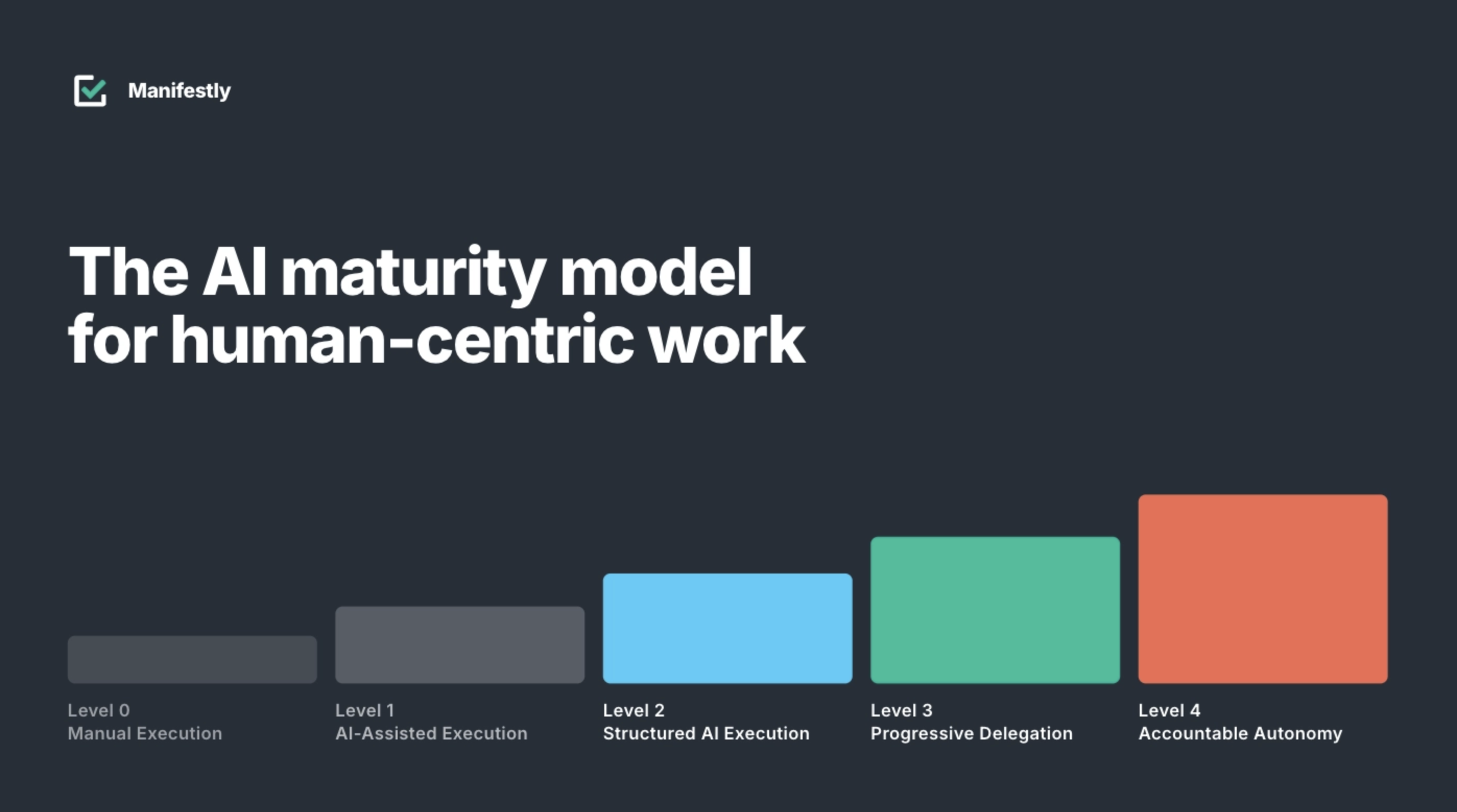
Teams progress through five levels:
Manual Execution → AI-Assisted Execution → Structured AI Execution → Progressive Delegation → Accountable Autonomy
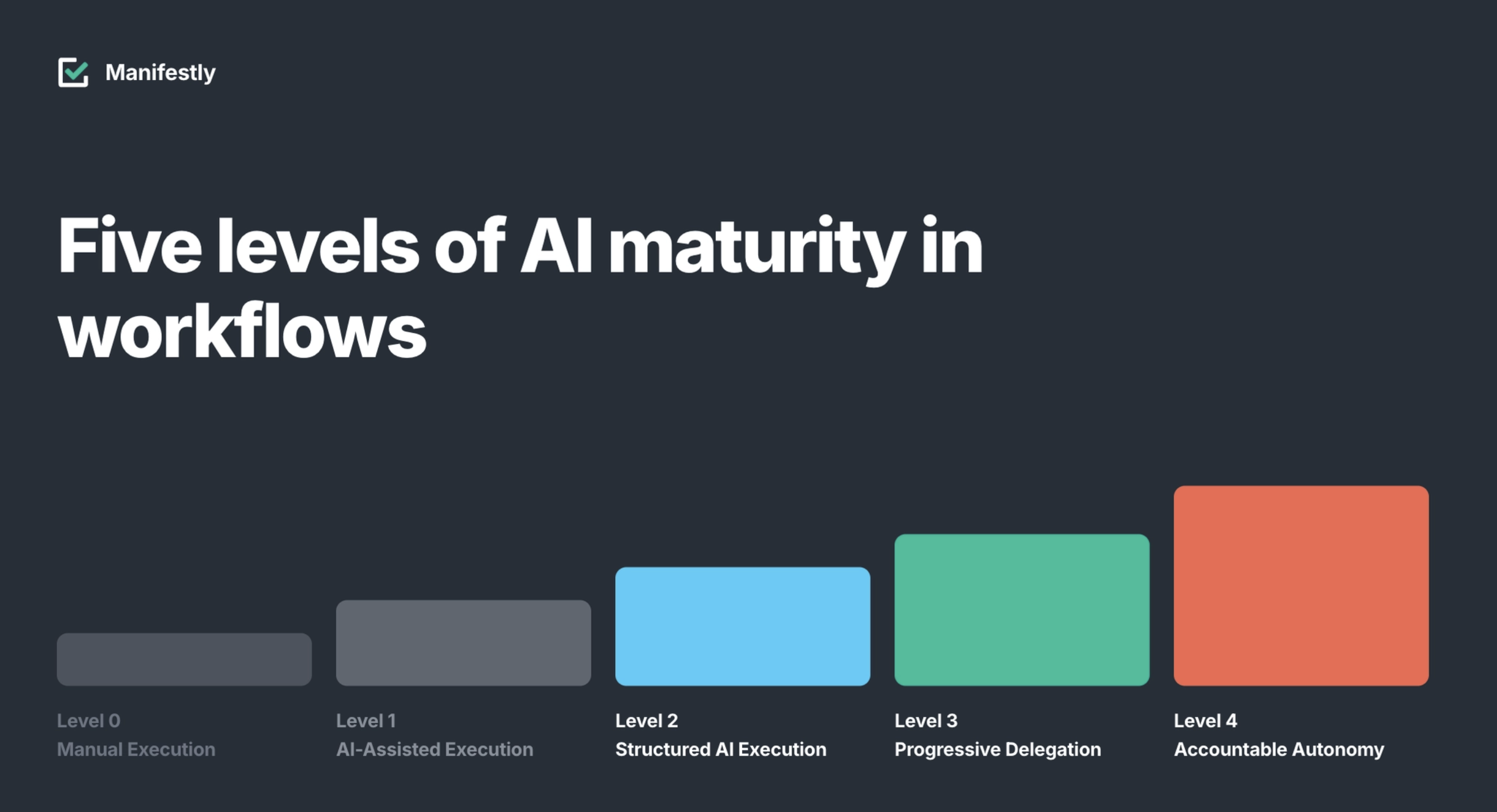
The decisive jump happens between Level 1 and Level 2. That is where AI adoption begins to become AI transformation: AI stops being an individual productivity tool and starts operating inside a recurring process with ownership, checkpoints, visible status, and a durable completion record.
What is an AI maturity model?
An AI maturity model is a framework for assessing how effectively an organization has integrated artificial intelligence into its operations.
Many AI maturity models evaluate the organization broadly across areas such as technology, data, governance, talent, culture, and adoption. Those dimensions matter, but they do not always show whether AI is changing how everyday work actually gets done.
The AI maturity model for human-centric work isolates one specific axis:
Has AI capability been integrated into work that has a clear owner, defined review, visible status, and a reliable record?
This distinction matters because AI adoption and AI transformation are not the same thing.
AI adoption occurs when employees begin using AI. AI transformation begins when the organization redesigns recurring work around what humans and AI can each do. The difference is visible in ownership, review, handoffs, operating roles, and records, not merely in usage rates.
A team may have hundreds of employees using AI every day while its recurring work remains informal, fragmented, and dependent on individual follow-through. AI usage may be high even when operational maturity remains low.
The maturity ladder therefore does not ask how powerful the model is. It asks how reliably the organization can turn that power into completed work.
Why AI adoption does not automatically create impact
Most businesses did not begin using AI with perfectly designed processes.
They already had work spread across outdated documentation, spreadsheets, email threads, shared drives, project boards, chat messages, and individual memory. Responsibilities were sometimes implied rather than assigned. Deadlines were tracked manually. Managers relied on status meetings to learn what was late or incomplete.
AI entered that environment as another layer of capability.
It could produce a draft, analysis, summary, or recommendation, but the surrounding operating model often stayed exactly the same.
AI drafts a customer follow-up, but no one is assigned to review and send it.
AI flags an accounting discrepancy, but there is no defined escalation path or deadline.
AI summarizes an employee onboarding case, but the output remains in a chat window rather than entering the onboarding process.
In each case, the model may have completed its task successfully. The business still failed to complete the work.
This is the central difference between task output and operational outcome.
A task output is something the AI produces. An operational outcome requires that the output reaches the right person, receives the appropriate review, leads to the required action, and leaves behind evidence of completion.
Without that structure, AI can make work faster without transforming how the process runs.
The five levels of AI maturity for human-centric work
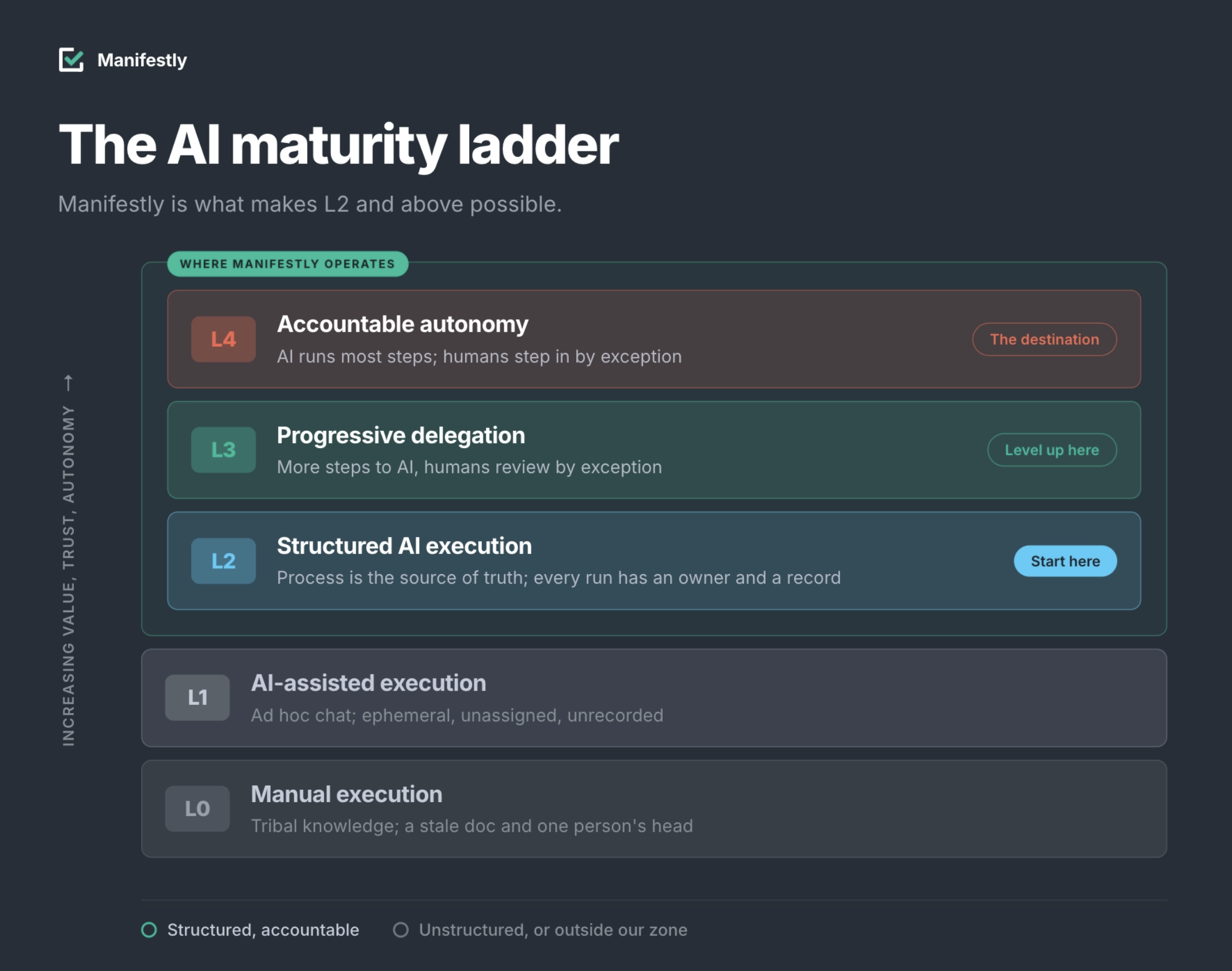
The five levels describe how responsibility for recurring work evolves as AI becomes more integrated into the process.
The axis is the degree to which execution is structured, delegated, and accountable.
Level 0: Manual Execution
At Level 0, people perform the work manually, and process reliability depends primarily on human memory, judgment, and follow-through.
The process may live in someone’s head, in a standard operating procedure, or across several tools. Even when documentation exists, a person still has to remember when to begin, determine what happens next, coordinate with others, and confirm that the work is finished.
Some Level 0 processes are well run. Experienced employees may execute them consistently for years.
The weakness is structural dependence. Reliability is attached to the person rather than embedded in the process. When the person is busy, absent, or replaced, the work slows down or breaks. Managers often have limited visibility unless they ask for an update. Completion may be assumed rather than recorded.
At Level 0, the human is not only doing the work. The human is also acting as the scheduler, router, reviewer, reminder system, and record keeper.
Level 1: AI-Assisted Execution
At Level 1, AI helps individuals perform tasks, but the organization has not changed how the work is owned, reviewed, or recorded.
This is where many businesses currently operate while believing they are further along.
Employees use AI chat or standalone tools to draft communications, analyze information, summarize documents, generate ideas, or troubleshoot problems. The assistance is real and may save time and improve the quality of their work, but the underlying process remains informal.
The employee still knows which context to provide, decides whether the output is correct, and remembers what needs to happen next. The employee transfers the result into another system, sends it to the right person, or records it somewhere permanent.
The AI makes the individual more capable, but the business remains dependent on that individual.
The output is often ephemeral, unassigned, and disconnected from the system where the work is supposed to happen. It may disappear inside a chat history or remain known only to the person who generated it.
This is what makes Level 1 deceptive. It creates visible activity and measurable time savings without necessarily improving organizational reliability.
The employee improved. The operating system did not.
A simple test exposes the difference:
If the person who knows the prompts, context, and handoffs is unavailable, does the process still run?
If the answer is no, the team is probably still at Level 1.
Level 2: Structured AI Execution
At Level 2, AI performs defined work inside a recurring process where ownership, timing, review, status, and completion are explicit.
This is the structural threshold in the maturity model and also where AI adoption begins to become AI transformation.
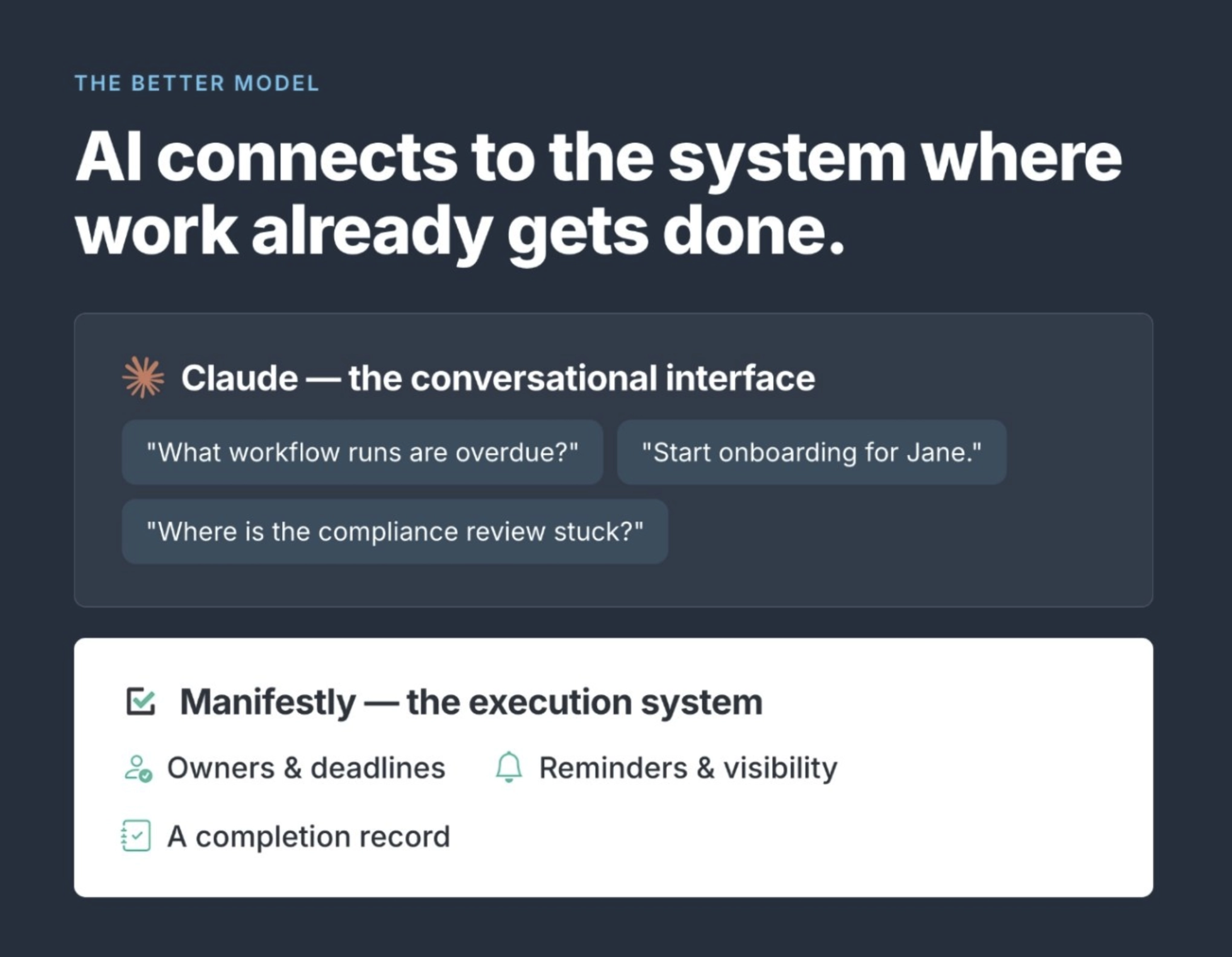
The recurring process becomes the source of truth. AI is no longer used only when an individual remembers to open a chat window. It performs designated tasks inside a defined workflow.
A human may review the output at a required checkpoint and another person may be assigned to make a judgment or approve an exception, but the process itself determines what happens next.
Every run has a named owner. The work has a trigger or cadence. Due dates and reminders are attached to the process. Managers can see its current state. Completion creates a durable record.
AI capability finally lands somewhere that can carry it through to an operational outcome.
The important change is not that AI suddenly becomes more advanced. The surrounding system becomes more explicit.
At Level 1, the person coordinates the process around the AI.
At Level 2, the process coordinates the work of both humans and AI.
This is where AI use becomes organizational capability rather than individual productivity.
Level 3: Progressive Delegation
At Level 3, teams delegate more steps to AI as those steps demonstrate sufficient reliability, while human oversight becomes increasingly risk-based and exception-driven.
The accountability structure established at Level 2 remains intact. The process still has an owner, its state is still visible, review and completion are still recorded.
What changes is the amount of work AI is trusted to perform.
Teams do not need to decide whether an entire workflow should be manual or autonomous. They can evaluate each step independently.
A low-risk, easily verified step may require little or no routine review. A step with uncertain inputs may be routed to a person only when confidence falls below a defined threshold. A high-consequence decision may always require human approval.
Trust accrues step by step.
This is the core mechanism of progressive delegation. AI does not receive blanket authority because the model appears capable. Individual tasks earn lighter review through demonstrated reliability, clear boundaries, and a manageable cost of error.
At Level 2, human review is designed into the process.
At Level 3, the amount and type of review varies according to the risk and reliability of each step.
Humans begin to spend less time checking routine work and more time handling ambiguity, exceptions, and high-value judgment.
The execution model changes. The accountability skeleton does not.
Level 4: Accountable Autonomy
At Level 4, the process runs autonomously by default, while a named owner remains accountable and every run remains visible and recorded.
AI performs most routine execution. Humans become involved when the process encounters an exception, crosses a risk threshold, or reaches a judgment point that requires deliberate human involvement.
The defining feature is the preservation of accountability. Even on runs that no person touches, the organization can still determine:
- who owns the process;
- what actions occurred;
- what information the AI used;
- what exceptions were raised;
- whether the required outcome was reached;
- and what record remains.
This is what separates accountable autonomy from unattended activity. The labor may disappear from a particular run. The owner and record do not.
Level 4 does not mean every human-centric process should become fully autonomous. Many processes involve decisions, relationships, ethical considerations, or consequences that warrant human participation by design.
That is not a failure of mature AI systems, it’s a feature of the work.
Accountable autonomy means automating as much of the execution as the process can safely support without automating away responsibility for the result.
The structural threshold between Level 1 and Level 2
The largest jump in the maturity ladder is not between Level 3 and Level 4. It is between Level 1 and Level 2.
The later levels increase delegation. The Level 1-to-Level 2 transition changes the operating model itself.
At Level 1, AI use is attached to the person.
At Level 2, AI use is attached to the process.
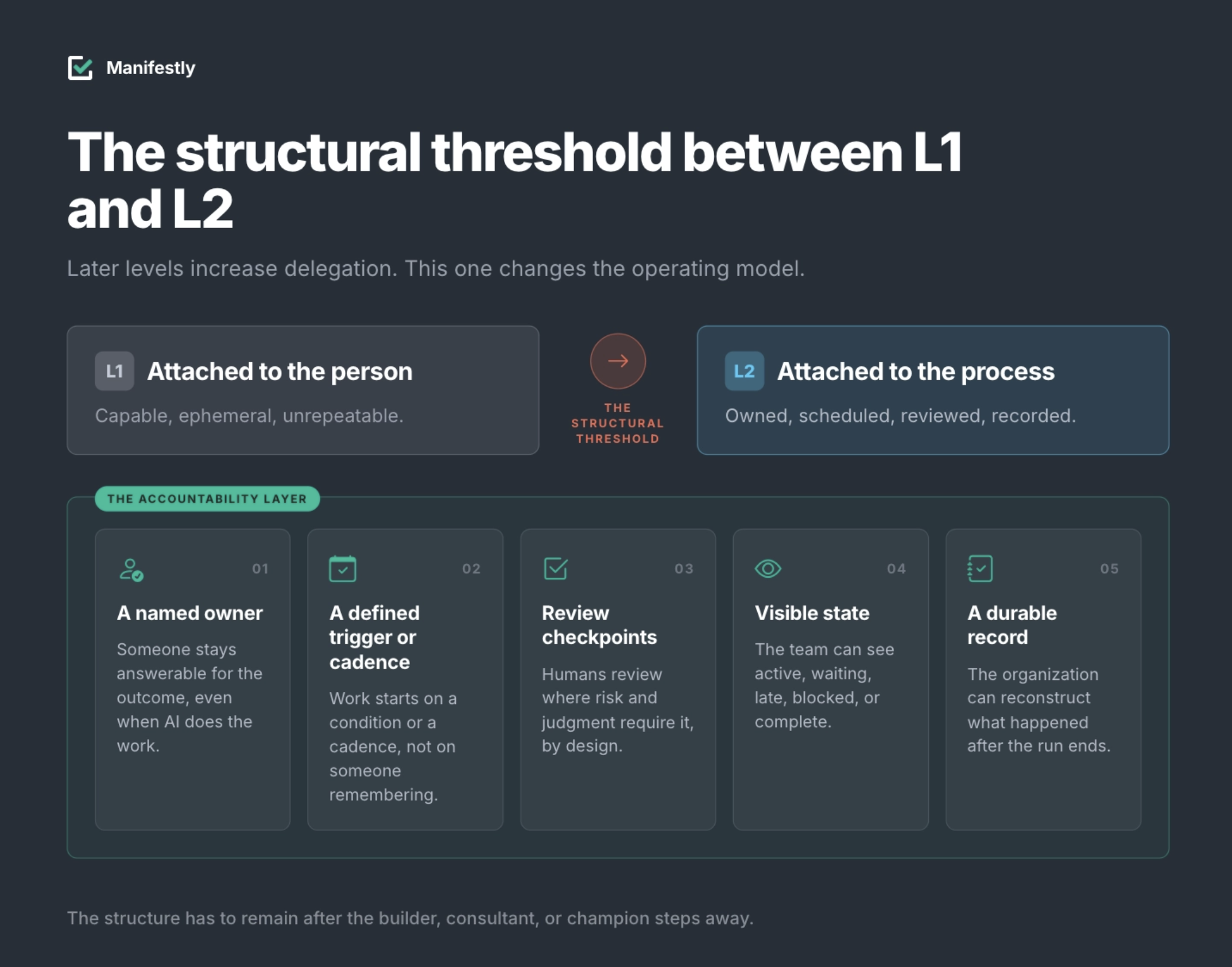
That shift introduces five elements that ad hoc AI usage usually lacks.
A named owner
Someone remains answerable for the outcome, even when AI performs part of the work.
A defined trigger or cadence
The process begins because a condition is met or a recurring schedule requires it—not because someone remembers to start it.
Deliberate review checkpoints
Human review occurs where the risk or judgment of the work requires it, rather than informally or inconsistently.
Visible state
The team can see whether the process is active, waiting, late, blocked, or complete.
A durable record
The organization can reconstruct what happened after the process ends.
These elements form the accountability layer around AI capability.
Forward-deployed engineering teams and internal AI transformation leaders often focus on this same transition: moving AI out of isolated experiments and into production workflows that change how the business operates.
But technical deployment alone does not complete the transformation. The workflow also needs an operating structure that remains after the builder, consultant, or internal champion steps away.
Without that structure, the business may have an impressive AI implementation but no reliable way to turn it into repeatable execution.
How AI maturity differs from workflow automation
AI maturity and workflow automation overlap, but they are not the same thing.
Automation platforms such as Zapier and n8n are designed primarily to connect systems, respond to triggers, and move data or actions from one application to another. They are well suited to high-volume, deterministic work that does not require ongoing human judgment.
For example, an automation might copy a new form submission into a customer relationship management system, send a notification, create a folder, or update a database record.
The AI maturity ladder for human-centric work measures a different dimension.
Its organizing object is not the system connection. It is the recurring unit of work:
- Who owns it?
- What outcome is required?
- Which steps can AI perform?
- Where is human judgment necessary?
- What is the current state?
- What happens when something goes wrong?
- What proves the work was completed?
Automation may perform important steps inside a mature process. Agentic systems may perform even more of them, but successful data movement does not by itself prove that an accountable business process reached the right outcome.
This is why automation is not automatically a higher rung on the ladder. It is a different capability that can support maturity when placed inside the right operating structure.
The right system depends on the type of work.
One-off writing, thinking, and analysis may belong in AI chat.
High-volume, deterministic routing may belong in an automation platform.
Human-centric recurring work with judgment gates, named owners, and meaningful consequences requires a system built around accountable completion.
Why Level 1 feels more mature than it is
Level 1 creates many of the visible signs leaders associate with AI transformation.
Employees use AI every day. Teams share prompt libraries. Outputs appear faster. Individual productivity rises. Leadership may see strong usage numbers and assume the organization is progressing toward mature adoption.
But activity is not the same as integration, and adoption is not the same as transformation.
A Level 1 team may produce more work while preserving every weakness of the original process:
- responsibility remains implicit;
- deadlines remain manually tracked;
- review varies by person;
- outputs remain scattered;
- exceptions are noticed inconsistently;
- and completion is difficult to verify.
In some cases, the organization becomes even more dependent on high-performing individuals because those employees now hold the prompts, context, judgment, and handoffs that make the AI useful.
The person has become the system.
That is why moving beyond Level 1 requires more than better prompts, more training, or a stronger model. It requires a structural change in where AI operates.
The question is no longer simply:
Can AI perform this task?
The more mature question is:
What process will own, review, advance, and record the work after AI performs the task?
As capability rises, accountability becomes more valuable
AI models will continue to become more capable and AI agent builders will make complex workflows easier to assemble. The technical effort required to automate individual steps will continue to fall.
That makes the accountability layer more important.
When human labor is visible throughout a process, organizations often rely on presence as a rough proxy for oversight. Someone touched the work, checked the output, moved it forward, and knew what happened.
As AI performs more of the doing, that assumption disappears.
The organization needs another way to establish that the right work happened under the right conditions. It needs to know that exceptions were handled, required judgments were made, and an accountable owner can stand behind the result.
Execution becomes cheaper and more abundant. Assurance becomes scarce.
This is the durable value of the maturity ladder. It does not depend on models remaining weak or automation remaining difficult. It assumes the opposite.
The more AI can do, the more valuable it becomes to place that capability inside systems that preserve ownership, judgment, visibility, and records.
Real AI transformation does not end when AI can perform the task. It begins when the organization can reliably own, review, and account for the result.
The future of AI maturity is not less accountability. It is more work happening without direct human effort while accountability remains intact.
That is the climb from AI adoption to accountable autonomy.
Frequently asked questions
What is an AI maturity model?
An AI maturity model is a framework for assessing how effectively an organization has integrated artificial intelligence into its operations. The AI maturity model for human-centric work evaluates whether AI-supported work has clear ownership, defined review, visible status, and a durable completion record.
What is the difference between AI adoption and AI transformation?
AI adoption occurs when employees begin using AI tools. AI transformation begins when the organization redesigns recurring work around what humans and AI can each do, including how work is owned, reviewed, handed off, escalated, and recorded.
What are the five levels of AI maturity for human-centric work?
The five levels are Manual Execution, AI-Assisted Execution, Structured AI Execution, Progressive Delegation, and Accountable Autonomy. They describe the progression from fully manual work to AI-powered processes that run autonomously while preserving human accountability.
Why does AI adoption fail to create business impact?
AI adoption often fails to create impact because companies introduce AI capability without changing the systems around the work. AI may produce useful outputs, but those outputs do not reliably become completed outcomes unless ownership, review, deadlines, visibility, and records are built into the process.
Is workflow automation the same as AI maturity?
No. Workflow automation can support AI maturity, but automating triggers and actions does not automatically create accountable execution. AI maturity also requires clear ownership, appropriate human judgment, visible process state, exception handling, and evidence that the required outcome was reached.
How can a business move from Level 1 to Level 2?
A business moves from Level 1 to Level 2 by placing AI inside a defined recurring process rather than relying on individual ad hoc usage. Each process should have a named owner, a clear trigger or cadence, designated AI tasks, deliberate human checkpoints, visible status, and a durable completion record.