
Most Companies Are Lower on the AI Maturity Ladder Than They Think
August 13, 2026
Your employees are using AI.
They draft emails, summarize meetings, analyze documents, clean up reports, prepare customer responses, build internal tools, and experiment with agents. Leadership sees usage rising across the company and assumes the organization is becoming more mature.
But many of the same operational problems remain. Recurring processes still begin because someone remembers to start them. Handoffs still happen through email and chat. Managers still chase status. Important context still lives in one person’s head. AI outputs still sit inside private conversations until someone manually moves them into the rest of the business.
The company adopted AI. The operating model did not.
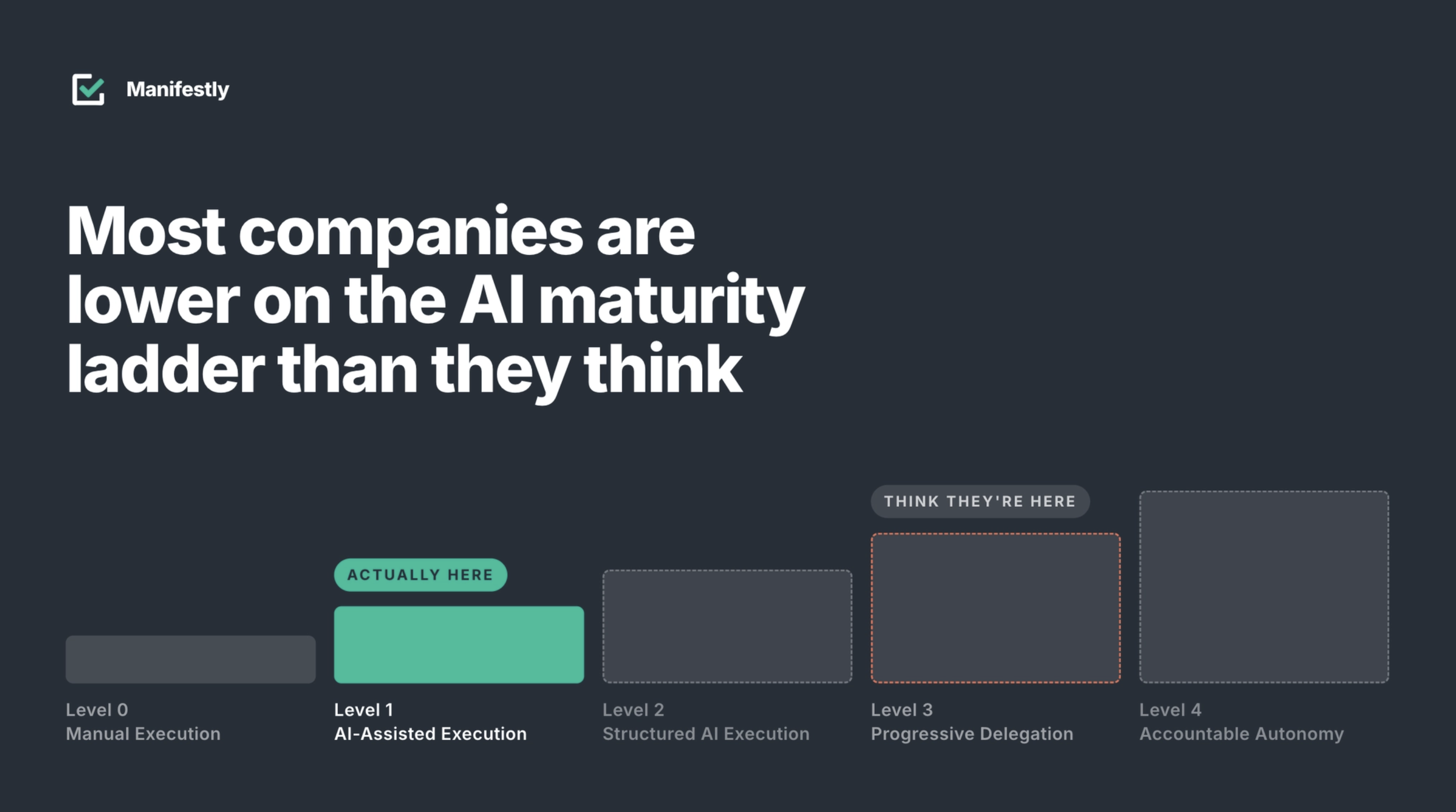
That is why most organizations are lower on the AI maturity ladder than their usage numbers suggest. Using AI is not the same as integrating AI into how work gets done.
Adoption measures activity. Maturity measures integration.
Most companies assess AI progress through visible signs of activity. They track how many employees have access, how often people use AI, how many tools have been purchased, how many pilots are underway, or how much time employees report saving.
These metrics are useful. They show whether adoption is spreading and whether employees are finding value in the technology.
They do not show whether the organization has changed how recurring work is owned, reviewed, advanced, or recorded.
AI adoption measures whether people are using the technology. AI maturity measures whether that technology has become part of a reliable operating process. A company can have widespread usage and still depend on the same informal handoffs, personal judgment, and manual follow-up it relied on before.
That is the measurement error behind much of today’s AI transformation gap.
Four false signals of AI maturity
Several signs commonly treated as proof of maturity are really signs of adoption. They matter, but they do not prove as much as companies often assume.
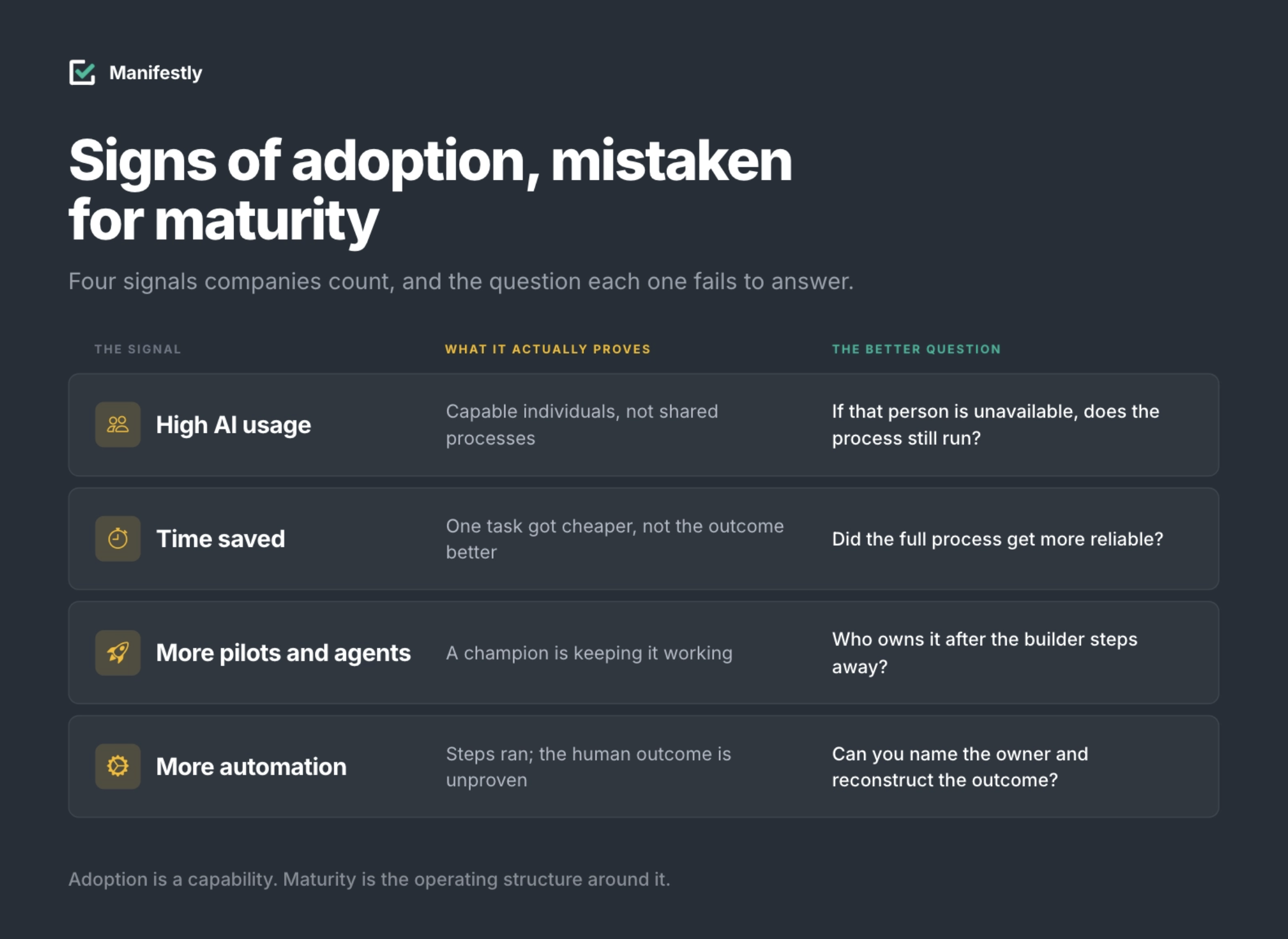
1. High AI usage
A large percentage of employees use AI every week. On the surface, that looks like maturity because the technology is visible across the organization.
But much of that usage may still consist of private interactions between individual employees and general-purpose AI tools. One person knows which context to provide, how to write the prompt, how to judge the result, where the output belongs, and what needs to happen next.
The company may have many capable AI users without having any shared AI-enabled processes.
The more useful question is:
If the person using the AI is unavailable, does the process still run reliably?
When the answer is no, the capability remains attached to the individual rather than the organization.
2. Time saved
AI can make individual tasks dramatically faster. A report that once took two hours may now take twenty minutes. A customer email can be drafted in seconds. A meeting summary appears immediately. An analysis that once required a specialist may be produced by a generalist with the right context and prompt.
Those gains are real. They still do not tell us whether the full process improved.
The email may be drafted faster while approval continues to stall. The analysis may appear instantly while nobody owns the follow-up. The meeting summary may save time while decisions remain scattered across tools and never make it into the operating record.
The better question is:
Did the full process become more reliable, or did one task become cheaper?
A mature AI-enabled process should improve the outcome, not only reduce the production time of one step.
3. More pilots and agents
An organization may have launched proofs of concept, internal assistants, or agentic workflows. That demonstrates technical ambition and can produce meaningful value.
But a successful pilot does not automatically become an enduring operating capability. Many pilots still depend on the person who built them, a technically sophisticated internal champion, undocumented context, informal monitoring, or manual recovery when something fails.
The system works because someone still knows how to keep it working.
The better question is:
Who owns the process after the builder or champion steps away?
When nobody else can operate, supervise, and improve the system, the organization may have deployed AI without fully integrating it.
4. More automation
AI systems can trigger actions, update records, move data, and complete technical steps automatically. Automation can reduce manual work and improve consistency, and it will be an essential part of many mature AI-enabled processes.
But a successful system action does not prove that a human-centered business outcome was reached.
A workflow may create every required record while an approval remains missing. An agent may complete several actions while an exception goes unresolved. A system may show that every technical step ran without proving that the customer, employee, or compliance outcome was actually completed.
The better question is:
Can the organization identify the accountable owner and reconstruct the full outcome?
Automation is a capability. Maturity depends on the operating structure around it.
The real test: where does the work live?
The clearest dividing line in AI maturity is not whether AI performs the task. It is where the work around that task lives.
At lower levels of maturity, the work lives with the individual. The employee holds the context, the prompt, the judgment, the working history, the informal handoffs, the next action, and the knowledge of whether the result is complete.
AI may help that employee substantially. It may make them faster, more capable, and able to handle a larger volume of work. But the process still depends on their personal operating method.
At higher levels of maturity, the work lives in the process. The process holds the trigger or cadence, shared context, named ownership, defined AI steps, human checkpoints, visible state, escalation rules, and the completion record.
The person no longer has to carry the entire operating system around the AI.
That is the real dividing line. The question is not simply whether AI performs the task. The question is whether the person or the process carries everything around it.
What AI maturity level are you really at?
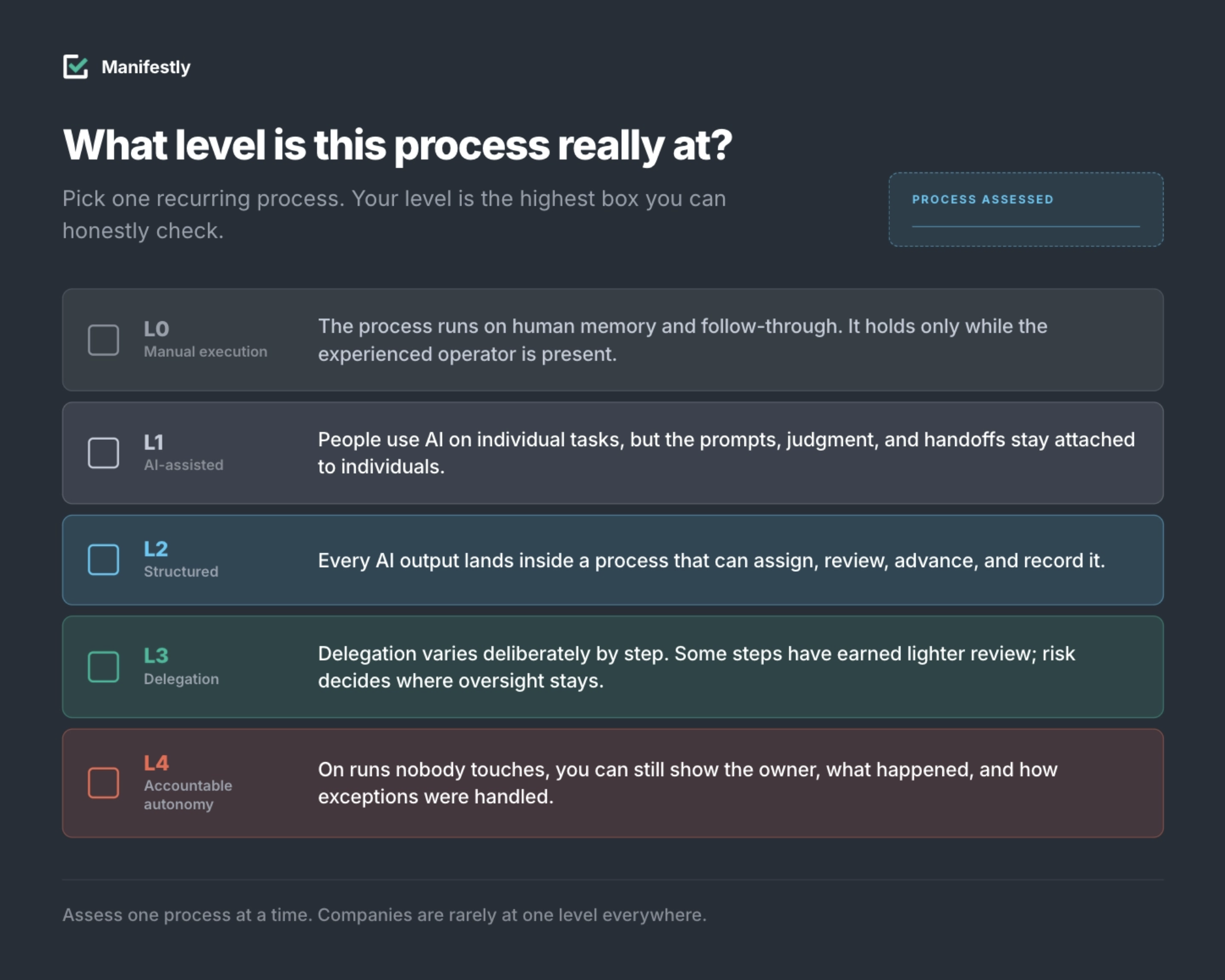
The AI maturity model for human-centered work has five levels. Each level describes a different relationship between the individual, the process, and the AI.
The model is best applied to a specific recurring process rather than to the company as a whole.
Level 0: Human Execution
At Level 0, people perform the work manually, and reliability depends on human memory, judgment, coordination, and follow-through.
The process may be documented, but people still have to remember when to begin, determine what happens next, chase inputs, manage handoffs, and confirm completion. AI is either absent or not meaningfully involved.
A Level 0 process can still work well when experienced people are present. The weakness appears when the process must scale, when several teams are involved, or when the experienced operator is unavailable.
Diagnostic question:
If the experienced operator leaves, can the process still run reliably?
When the answer is no, the process is likely at Level 0.
Level 1: AI-Assisted Execution
At Level 1, people use AI to complete individual tasks, but the surrounding process remains informal.
The employee still assembles the context, invokes the AI, evaluates the output, transfers it into another tool, coordinates the next handoff, updates the record, and notices when something has gone wrong.
AI improves the person’s productivity. It does not fundamentally change where the process lives.
This is where many organizations are today. Employees have incorporated AI into their personal working methods, but those methods are difficult to see, reproduce, govern, or transfer.
Diagnostic question:
Is AI usage a shared organizational capability, or a collection of private working methods?
When the prompts, context, judgment, and handoffs remain attached to individuals, the process is likely at Level 1.
Level 2: Structured AI Execution
At Level 2, AI performs defined work inside a recurring process with named ownership, deliberate review, visible state, and a durable record.
The AI output lands somewhere the process can own and advance. It does not remain inside a private chat or depend on someone remembering to copy it into the next system.
A Level 2 process defines what the AI is responsible for, what a human must review, who owns the outcome, where exceptions go, and what counts as complete. The process can continue even when the usual operator is absent because the operating structure is no longer held entirely in that person’s head.
Diagnostic question:
Does every AI output land inside a process that can assign, review, advance, and record it?
When the answer is yes, the process has likely crossed into Level 2.
Level 3: Progressive Delegation
At Level 3, different steps receive different levels of delegated authority based on evidence, risk, and clear exception signals.
Some AI outputs may still require human approval. Routine, low-risk steps may move forward automatically. Humans spend more of their attention on uncertainty, high-consequence decisions, unusual cases, and exceptions.
The important shift is that review is no longer treated as one universal requirement. The organization has learned enough from operating the process to decide where close oversight remains necessary and where the system has earned greater autonomy.
Diagnostic question:
Has any step earned lighter review, or is every AI output still handled the same way?
When delegation varies deliberately by step, the process may be at Level 3.
Level 4: Accountable Autonomy
At Level 4, suitable processes run autonomously by default, with people involved through defined exceptions and judgment gates.
Even when no person directly touches a particular run, a named owner remains accountable for the outcome. The organization can still reconstruct what happened, what the system decided, which rules were applied, and how exceptions were handled.
This is not autonomy without ownership. It is autonomy inside an accountable operating structure.
Diagnostic question:
On runs nobody touches, can the organization still show who owns the outcome, what happened, and how exceptions were handled?
When the answer is yes, the process may be operating at Level 4.
Why most companies are at Level 1
Level 1 is easy to mistake for maturity because its gains are highly visible.
Employees work faster, outputs look better, and usage can be measured. Teams share success stories and demos. Leaders see AI appearing throughout the organization.
None of that is imaginary. Level 1 can produce substantial value.
The limitation is that it improves the person without necessarily improving the process. The employee still assembles the context, knows what to ask, evaluates the result, moves the work forward, updates the shared systems, and notices when something has gone wrong.
AI helps that person carry more of the process. It does not make the process less dependent on them.
This is why Level 1 can produce genuine productivity gains while leaving the organization’s execution gap largely untouched. The work may happen faster, but it still begins, moves, and finishes through the same informal operating model.
The threshold that matters: Level 1 to Level 2
The largest jump on the maturity ladder is not from Level 3 to Level 4. It is from Level 1 to Level 2.
The later levels increase delegation. The Level 1-to-Level 2 transition changes where the operating structure lives.
At Level 1, AI is attached to the person. At Level 2, AI is attached to the process.
That transition introduces a named owner, a defined trigger or cadence, designated AI tasks, human review checkpoints, visible process state, exception and escalation paths, and a durable record of completion.
The model does not need to become more capable for this transition to happen. The process needs to become more explicit.
This is where AI adoption begins to become AI transformation. The organization stops asking only whether employees are using AI and begins redesigning recurring work around what humans and AI should each do.
AI maturity varies by process
A company rarely has one universal AI maturity level.
Different functions and workflows may sit at very different places on the ladder. A company might have Level 4 invoice classification, Level 3 employee onboarding, Level 2 compliance reviews, Level 1 customer-success planning, and Level 0 annual operational procedures.
That variation is normal and expected. Maturity depends on the process, its risks, its systems, the quality of its inputs, and the way AI has been integrated into the work.
This is why the most useful question is usually not:
How mature is our company’s AI use?
It is:
How mature is this specific recurring process?
That shift makes the model actionable. Instead of assigning the company one broad score, teams can evaluate individual processes, identify the structural gaps, and decide which workflows are worth moving upward.
Not every process needs to reach Level 4. Some should remain human-led because the stakes, ambiguity, or need for judgment are too high. The goal is not maximum autonomy everywhere. The goal is to choose the right operating model deliberately.
What to measure instead of adoption alone
Licenses, active users, prompts, pilot counts, and reported time savings are useful adoption metrics. They should not be mistaken for complete maturity metrics.
A stronger assessment asks whether AI-supported processes have become more reliable. That means measuring whether the work has clear ownership, whether outputs enter shared process state, whether consequential steps have defined review rules, whether exceptions reach a responsible person, and whether the organization can prove completion.
Useful indicators might include:
- the percentage of AI-supported processes with named owners
- the percentage of AI outputs that land in shared process state
- the percentage of consequential AI steps with defined review rules
- the percentage of exceptions routed to a clear owner
- exception resolution time
- end-to-end process completion reliability
- continuity when the usual operator is absent
- and the availability of a defensible completion record
These measures shift attention from activity to operating capability. They ask whether AI is changing what the organization can reliably accomplish, not merely what individual users can produce.
Mature AI adoption should become visible in the reliability of the process, not only in the activity of the user.
What companies measure versus what maturity requires
Many organizations are still measuring the left side of this comparison while expecting the outcomes on the right.
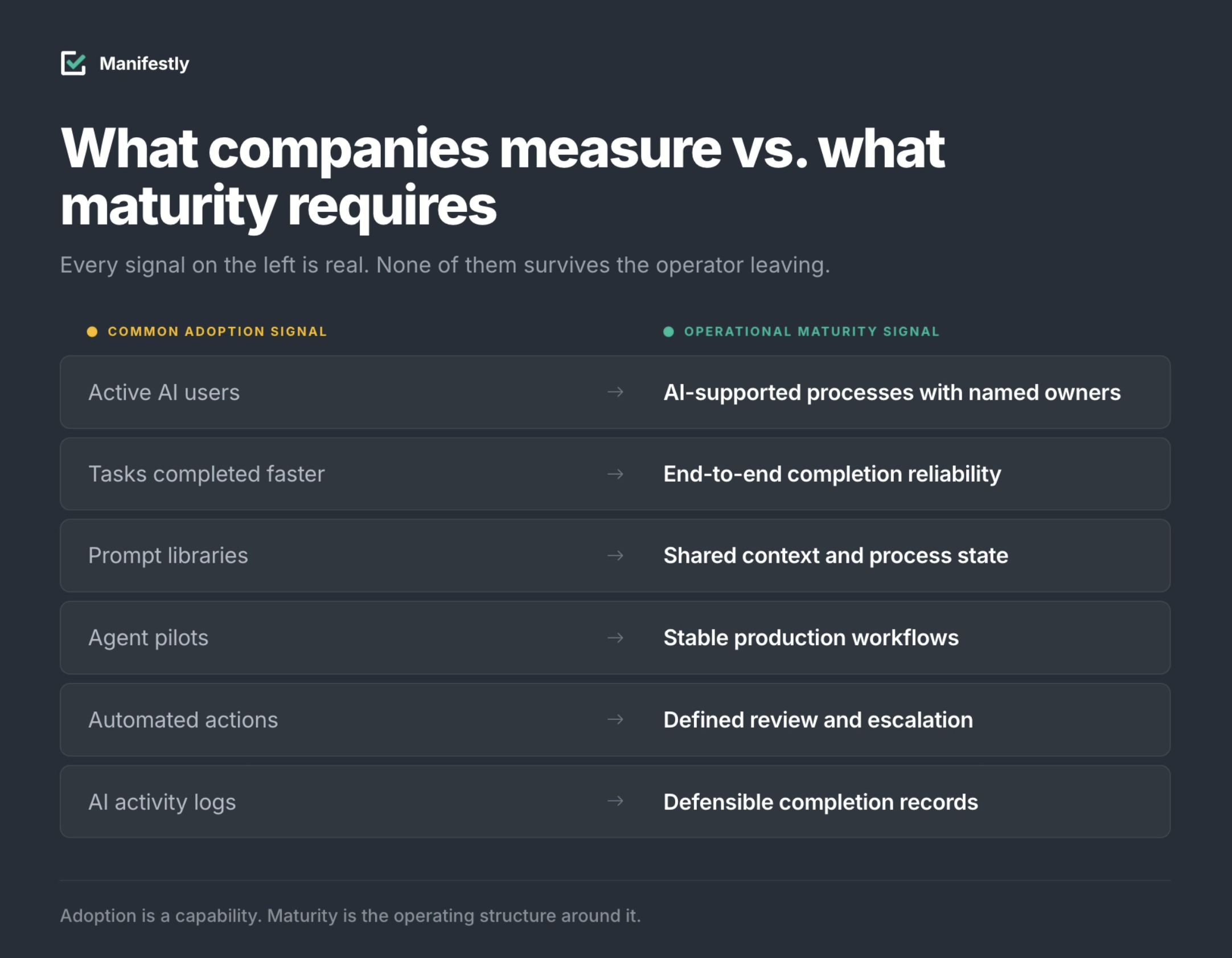
The left side shows that AI is present. The right side shows that AI has been integrated into how work gets done.
Both matter. Only one tells you whether the operating model has changed.
Measure what changed in the work
A company can have strong AI adoption and limited AI maturity.
It can buy the tools, train employees, launch pilots, and automate individual tasks while the underlying process remains informal. The technology changes, but recurring work still depends on memory, manual handoffs, and the people who know how everything fits together.
The proof of maturity is not that people can use AI. It is that recurring work now runs differently.
It depends less on individual memory. Ownership is clearer. Review is more deliberate. Current state is more visible. Exceptions follow a known path. Completion is recorded instead of assumed.
Using AI changes what a person can do.
AI maturity changes what the organization can reliably get done.
Frequently asked questions
What is an AI maturity level?
An AI maturity level describes how deeply AI has been integrated into an operating process, from fully human execution and individual AI assistance to structured execution, progressive delegation, and accountable autonomy.
How do you assess AI maturity?
Assess whether AI-supported work has named ownership, defined review, visible process state, escalation paths, and durable completion records. Do not rely only on usage, licenses, pilot counts, or time saved.
What is the difference between AI adoption and AI maturity?
AI adoption measures whether people use AI. AI maturity measures whether AI has changed how work is owned, coordinated, reviewed, advanced, and completed.
Why are most companies at Level 1?
Most companies are at Level 1 because employees use AI for individual tasks while the surrounding context, judgment, handoffs, and process state remain attached to those employees.
Can a company have more than one AI maturity level?
Yes. Different departments and recurring processes can operate at different maturity levels depending on how AI has been integrated into the work.