
Why AI Chat Does Not Scale
September 10, 2026
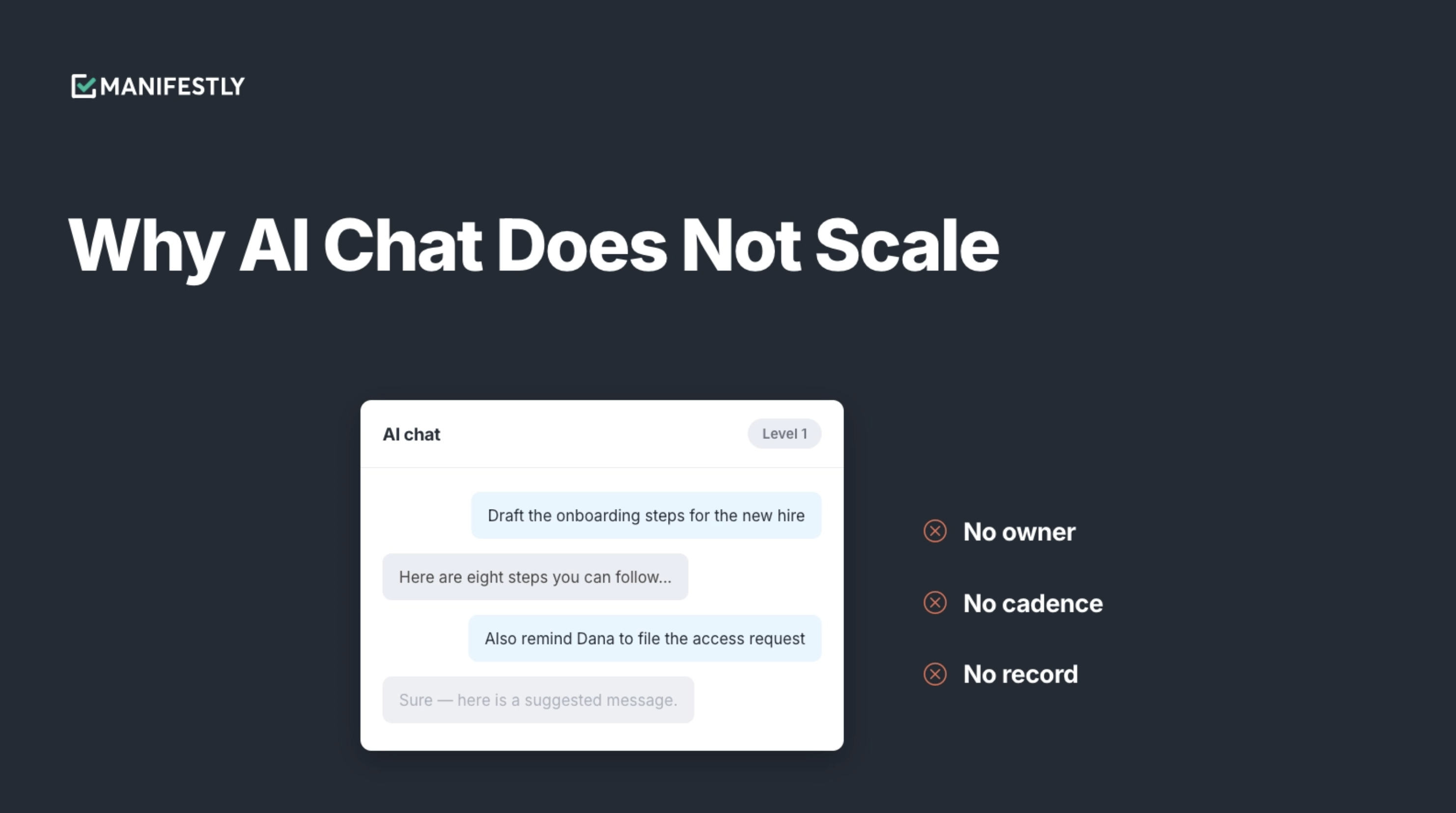
Your employees are using AI to improve their work.
But is the business becoming more capable, or are individual employees simply getting faster?
They use chat to prepare for customer calls, summarize meetings, analyze documents, draft follow-ups, troubleshoot problems, and plan what happens next. They move faster, handle more work, and produce better outputs than they could before.
The gains are real. But most of the capability still lives with them.
They know which context to provide, which prompts work, which outputs need correction, where the result belongs, and what the rest of the process requires. When the AI gets something wrong, they catch it. When a handoff stalls, they follow up. When someone asks where things stand, they reconstruct the answer from their chat history, notes, memory, and the tools around them.
The person looks capable. The process is still person-dependent.
This is the ad hoc AI chat trap: real personal productivity that looks like organizational progress. AI makes the employee faster, but it does not automatically make the work more reliable, repeatable, or visible to anyone else.
Why the trap is convincing
AI chat creates immediate value.
An employee can move from a blank page to a credible draft in minutes. They can make sense of an unfamiliar document, compare options, summarize a long conversation, or work through a problem without waiting for someone else to become available.
This expands what one person can do. It makes expertise more accessible, reduces repetitive effort, and helps work move when it might otherwise stall.
That value should not be dismissed, because the trap exists precisely because the gains are real.
If chat produced weak results, companies would stop using it. Instead, employees experience immediate improvements, leaders see adoption rising, and teams hear stories about work that now takes minutes instead of hours.
It is easy to look at those signals and conclude that the organization has developed a new capability. But personal productivity and organizational capability are not the same thing.
Personal productivity means one person can complete a task faster, better, or with less effort. A company gains a capability when other people can find the same context, produce a comparable result, review it correctly, and carry the work through to completion.
A simple question exposes the difference:
If the person leaves, does the capability remain?
If the answer is no, the company has not yet built a new way of working. It has made one employee more capable.
The person becomes the system around the chat
Ad hoc AI chat appears simple because the visible interaction is simple: the user asks a question, and the AI produces an answer.
But an answer is only one part of most business processes. Around that exchange, the user performs several hidden roles that keep the work moving.
Consider a customer onboarding manager using AI to prepare a new account plan. The AI may produce the draft, but the manager still has to assemble the customer history, identify contractual commitments, catch mistakes, create assignments, coordinate handoffs, remember approved exceptions, and follow up when something runs late.
The AI helps with the task. The person carries the process around it.
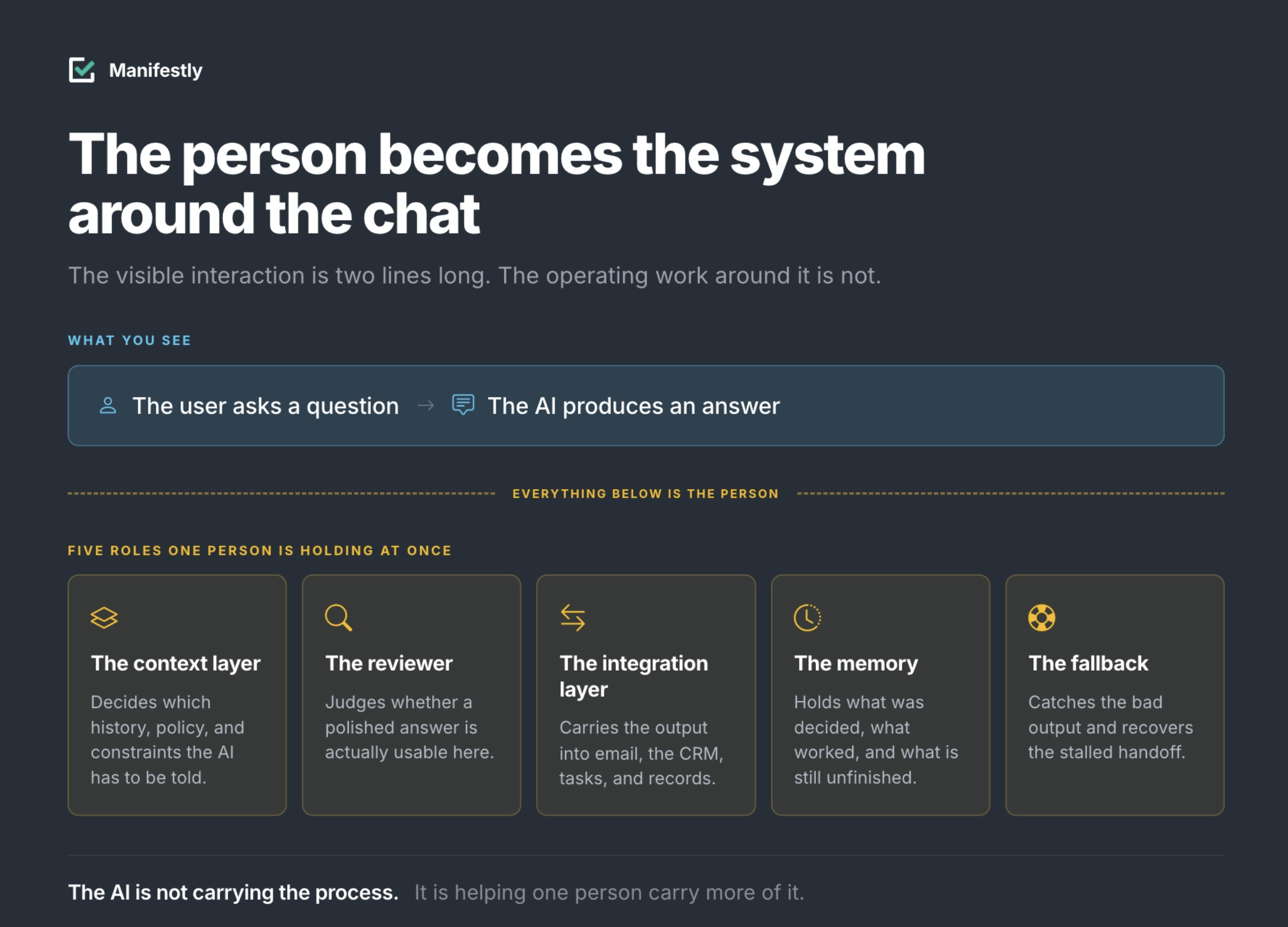
The person supplies the context
The AI does not automatically know the full customer history, the internal policy, the exception approved during the sales process, or the current state of the account.
The manager assembles that context. They decide which documents matter, what background to include, what can be omitted, and which constraints the AI must understand.
The prompt is only the visible part of the work. The deeper capability is knowing what the prompt needs.
Another employee may use the same model and receive a much weaker result because they do not know which details matter. The organization therefore remains dependent on the original user’s accumulated knowledge, even when AI performs much of the visible production.
The person reviews the result
AI can produce a polished answer that is incomplete, inappropriate, or based on the wrong assumption.
The manager decides whether the onboarding plan can be trusted. They notice the missing commitment, recognize when a recommendation conflicts with policy, and know when a confident answer does not fit the customer in front of them.
AI may generate the draft. The person supplies the judgment that makes it usable.
The person connects the work
The answer appears in chat. The onboarding process lives somewhere else.
The manager creates tasks, updates the CRM, sends the plan to the implementation team, assigns the next step, and records the decisions where other people can find them.
AI handles one part of the task. The person makes sure the work continues.
Without that connection, the output remains useful information inside a private conversation rather than a step in a shared process.
The person remembers what matters
The manager remembers which prompt worked, what the customer said, why an exception was approved, which version of the plan was accepted, and what remains unfinished.
Some of that information may exist in the chat history. Much of its meaning still depends on the person who created it. They know which conversation matters, what was decided elsewhere, and what needs to happen next.
The information may be stored. The process still depends on someone knowing how to interpret it.
The person recovers the process
When something goes wrong, the manager steps in.
They repair missing context, correct the bad output, follow up on the stalled handoff, answer the status question, and keep the customer from feeling the internal confusion.
The system appears functional because a capable person continuously compensates for what is missing.
The AI is not carrying the process. It is helping one person carry more of it.
Why AI-assisted work looks more impactful than it is
Ad hoc AI use creates several signals that can make an organization look like it has mature AI systems.
The company produces more. Employees save time. AI appears throughout the workday. A few power users build impressive personal methods and become examples for the rest of the organization. Chat histories preserve more information than an unsaved conversation would.
All of this is valuable. But each signal can be misread.
More output may mean employees are producing faster, not that the work is more reliable. Time saved may reflect a cheaper task, not a process the company can repeat. Frequent use may show that AI is present in the work, not that everyone can see its current state. A sophisticated power user may demonstrate what one person can do, not what the company can reproduce.
Even a saved chat history is not automatically institutional memory. Institutional memory exists when the relevant context, decisions, exceptions, and review rules are organized and available when the process needs them. A private conversation may contain the information without making it usable to the next person.
AI chat optimizes the moment of production. A business process has to carry the work beyond that moment.
A draft still needs to be reviewed and sent. A recommendation needs to enter a decision process. An anomaly needs an owner and a resolution. An onboarding plan needs assignments, due dates, handoffs, and follow-through.
The chat ends when the answer appears. The business process is often just beginning.
The absence test
The clearest way to assess an AI-assisted process is to remove the power user from the picture.
Imagine they are unavailable for two weeks.
Can someone else see what work is active? Can they find the context the AI needs, understand what has already been decided, and know what requires review? Can they tell which output was accepted, what happened next, and whether the required outcome was completed?
Or do they have to reconstruct the process from chat histories, documents, messages, and someone else’s memory?
If the work stops or becomes difficult to recover, AI has increased personal leverage without making the process more resilient.
The true measure of maturity is not what the power user can do. It is what the process can still do without them.
From Level 1 to Level 2
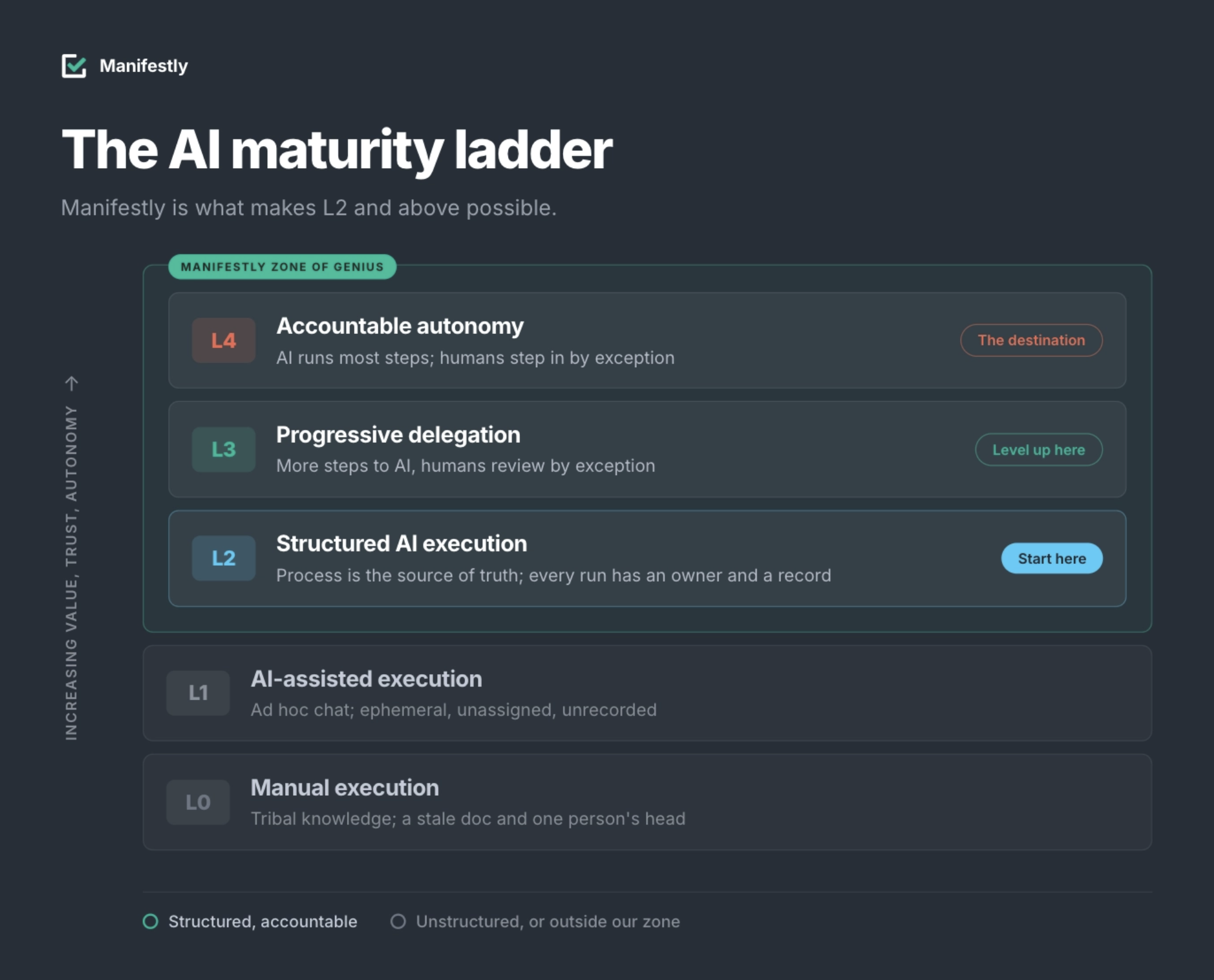
On the AI maturity ladder for human-centric work, ad hoc chat is Level 1: AI-Assisted Execution.
At Level 1, AI supports the individual while the process around them remains informal and person-dependent. The user supplies the context, judgment, routing, memory, and recovery that make the output useful.
At Level 2: Structured AI Execution, those responsibilities begin moving into the process itself.
The context travels with the work. AI tasks are defined. Human review happens at deliberate checkpoints. Ownership and due dates are clear. Current status is visible. Exceptions follow a known path. Completion leaves a record.
Consider the onboarding plan again. Instead of relying on one manager to assemble everything from memory, the process brings together the approved customer information, assigns the plan to an owner, defines where AI can assist, routes the result for review, creates the required handoffs, and records what was completed.
The transition is not from bad chat to better chat. It is from person-held capability to a process other people can run.
The right role for AI chat
AI chat remains an excellent tool for exploration, one-off analysis, drafting, brainstorming, preparation, and personal assistance. Many tasks do not need more structure than that.
The problem begins when chat becomes the hidden operating system for recurring work that crosses roles, carries meaningful consequences, or needs a reliable record.
When the work repeats, the organization needs to know more than whether AI produced a useful answer. It needs to know who owns what happens next, what requires review, how exceptions are handled, and whether the work was completed.
AI chat can make someone dramatically more effective. But when the surrounding process still depends on that person to supply the context, judge the result, manage the handoffs, and remember what happens next, the company has amplified an individual without strengthening the process.
At Level 1, the person gets stronger. AI begins to scale when the process gets stronger too.