
The AI Adoption Gap Is Really an Execution Gap
August 27, 2026
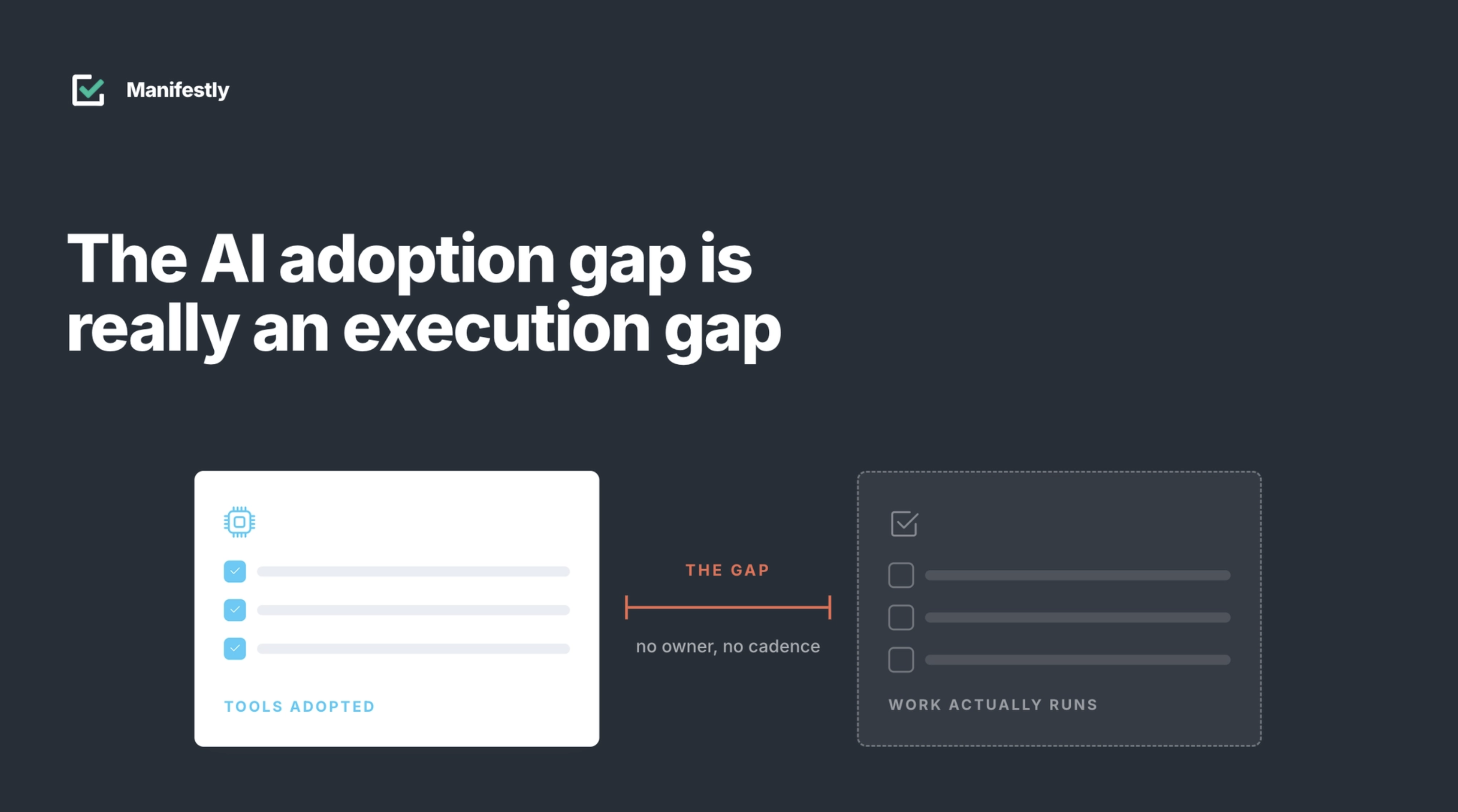
The team asks AI to analyze a large set of customer feedback. Within minutes, it identifies recurring complaints, groups them by theme, and recommends several changes. The analysis is clear, the findings are useful, and the recommendations make sense.
Then nothing happens.
No one owns the next step. No decision meeting is scheduled. No action is assigned. Three weeks later, the analysis is buried in a shared folder or an old chat thread.
The AI succeeded. The work failed.
When AI produces a useful output and the business outcome never follows, the problem is often not the model. It is the execution system around the output. Companies are adding AI to processes that already lack clear ownership, deadlines, review, visibility, and reliable follow-through. AI makes individual tasks faster, but it does not automatically repair the structure required to carry the work to completion.
The AI adoption gap is often an execution gap.
What is the AI adoption gap?
The AI adoption gap is the distance between widespread AI use and the limited operational or financial impact many organizations receive from it.
Employees are using AI. Teams are launching pilots. Leaders can point to faster drafts, instant summaries, automated analysis, and new internal agents. Yet the expected transformation often fails to appear. Recurring work still slips, decisions still stall, and useful outputs still fail to become completed outcomes.
When that happens, companies tend to look first at the capability layer. Perhaps the model is not advanced enough. Perhaps employees need more training, the prompts are weak, or the AI needs access to more data and systems.
Any of those may be true. Model capability, input quality, employee skill, and system integration all affect performance. But when the AI output is already useful and the organization still fails to act on it, the deeper problem is usually execution.
The organization knows more. It still cannot reliably turn what it knows into completed work.
The execution gap existed before AI
Most companies did not begin adopting AI with perfectly designed operating processes. The gaps were already there.
The standard operating procedure existed, but no one ran it consistently. The checklist documented the steps, but no one clearly owned the full outcome. Meetings produced decisions that never became assignments with deadlines. Dashboards revealed problems without creating an escalation path. Managers still had to chase status because the process itself could not show what was late or incomplete.
A documented process and a running process are not the same thing.
The execution gap is the distance between knowing what should happen and having a system that reliably carries the work to completion under clear ownership.
That gap predates generative AI. Businesses have spent years documenting processes, installing project tools, building dashboards, and holding status meetings without fully resolving it. Work still depends on someone remembering to start it, noticing what is late, coordinating the handoffs, and confirming that everything finished.
AI entered that same operating environment. It brought more capability into the process, but it did not automatically change how the process ran.
AI shortened the task. It did not close the process.
Before AI, a person prepared the report, summarized the customer interviews, or drafted the communication. After AI, the report appears in minutes, the themes are extracted automatically, and the draft is ready almost instantly.
The task changed. The surrounding questions did not.
Who owns what happens next? Who reviews the result? What deadline applies? Where is the decision recorded? What happens when the output is incomplete or uncertain? How does anyone know the full process finished?
In many cases, the AI output lands directly inside the weakest part of the company’s operating model: the informal handoff. The analysis sits in a chat. The draft is copied into a document. The recommendation is sent in a message. Then one person has to decide who needs to see it, whether it is ready, what should happen next, and how to record the result.
The capability changed. The failure mode did not.
This is why AI can produce impressive local gains without changing the reliability of the business as a whole. The organization improved a step. It did not improve the system that turns steps into outcomes.
The same failure pattern, now with AI
The old execution problem does not disappear when AI enters the process. It reappears around a faster task.
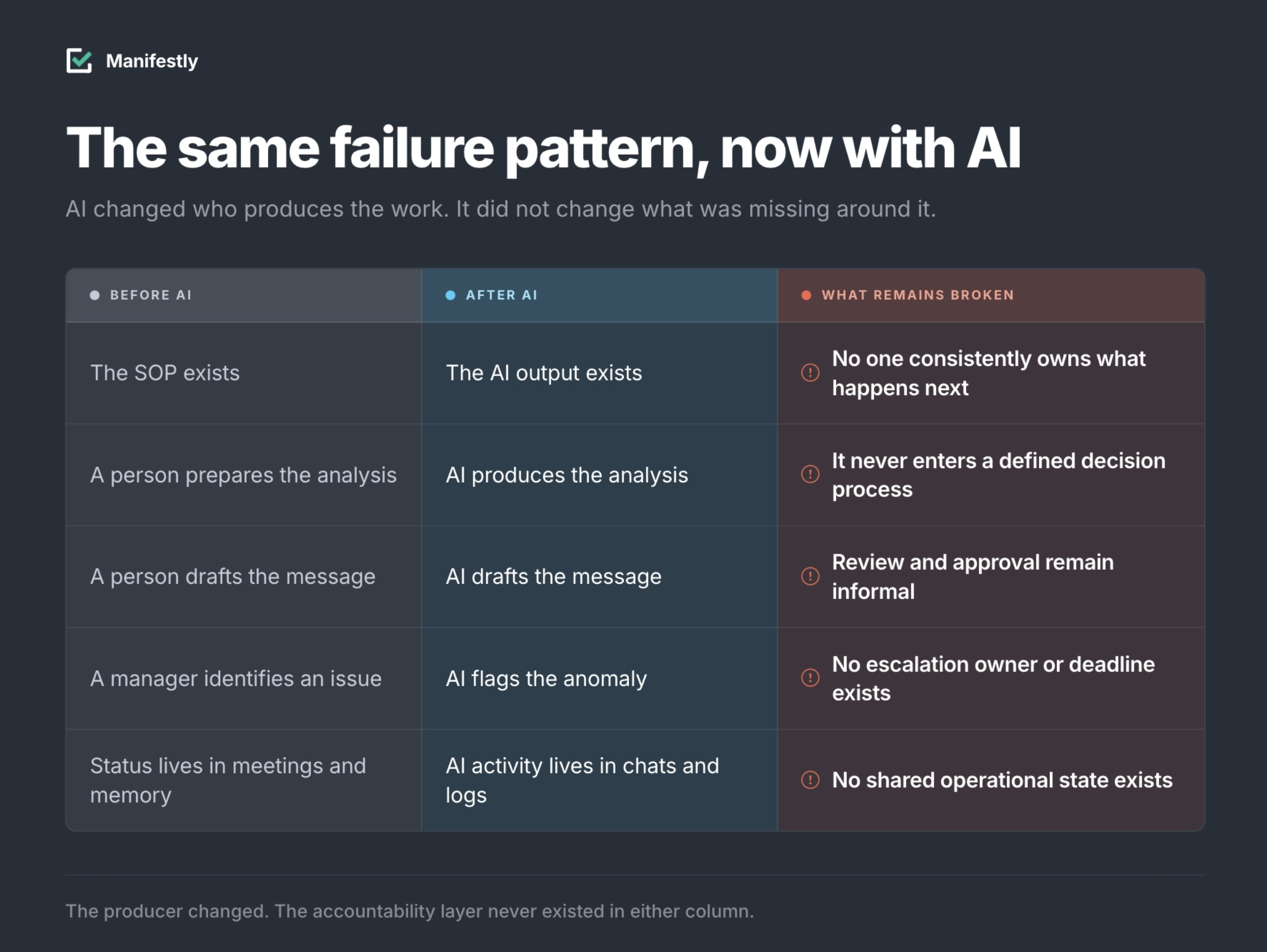
The new system may save meaningful time. It may improve quality and allow a smaller team to produce more. But the same structural weaknesses remain around it: informal ownership, invisible handoffs, missing deadlines, inconsistent review, and completion that is assumed rather than verified.
AI did not create these weaknesses. It made them easier to see.
Why companies diagnose the wrong problem
The capability layer is visible. The execution layer often is not.
A weak output is easy to notice. A missing operating structure is harder to see because capable employees compensate for it every day. They remember what happens next, know who needs to be involved, follow up when the deadline passes, transfer outputs between tools, and notice when a handoff has failed.
Because the work eventually moves, the surrounding process appears more reliable than it really is.
When AI impact disappoints, organizations naturally optimize the visible layer. They upgrade the model, improve the prompts, train employees, and connect more tools. Those investments can help, but they do not solve the same problem.
A better model may improve the recommendation, but the recommendation still does not assign itself. Better prompts can produce clearer outputs, but they do not create a deadline or appoint a reviewer. Training can make employees more effective, but it may also make the process more dependent on the few people who know how to use AI well. Integrations can move data automatically without establishing who owns the outcome or what should happen when the normal path fails.
Capability, training, prompts, and integrations all matter. The mistake is treating them as substitutes for execution structure.
Better inputs improve the answer. They do not determine what the organization does with it.
Output is not impact
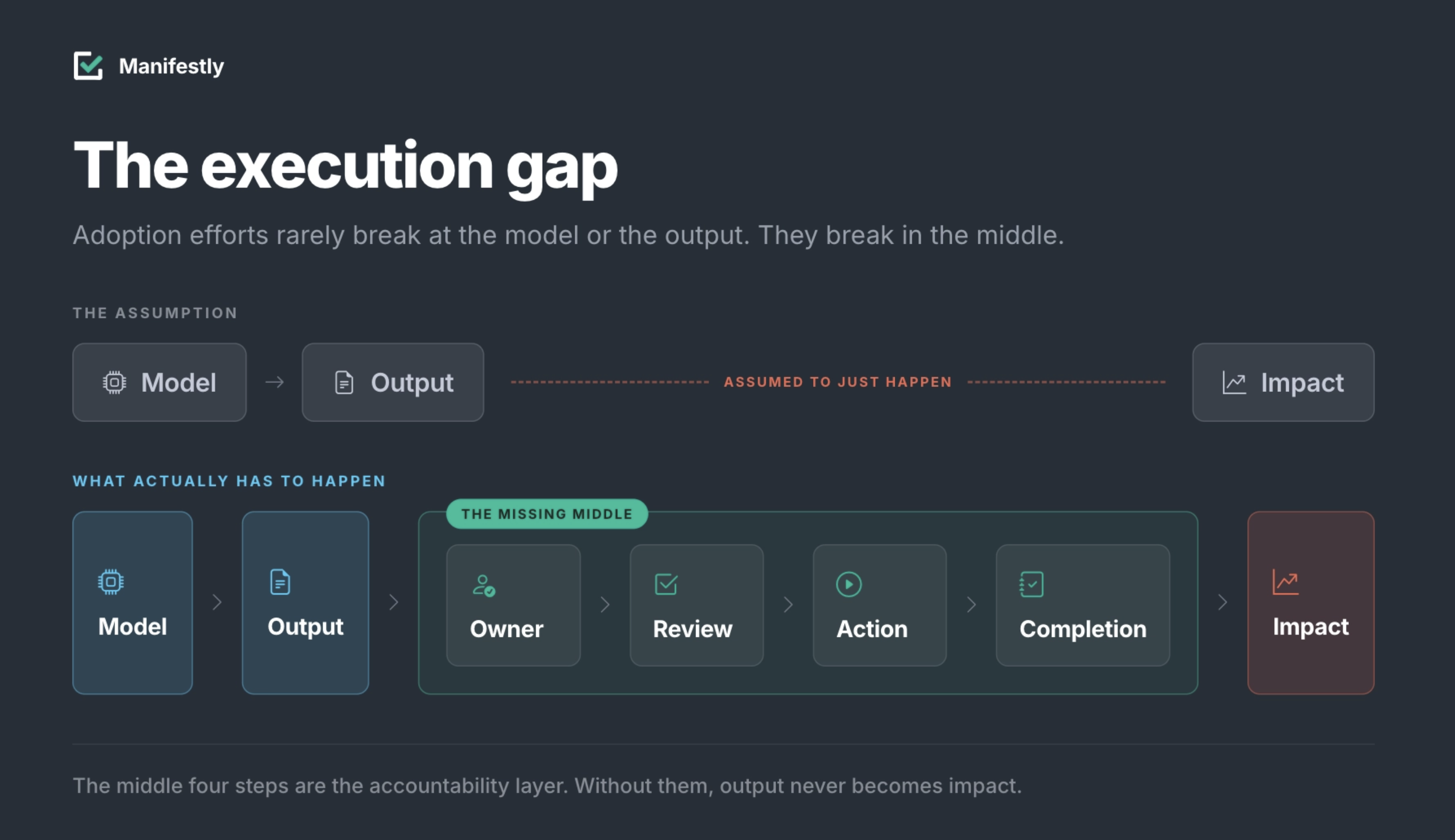
AI adoption efforts often measure what the system produces. Business value appears several steps later.
An AI output may be a draft, summary, recommendation, classification, anomaly flag, or completed technical action. An operational outcome requires that output to be reviewed, accepted or corrected, assigned, acted upon, escalated when necessary, and recorded as complete.
The customer does not need a draft. The customer needs an accurate response.
The finance team does not need an anomaly flag. It needs the discrepancy resolved.
The executive team does not need another analysis. It needs a decision and the work that follows from it.
Only when those outcomes happen consistently does the organization see impact: faster onboarding, fewer missed controls, shorter close cycles, lower error rates, improved retention, or more reliable service delivery.
Most failed adoption efforts do not break at the model or the output. They break in the middle.
That missing middle is the execution gap.
The structure AI output needs
An AI output needs somewhere operational to go. Five elements turn capability into accountable execution:
- Ownership: A named person or role is answerable for the outcome.
- Timing: The work has a trigger, deadline, cadence, or service level.
- Review: The process defines what requires judgment and who provides it.
- Visibility: The team can see whether the work is waiting, blocked, late, resolved, or complete.
- Record: The organization can show what happened and whether the required outcome was reached.
These elements are not AI capabilities. They are operating structures.
AI may support them. It may trigger the work, route an output to a reviewer, update the current state, or create part of the record. But producing an output does not establish ownership, timing, review, visibility, or completion by itself.
Without that structure, useful AI work remains information waiting for someone to turn it into an obligation.
The adoption-to-impact gap is the old execution gap
The execution gap appears whenever an organization knows what should happen but lacks a reliable system for making it happen.
Strategy fails to become action. A decision fails to become an assignment. An SOP fails to become consistent performance. Documentation fails to become accountability.
The AI adoption gap follows the same pattern. Capability fails to become integrated execution. Output fails to become an owned action. Actions fail to become completed outcomes, and those outcomes never accumulate into measurable impact.
AI did not introduce a new class of operational failure. It inserted a new capability layer into an unfinished operating model.
Companies are trying to solve an operating-model problem with a capability upgrade.
Where this sits on the AI maturity ladder
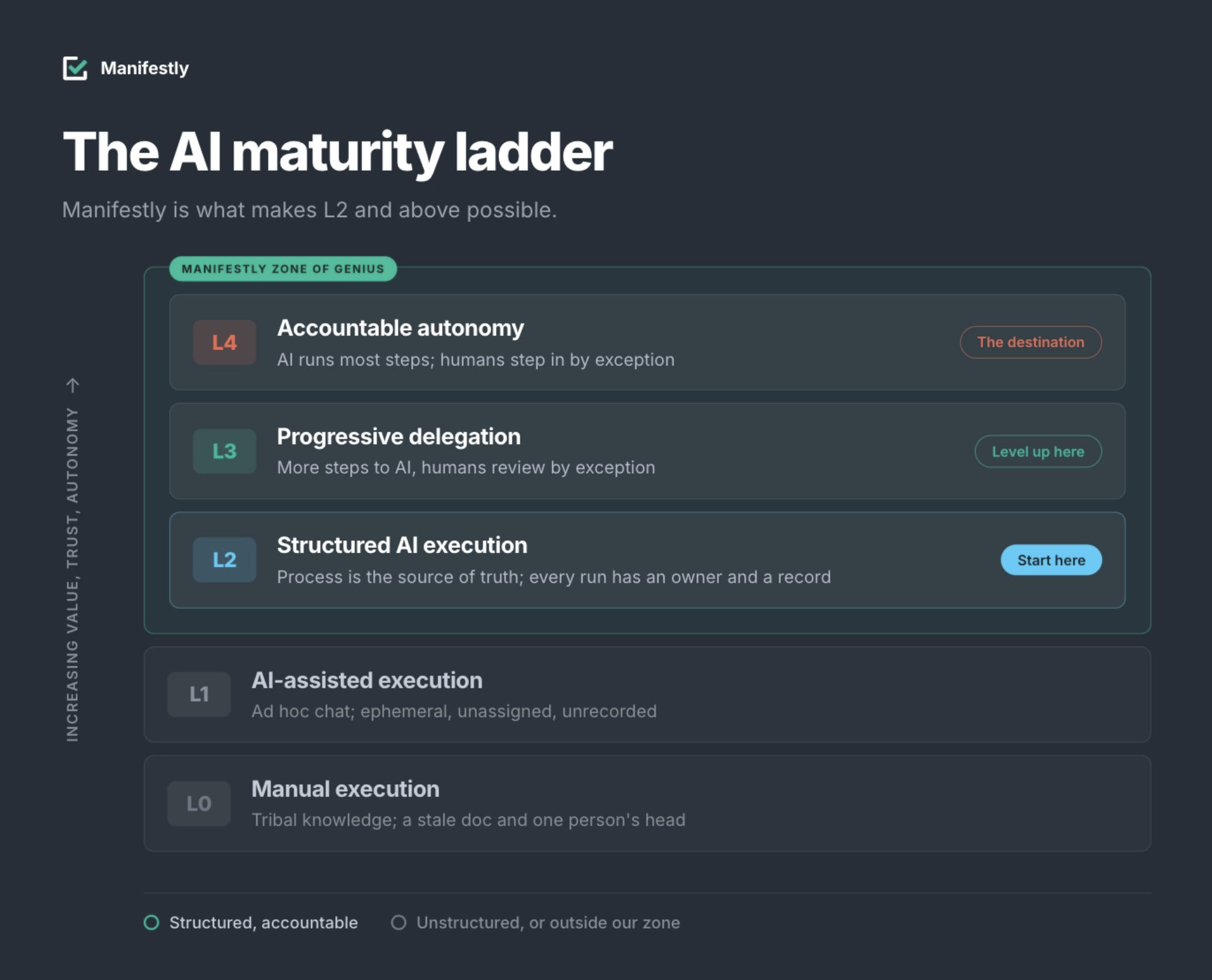
The distinction becomes clear on the AI maturity ladder for human-centric work.
At Level 1: AI-Assisted Execution, AI produces useful work, but the person still carries the context, review, handoffs, and follow-through. The output may be excellent, yet the surrounding execution remains informal and person-dependent.
At Level 2: Structured AI Execution, AI performs defined work inside a recurring process with an owner, timing, review checkpoints, visible state, escalation, and a durable record. The output finally has somewhere operational to go.
Level 2 does not begin when the model improves. It begins when the process can reliably absorb what the model produces.
That is the structural transition from AI adoption to AI transformation.
Is this an AI problem or an execution problem?
Not every weak AI result is caused by poor execution. Sometimes the model is not capable enough. Sometimes the inputs are incomplete, the data is unreliable, or the integration genuinely does not work.
The important thing is to diagnose the layers separately.
Ask whether the AI output is materially useful. Then ask whether someone owns what happens next, whether review and timing are defined, whether the current state is visible, whether exceptions reach someone with authority, and whether completion is recorded.
If the output is poor, the organization may have a capability, data, or prompt problem.
If the output is useful but stalls afterward, the primary problem is execution.
If both are weak, improve the capability and the process separately. Do not expect a better model to repair missing ownership, and do not expect a better workflow to turn an unusable output into a good one.
Each layer needs its own solution.
What to fix before buying a better model
Before upgrading the technology, define how the work should run.
What recurring outcome is the AI supporting? Who owns that outcome? Where does AI enter the process? What review is required? What advances the work after the output appears? What should trigger an exception, and who resolves it? What proves that the process reached completion?
Once those questions are answered, the organization can evaluate whether the model is truly the limiting factor.
It may discover that the current model is already capable enough. The missing investment was not another capability upgrade. It was the structure required to convert capability into execution.
Do not upgrade the model until you know the model is the reason the process fails.
AI exposed what the process was already missing
The analysis was useful. The draft was ready. The anomaly was correctly flagged. The classification was accurate.
The failure happened after the output appeared.
The organization had no reliable way to convert that capability into accountable completion. The missing owner, informal approval, invisible handoff, and deadline held in someone’s head were already part of the process.
AI did not create the execution gap. It exposed it.