
The Structural Leap from AI Assistance to Accountable Work
September 03, 2026
The AI has finished its task.
It summarized the customer history, drafted the implementation plan, classified the documents, or identified the issue that needs attention. The output is useful. It may be good enough to save someone hours of work.
But the business process is not finished.
Someone still has to decide what happens next. Someone has to review the result, move it into the right place, handle anything unusual, and make sure the required outcome is actually reached.
We tend to treat these two things as the same. They are not.
AI completing a task is not the same as the organization completing the work.
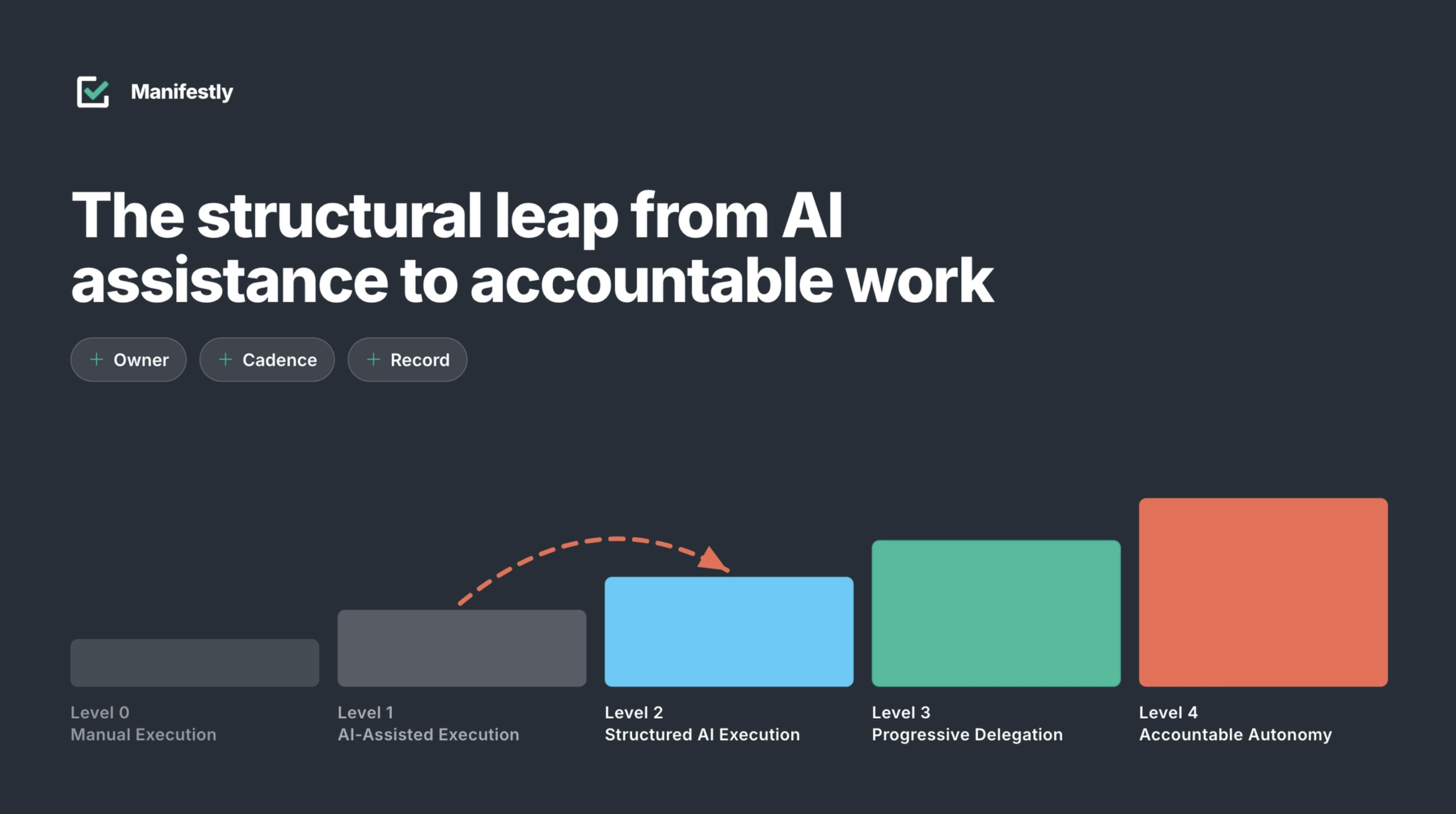
That is the dividing line between AI assistance and accountable execution.
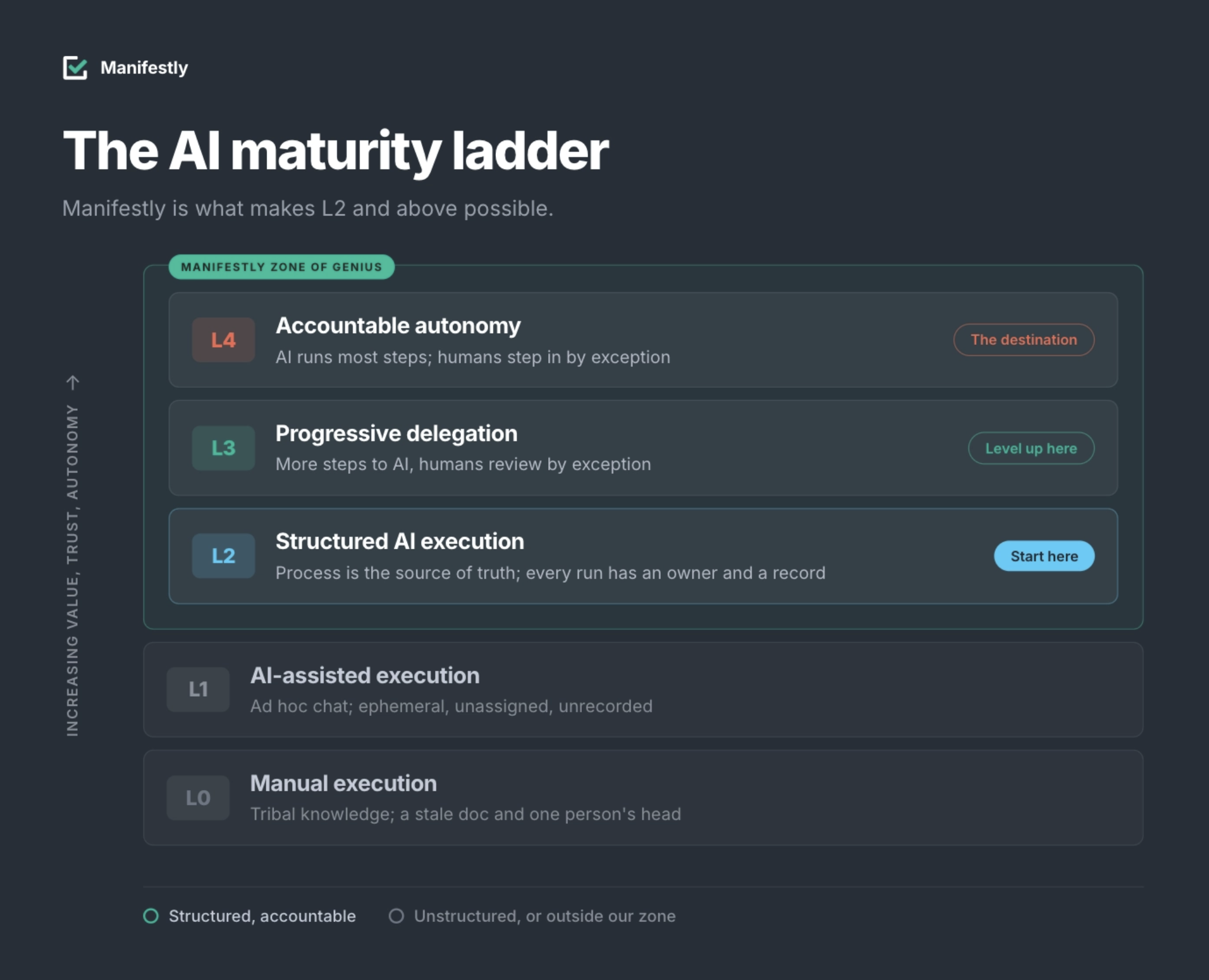
At Level 1 on the AI adoption maturity ladder, AI helps a person perform part of the work. The person still supplies the context, judges the output, moves it into the next system, remembers what remains unfinished, coordinates the handoffs, and catches anything that goes wrong.
At Level 2, those responsibilities begin moving into the process itself.
The work starts from a defined trigger. Someone owns the outcome. The AI receives the context attached to the active process. Its output lands where the next person can use it. Review happens at deliberate checkpoints. Exceptions become visible, and completion leaves a record.
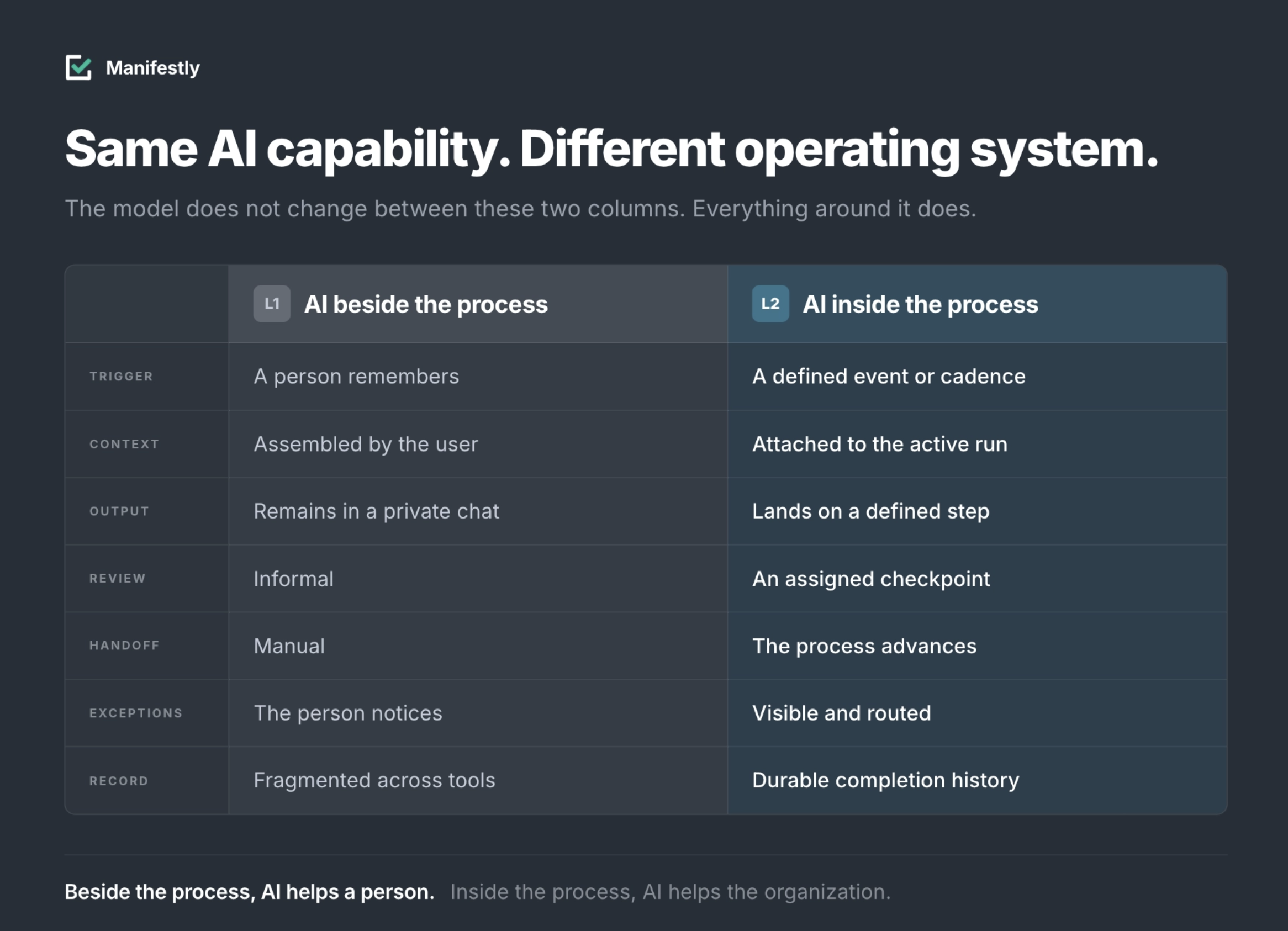
The AI may be exactly the same. What changes is the process around it.
What changes between Level 1 and Level 2?
At Level 1, the person coordinates the AI.
They decide when to use it, assemble the background information, evaluate the response, and move the output into the rest of the business. The process works because the person supplies everything the chat does not know.
This can create meaningful productivity gains. But the work remains dependent on the individual’s memory, judgment, and follow-through.
At Level 2, the process coordinates the work of both humans and AI.
The trigger, context, ownership, review rules, current state, and completion requirements no longer have to be recreated each time. They are built into a recurring structure that can guide every run of the work.
This is more than a small improvement in organization. It changes where the operational capability lives.
At Level 1, the capability is attached to the person.
At Level 2, it is attached to the process.
Level 2 begins when AI stops producing isolated outputs and starts participating in an owned process.
From an AI output to an active process
Consider a customer onboarding process.
At Level 1, a customer success manager may use AI to summarize the signed contract, draft an onboarding plan, prepare the kickoff agenda, and identify potential implementation risks.
The AI is genuinely helpful. The manager can move faster and handle more accounts.
But the manager still has to remember when to begin, find the relevant documents, copy the outputs into other tools, assign work to finance or legal, follow up on missing information, update the project record, and answer questions about the current status.
The AI performs several valuable tasks. The manager remains the operating system around them.
At Level 2, the signed contract starts a recurring onboarding workflow. The workflow has a named owner, holds the relevant customer information, defines where AI contributes, assigns human review, tracks exceptions, and records completion.
The work no longer exists as a series of useful outputs that one person must manually assemble into a process. It exists as a process in which AI and people each perform defined roles.
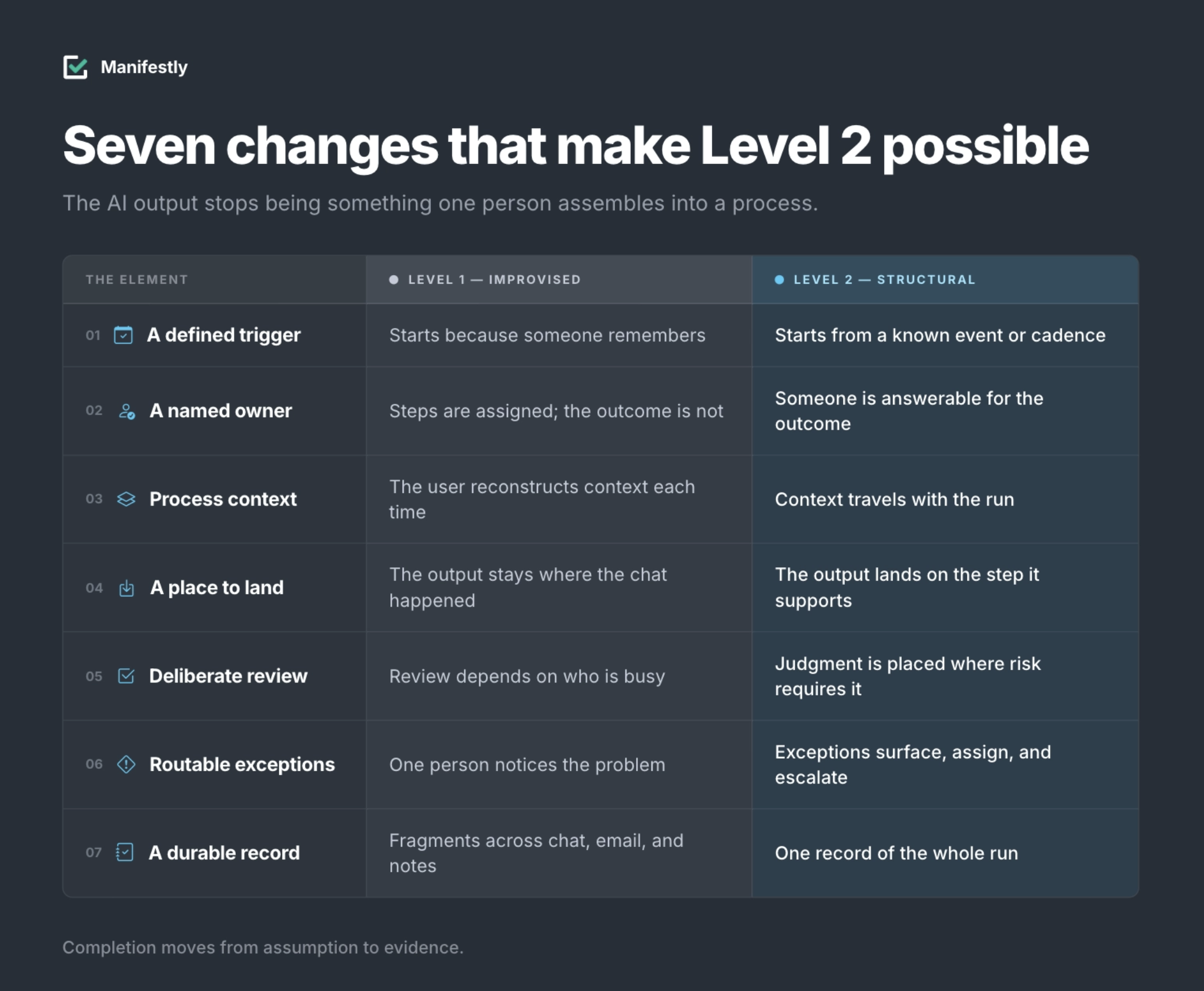
Seven structural changes make that possible.
1. The work begins from a defined trigger
Informal AI-assisted work often starts because someone remembers.
The customer success manager notices that a contract was signed, opens the relevant documents, starts a chat, and begins assembling the onboarding plan. If they are busy, absent, or unaware that the deal closed, the process may begin late.
A structured workflow starts from a known event or cadence. A signed contract, a new employee record, the end of the month, or an upcoming review date initiates the work.
The trigger does not need to be technically complex. Its importance is structural: it establishes when the process is supposed to begin.
Reliable work starts because the process says it is time, not because someone happens to remember.
2. Every run has a named owner
A process can involve several employees, automated actions, and AI-generated outputs without anyone clearly owning the final result.
Tasks may be assigned, but task assignment is not the same as outcome ownership.
At Level 2 with structured AI execution, every active run has a named owner. That person or role is answerable for making sure the process reaches the required outcome, even when other people or systems perform most of the individual steps.
In customer onboarding, finance may verify billing details, legal may review an unusual contract term, and AI may generate the initial implementation plan. The onboarding owner does not personally perform all that work. They remain responsible for ensuring the customer reaches a successful handoff into delivery.
Assignees complete steps. The owner makes sure the outcome is reached.
This accountability remains intact even as more execution is delegated to AI.
3. AI receives process context, not improvised context
Ad hoc AI chat depends on the user knowing what to provide.
They locate the contract, recall the customer’s goals, paste in notes from the sales process, explain the company’s onboarding standards, and tell the AI which exceptions matter. The quality of the result depends heavily on what that person remembers to include.
At Level 2, relevant context travels with the active workflow.
Customer details, contract terms, prior decisions, required documents, process instructions, and the current state of the work can be attached to the run or made available at the step where AI needs them.
This does not mean the AI magically knows everything. It means the process defines which context belongs with the work instead of relying entirely on one user to reconstruct it.
The workflow becomes a shared context layer.
That makes AI performance more consistent and reduces the gap between what an experienced power user can produce and what the organization can reproduce.
4. The output lands on a defined step
In ad hoc chat, the output appears where the conversation happened.
The user then has to decide what to do with it. They may copy the summary into a document, paste the plan into a project tool, send the recommendation to a manager, or leave it in the chat until someone asks for it.
At Level 2, the AI output lands inside the active process and is attached to the step it supports.
The onboarding summary appears in the onboarding run. The implementation plan is available to the person assigned to review it. The risk assessment remains connected to the customer, the decision, and the actions that follow.
The output stops being a private answer and becomes shared process state.
This is a subtle but important transition. Once the output belongs to the process, it can be reviewed, advanced, revised, referenced, and included in the completion record without depending on the original user to move it manually.
5. Human review happens at deliberate checkpoints
Human review at Level 1 is often informal.
The person using the AI decides whether the result looks right. They may ask a colleague for an opinion, send it to a manager, or act on it directly. The review standard changes depending on who created the output, how busy the team is, and how consequential the work appears in the moment.
At Level 2, review is designed into the process.
The workflow defines which outputs require human judgment, who provides it, and what happens after the reviewer accepts, rejects, or revises the work.
For example, AI might draft a standard onboarding plan that the customer success manager can approve. An unusual data-security requirement might route the plan to a security specialist. A low-risk communication might move forward without an additional checkpoint.
The purpose of the checkpoint is not to add a human to every step.
It is to preserve judgment deliberately where the work requires it.
When review is part of the process, the organization can adjust it over time. Reliable steps may earn lighter review. Higher-risk decisions can retain stronger controls. The process becomes capable of progressive delegation because review is explicit rather than accidental.
6. Exceptions become visible and routable
The happy path is rarely the real test of an operational process.
The test comes when information is missing, an output is rejected, a deadline passes, a policy conflict appears, or the normal sequence no longer applies.
At Level 1, the person carrying the process usually notices the exception. They remember that the customer never submitted a required document, recognize that the AI misunderstood a contract clause, or see that another department has not completed its part.
They then decide whom to contact and how urgently to follow up.
At Level 2, the exception becomes visible in the process. It can be assigned, escalated, and tracked until it is resolved.
The process does not need to predict every possible problem. It needs a reliable way to surface departures from the expected path and place them in front of someone with the authority to act.
This is one of the clearest differences between a useful AI task and an operational system.
A model can produce the expected output.
A workflow must also know what happens when the expected output is missing, uncertain, rejected, or late.
7. Completion creates a durable record
Informal AI-assisted work often leaves fragments behind.
The chat shows what the AI produced. Email shows part of the review. A project board shows a few tasks. A manager’s notes explain why an exception was approved. The final outcome may be known only because the customer onboarding manager remembers that everything was resolved.
At Level 2, the process creates a coherent record of the run.
The organization can see when the work began, who owned it, what AI produced, what humans reviewed, which exceptions occurred, what actions followed, and whether the required outcome was reached.
This is not simply an AI activity log.
An activity log shows what the system did. A process record shows whether the organization completed the work.
Completion moves from assumption to evidence.
That record supports continuity, management visibility, compliance, learning, and later improvement. It also creates the foundation needed to delegate more work safely because the organization can evaluate how the process actually performed.
The model may be exactly the same
This is why the move from AI-assisted execution to structured AI execution is easy to underestimate.
You could use the same model, with the same prompt, to produce almost the same onboarding plan in both versions of the process. The technical capability may barely change.
Before the transition, the manager decides when to begin, reconstructs the context, moves the output, arranges the review, coordinates the handoffs, catches the exceptions, and records the result.
After the transition, the process carries more of that responsibility.
The process no longer works simply because one capable person knows how to hold it together.
That is the structural leap from Level 1 to Level 2.
AI assistance becomes accountable work when the output enters a process that can carry it through ownership, judgment, exceptions, and completion.
Where Manifestly fits
This is the role Manifestly is designed to play.
Manifestly does not need to replace the AI, the CRM, or the other systems involved in the work. Its role is to hold the recurring process around them: who owns the work, what happens next, when something is due, what requires review, how exceptions are handled, and how the organization knows the outcome was reached.
With Manifestly’s MCP server, Claude can participate inside that process rather than producing output in a separate conversation that someone must manually turn into operational work.
Claude can contribute to the process. Humans can review what matters. The workflow holds the ownership, state, deadlines, exceptions, and record around both.
The important change is not that chat becomes the workflow.
It is that AI-supported work finally has somewhere accountable to land.
This is what makes greater delegation possible
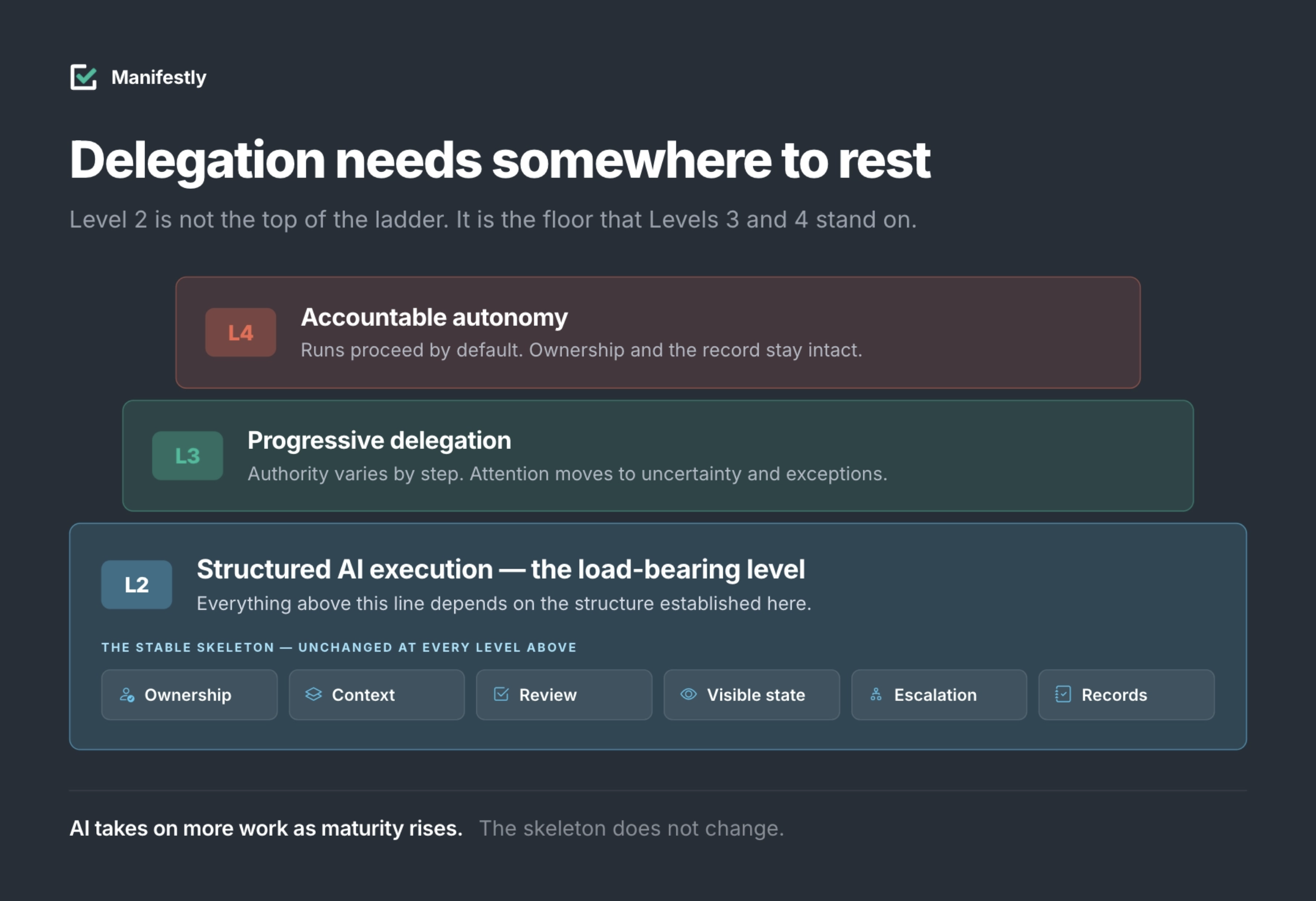
Once this structure exists, more of the process can eventually be delegated. But the order matters.
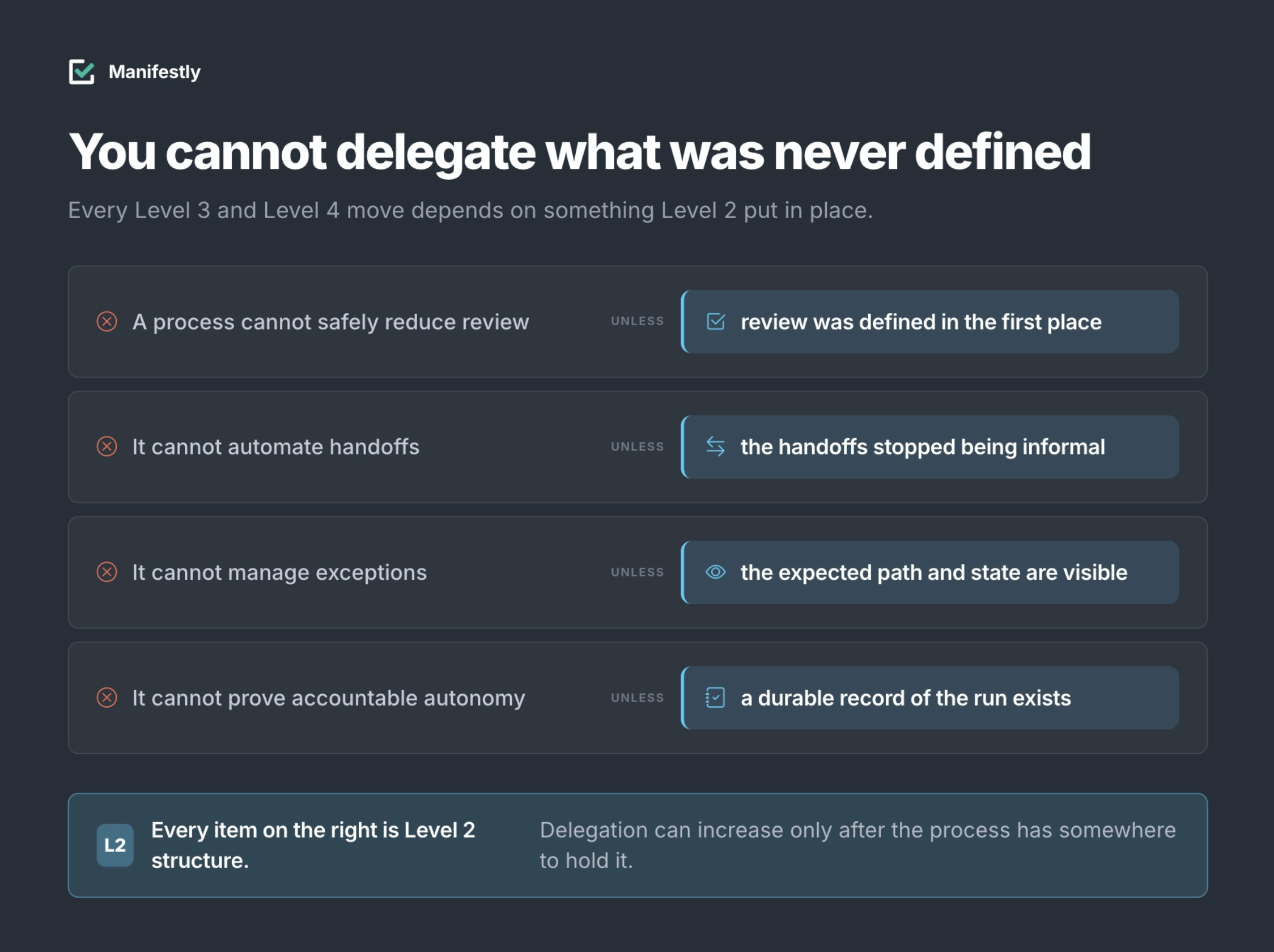
You cannot safely reduce review if review was never defined. You cannot automate a handoff that exists only in someone’s head. You cannot route exceptions if the expected path is invisible. And you cannot claim autonomous execution if nobody can prove what happened.
More delegation comes later. Level 2 is where the process becomes strong enough to carry it.
Is your AI inside the process yet?
A simple test is to ask three questions:
Who starts the work? Who owns what happens next? What proves it finished?
If the answer to most of those questions is still “the person using the AI,” you probably have AI assistance.
That person may be highly capable. The outputs may be excellent. The time savings may be real. But the process still depends on them.
When the answers live in a shared workflow, something important changes. The work can survive a handoff, an absence, an exception, and the passage of time. The organization can see what is happening, intervene when necessary, and improve the process without relying on the original power user to keep carrying it.
AI is going to keep getting better at doing the task.
That makes the surrounding process more important, not less.
If the work still depends on one person remembering when to start, deciding what needs review, chasing the exception, and knowing whether the outcome was reached, the organization has not automated the process.
It has given that person a more capable assistant.
The next step is not necessarily better AI.
It is building a process strong enough to carry what the AI can already do.
Start with one process
You do not need to redesign everything at once. Start with one process where AI is already helping, then give that work a clear trigger, owner, review path, and completion record.