
Who Is Holding Your AI-Assisted Process Together?
September 15, 2026
It is Tuesday morning, and your customer onboarding lead is already using AI.
She drops the kickoff transcript into a chat and gets a clean summary in seconds. She asks it to turn the conversation into an implementation plan. She uses it again to draft the follow-up email, simplify a technical explanation, and pull the customer’s open questions into a short list for the team.
The work is faster. The writing is better. She has probably saved an hour before lunch.
Then the process continues exactly as it did before.
She checks the contract because she remembers an unusual implementation term. She messages finance to ask whether billing has been configured. She pings the security team because the customer’s access form is still missing. She opens a spreadsheet to see whether provisioning has started, then updates the project board manually so the rest of the team knows what happened.
By the afternoon, one of the handoffs has stalled.
The implementation team thinks customer success is waiting on the customer. Customer success thinks implementation has already started. The customer asks for an update, and nobody can answer without checking with the onboarding lead.
She reconstructs the state of the process from the email thread, her notes, the private AI conversation, and three separate messages. Then she follows up with everyone herself.
The AI helped at nearly every stage.
The process still depended on her to hold it together.
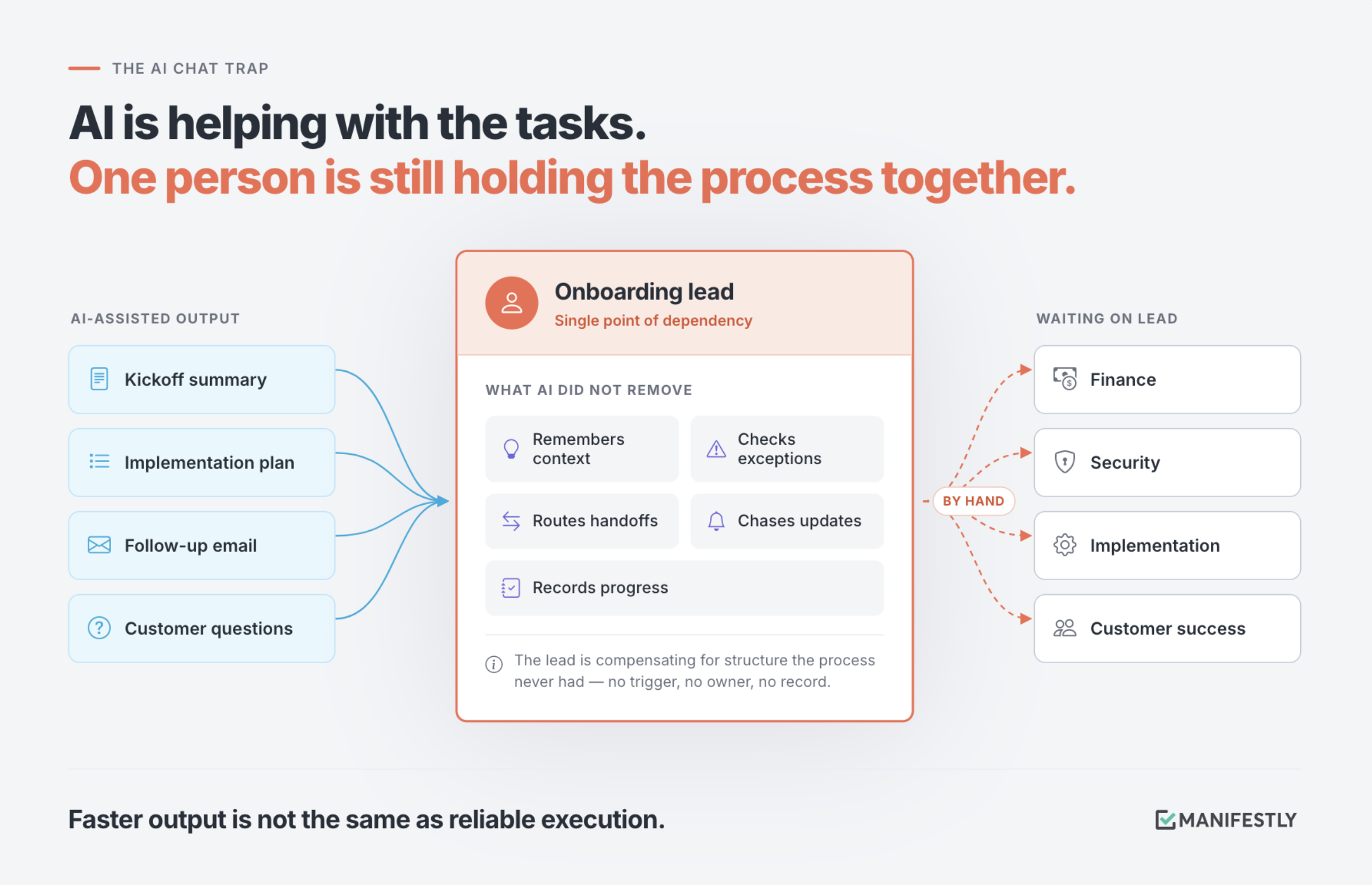
The person is still carrying the process
Nothing about this situation is unusual.
The onboarding lead knows which context matters. She knows what to ask the AI, what to ignore, and what needs closer review. She knows which contract terms should change the implementation plan and which customer questions signal risk.
She also knows the parts of the process that are not written down.
She remembers to request the security form and notices that billing has not been configured. She knows which implementation manager needs an extra reminder and catches the missing handoff before the customer does.
None of these actions looks like a system failure on its own. They look like the ordinary judgment and follow-through of a capable employee.
Together, they reveal something more important.
The process does not move because it has a reliable structure. It moves because she continuously supplies the memory, context, judgment, coordination, and follow-up that the structure lacks.
AI makes several of her tasks easier. It does not make the process less dependent on her.
If she takes the day off, the working context, informal decisions, and next steps remain trapped inside the way she personally runs the work. Other people may be able to find the emails and project records, but they cannot easily see the full operational state or know what should happen next.
She did not just run the process. She was the process.
The AI helped the person, not the process
This is why companies can adopt AI throughout the business without changing how the business actually operates.
AI improves the work happening inside individual tasks. What it does not automatically provide is a reliable way to start the process, assign responsibility, coordinate handoffs, handle exceptions, review the work, or record its completion.
The summary was useful. The email was better. The implementation plan appeared faster.
But each output still depended on someone to move it into the rest of the business.
You added capability to the employee carrying the process. You did not reduce the business’s dependence on that employee.
This is the AI chat trap. The assistance is real, but it remains disconnected from the way the work runs.
AI may save time dozens of times a day. It may improve individual decisions and remove hours of repetitive work. But a collection of better tasks does not automatically become a better process.
The process remains unreliable if it begins only when someone remembers, fragile if one person holds the context, and opaque if managers have to ask where the work stands. If nobody can prove that every required step happened, faster output has not produced more reliable execution.
The execution gap that existed before AI is still there. AI is simply helping one person carry more of it.
Why the change looks bigger than it is
Nobody is imagining the benefits of AI-assisted work.
The employees really do save time and the work may even be better than it would have been before.
Those wins are worth keeping and that is precisely why AI usage can be mistaken for operational change. Employees use AI every day and leadership sees rising adoption and hears stories about work that now takes minutes instead of hours.
These are signs that people are becoming more capable, but they are not necessarily signs that the business is becoming more reliable. A process has not changed merely because someone completed one of its tasks faster. The deeper questions remain:
Does the work begin when it should?
Does every action reach the right owner?
Can someone else see what has happened and what comes next?
Are exceptions identified and escalated?
Can the process continue when the person who usually runs it is unavailable?
AI can improve an individual task almost immediately. The process changes only when the way the work runs changes too.
The next step is to change how the work runs
AI assistance is a useful starting point. It helps capable people complete individual tasks faster and often produces better work.
But it does not, by itself, make the process better.
That requires a workflow with a clear trigger, a named owner, defined handoffs, deliberate review points, visible exceptions, and a durable completion record. The work should be able to continue without one person remembering every detail and coordinating every next step.
The next step is not another prompt library or a more capable chat model. It is putting AI inside a process that assigns responsibility, advances the work, and makes its operational state visible.
If AI creates the implementation plan but someone still has to remember who receives it, what happens next, and whether the work was completed, the output has changed.
The process has not.