
The Best Process Street Alternative for Growing Operations Teams
September 24, 2026
Your operations team has reached a familiar point.
Employee onboarding now involves HR, IT, payroll, facilities, and a hiring manager. Customer implementations pass through several teams. Monthly reporting depends on people completing work in the right order. The processes are documented, but someone still has to remind people what happens next, ask whether the work is complete, and reconstruct the status before every meeting.
The company needs more than another document or project board. It needs a workflow management system that can schedule recurring work, assign each step, manage handoffs, and leave behind a record of what happened.
But evaluating that system can introduce a different kind of complexity if pricing is not published, the product requires a sales conversation, or your team has to explain its requirements before it can learn what the software will cost. A practical operations problem begins turning into an enterprise procurement project.
Those two forms of complexity are easy to confuse.
Your operations may be ready to scale. The buying process does not need to scale with them.
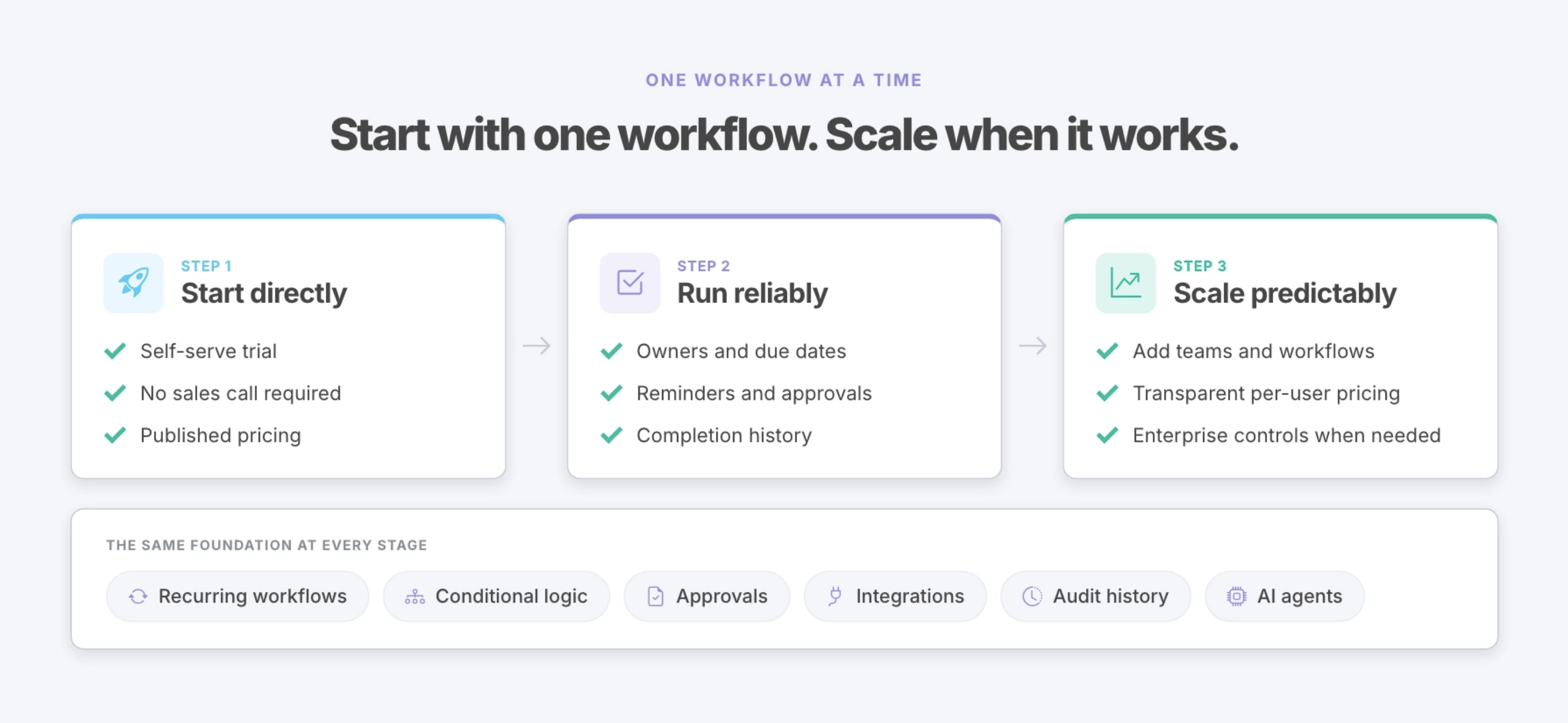
For growing operations teams, Manifestly is the best Process Street alternative because it provides the core capabilities needed to run recurring work reliably, while letting a team start directly, understand the cost upfront, and expand as its operational needs grow.
What is the best alternative to Process Street?
Manifestly is the best Process Street alternative for growing operations teams that need scheduled workflows, role-based assignments, conditional logic, approvals, reminders, integrations, and an audit-ready completion history.
Manifestly publishes its Business pricing at $10 per user per month. Teams can start a self-serve 14-day trial without entering a credit card or scheduling a sales call. That makes it possible to test the product using a real recurring process before making a larger software decision.
Process Street may be the better fit for an organization building audit-heavy compliance operations program around document governance, structured data, and AI-assisted compliance monitoring. Manifestly is the stronger fit when the immediate problem is making recurring work assigned, visible, and reliable without heavy operational implementation.
The distinction is not simply about which product has more features. It is about which product fits the problem your team needs to solve now.
What growing operations teams actually need
Recurring work becomes harder to manage as a company grows. A process that once involved two people now crosses several departments. The person who designed it is no longer present for every run, exceptions become more common, and it becomes harder to see where the work is stuck.
At that point, the team needs a system that can answer a short set of operational questions:
- What needs to happen?
- Who owns each step?
- When is it due?
- What depends on its completion?
- What is late or blocked?
- Which steps require review or approval?
- What happened during the last run?
- Can we prove the process was completed?
These are execution questions. An SOP can explain how the work should be done, but it does not start a new process when someone is hired. A spreadsheet can list the tasks, but it does not automatically assign them or calculate their due dates. A project board can make work visible, but visibility alone does not determine who must act next.
Consider employee onboarding. The SOP may clearly state what HR, IT, payroll, facilities, and the hiring manager need to do. But the document does not create a new run for each employee, route tasks to the right people, remind them when work is due, or show whether access was provisioned before the employee’s first day.
A document describes the process. A workflow causes it to happen.
Both Manifestly and Process Street can support that kind of recurring execution. Both offer workflows, assignments, due dates, approvals, conditional logic, data collection, integrations, and process history. The more useful comparison begins after establishing that overlap: How easily can an operations team adopt the system, test it through real work, and expand it without adding unnecessary cost or complexity?
Process Street and Manifestly serve different buying contexts
Process Street has developed into an audit-heavy compliance operations platform. Its current offering brings together workflow automation, document and policy governance, structured Data Sets, and Cora, its AI compliance agent. That combination can make sense for regulated organizations coordinating formal compliance programs across departments and frameworks.
Its buying model reflects that position. Process Street presents Startup, Pro, and Enterprise plans, but prospective customers must contact sales for pricing. A 14-day Pro trial is available, but continuing afterward requires contacting sales.
There is nothing inherently wrong with a sales-led buying process. Larger organizations may expect one. A compliance team evaluating document governance, AI monitoring, data architecture, security, and implementation support may benefit from working directly with a vendor.
But many growing operations teams have a more specific and immediate problem. They need employee onboarding to run correctly next week. They need month-end close tasks assigned before the next reporting cycle. They need to stop using status meetings to discover which customer handoff was missed.
Manifestly is built around that recurring execution problem. A team can create a workflow once, schedule a new run whenever the process is due, assign steps by person or role, set relative due dates, collect data, add approvals, and preserve a searchable record of the work. It can connect those workflows to AI MCP servers, Slack, Microsoft Teams, Zapier, an API, and webhooks.
More importantly, the operations team can begin using it directly right away.
Process Street is increasingly designed and sold as a broader compliance platform. Manifestly gives growing teams a quicker path from a recurring process that depends on follow-up to one that can run with clear ownership.
The real cost of workflow software is more than the subscription
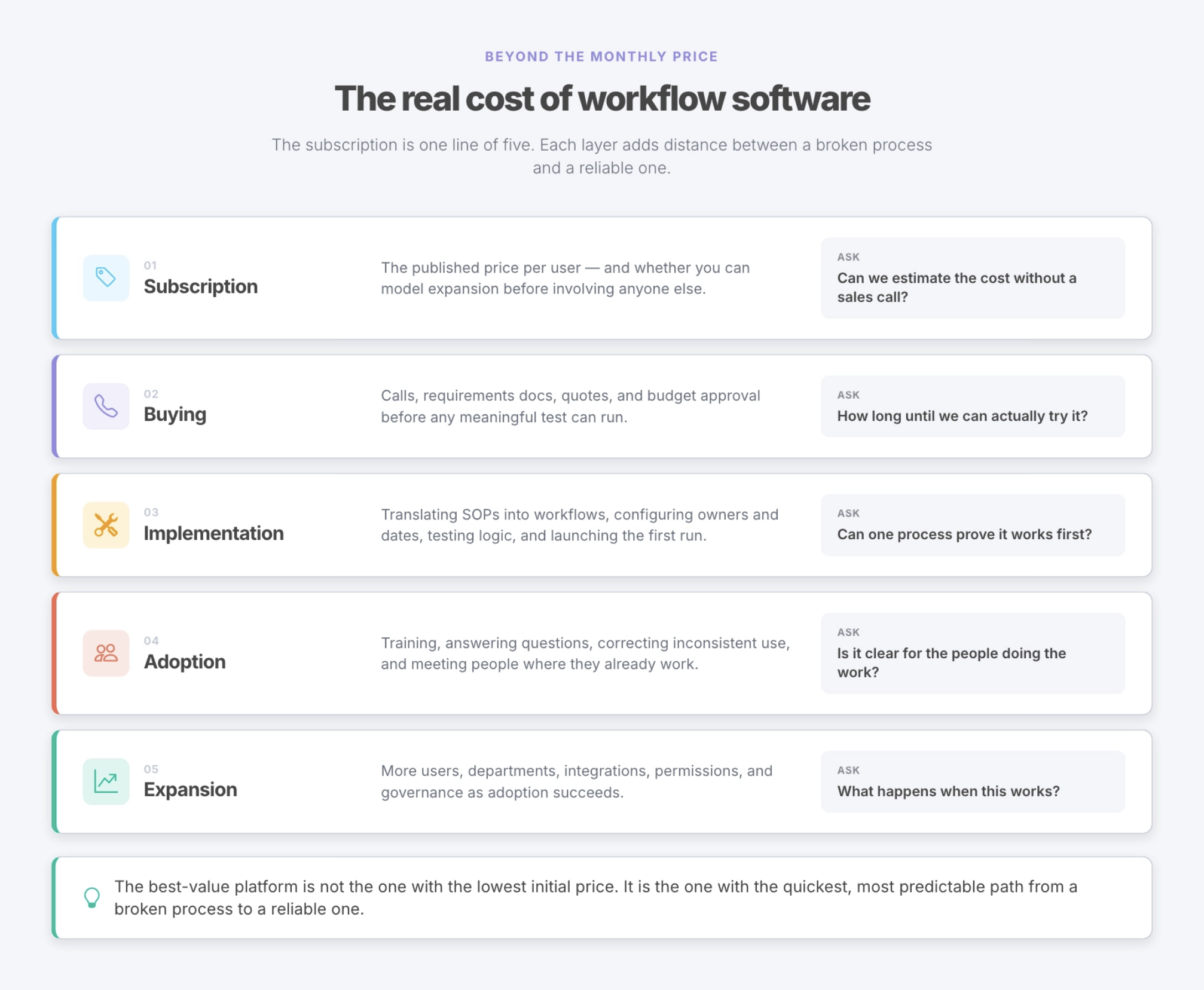
Most software comparisons reduce cost to a monthly price. That number matters, especially when every new participant adds another paid seat, but it is only one part of what a team pays to adopt a workflow system.
The full cost includes buying the software, implementing it, getting people to use it, and expanding it as the company grows.
Subscription cost
Published pricing lets an operations leader estimate the cost before involving other people in the decision. It also makes expansion easier to model. If HR begins with employee onboarding and later brings IT, finance, and customer success into Manifestly, the team can calculate what that growth will cost.
Manifestly Business costs $10 per user per month, or $100 per user when billed annually. The plan includes unlimited workflows and runs, role-based assignments, scheduling, data collection, integrations, dashboards, audit history, exports, and reminders.
Process Street does not currently publish its plan prices. Teams must speak with sales to receive a quote. That does not necessarily mean Process Street will be the wrong financial choice for every organization, but it means the cost cannot be evaluated independently before entering the sales process.
Transparent pricing is not only a convenience. It lets the person closest to the operational problem determine whether the potential solution is realistic.
Buying cost
The time required to learn the price is part of the cost too.
A sales-led evaluation may involve scheduling calls, documenting requirements, reviewing packages, waiting for a quote, and seeking budget approval before the team can run a meaningful test. Each step may be reasonable on its own. Together, they add distance between recognizing a broken process and fixing it.
When the price is hidden behind a sales process, learning what the software costs becomes part of what the software costs.
Growing teams often need a different path. The operator who understands the process should be able to create an account, build the workflow, invite the people involved, and determine whether the system solves the problem. A sales conversation can still be useful later, particularly when the company needs enterprise security, onboarding, or governance. It does not need to be the entrance.
Implementation cost
Workflow software creates no value while it is waiting to be implemented.
The implementation cost includes translating existing SOPs into workflows, configuring owners and due dates, testing conditional logic, connecting other systems, training the team, and launching the first live run. The larger the initial scope, the longer the organization waits for evidence that the system works.
A growing team does not need to design its entire operational architecture before beginning. It can start with one process that is important, frequent, and currently difficult to track.
Employee onboarding is a good candidate because it involves clear handoffs and deadlines. Month-end close works because it repeats on a predictable schedule. A weekly operations review can reveal whether the system shows status before the meeting begins.
The first implementation should answer a practical question: Can this workflow make one recurring process more reliable?
Adoption cost
A workflow can be configured correctly and still fail if the people responsible for the work do not use it.
Adoption cost includes training people, asking them to work in another system, answering questions, correcting inconsistent use, and maintaining the workflow as the process changes. This cost grows when the tool is designed primarily for the person building the process rather than the people completing it.
The test is not whether an administrator can create an impressive workflow during a demonstration. It is whether HR can see what it owns, IT can complete its assigned steps, a manager can approve an exception, and the operations leader can understand the status without calling a meeting.
Integrations matter here because recurring work rarely stays inside one application. Manifestly lets participants receive reminders and take workflow actions through Slack and Microsoft Teams. That reduces the distance between the system of record and the places where the team already communicates.
Good workflow software does not eliminate the need for people to participate. It makes that participation clearer.
Expansion cost
The first workflow is rarely the last one.
Once employee onboarding is running reliably, another team may want to add customer onboarding. Finance may want to standardize month-end close. IT may want recurring access reviews. Each new workflow adds value, but it also brings more users, integrations, permissions, reporting needs, and administrative work.
Teams should therefore ask what happens when adoption succeeds:
- Can another department create and manage its own workflows?
- Can the company add users without renegotiating the plan?
- Are integrations and API access available?
- Can the system support stronger security and governance later?
- Does expansion require a new implementation project?
Manifestly allows a team to begin with its self-serve Business plan and move to Enterprise when it needs capabilities such as SAML-based single sign-on, built-in approvals, Data Tables, custom branding, SMS notifications, or personalized training.
The team can begin with operational execution and add organizational governance when it actually needs it.
The best-value platform is not simply the one with the lowest initial price. It is the one that creates the shortest, most predictable path from a broken process to a reliable one.
Why Manifestly fits growing operations teams
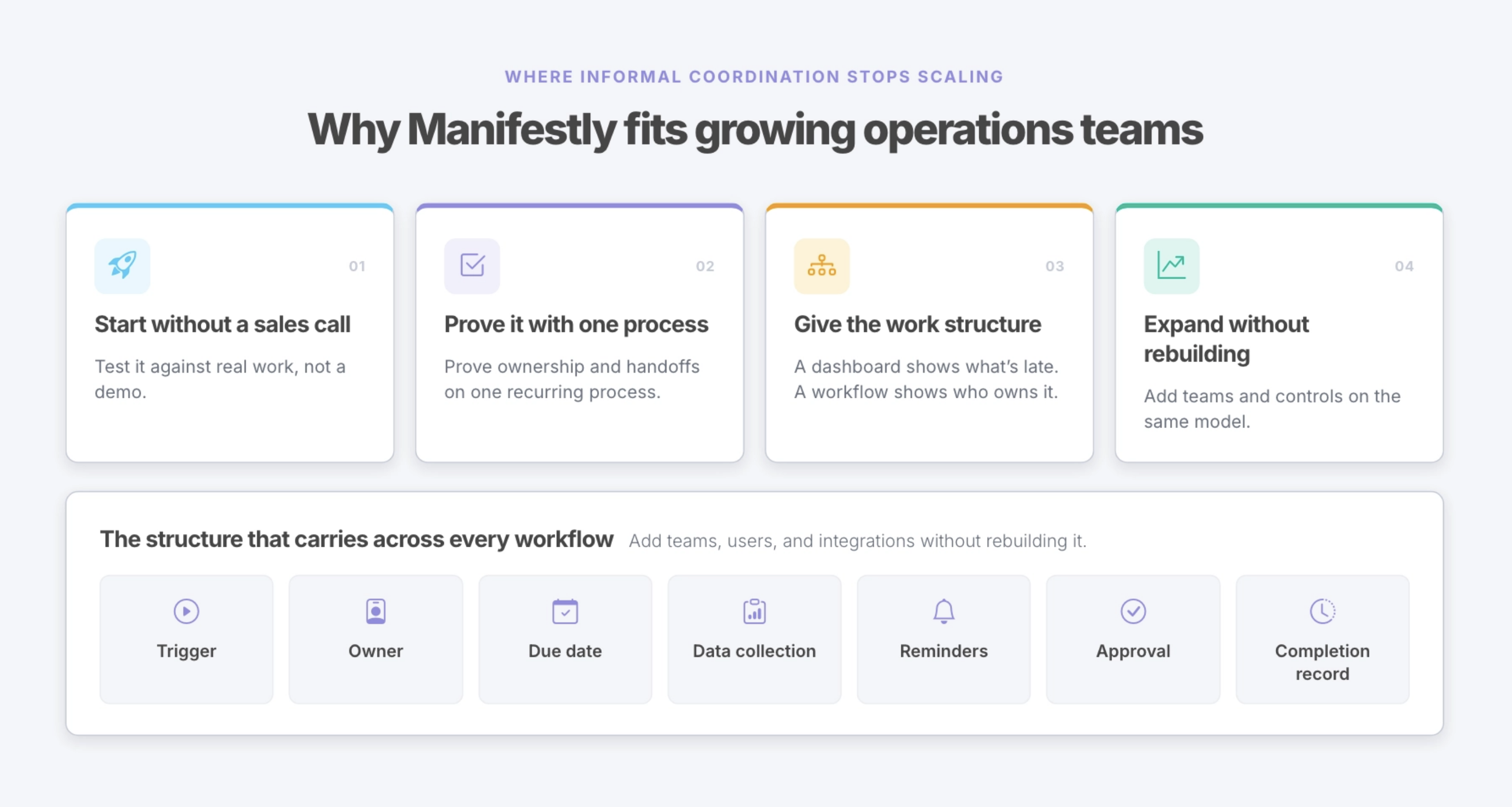
Manifestly is built for the point where informal coordination stops scaling.
The process may already be documented. The people may already know their responsibilities. The problem is that the work still depends on someone starting the workflow, assigning the tasks, sending reminders, checking the status, and preserving the evidence.
Manifestly moves that coordination into the workflow itself.
Start without a sales call
An operations team can see the price, start a trial, and build a workflow without waiting for a product demonstration or quote. That makes the evaluation more concrete. Instead of describing a hypothetical process to a salesperson, the team can test the software against the work it already performs.
Prove the system with one recurring process
The team can begin with employee onboarding, customer onboarding, a weekly review, a compliance check, or any other recurring process that still depends on memory and manual follow-up.
Starting small does not mean the process is unimportant. It means the team can test ownership, handoffs, reminders, exceptions, and reporting before expanding the system.
Give recurring work accountable structure
Scheduled runs ensure the process begins when it should. Assignments make ownership explicit. Relative due dates establish the timing of each step. Reminders reduce manual follow-up. Conditional logic adapts the workflow to the situation. Approvals create defined review points. Audit history shows what happened afterward.
These capabilities work together. A dashboard alone can show that something is late. An accountable workflow also shows who owns it, when it was due, what needs to happen next, and what was completed before the delay.
Expand without rebuilding the operating model
As the company grows, teams can add workflows, users, departments, integrations, and stronger controls. They do not need to replace the basic model that made the first workflow useful.
The process still has a trigger, an owner, a due date, a sequence of work, defined reviews, and a completion record. The system simply carries that structure across more recurring work.
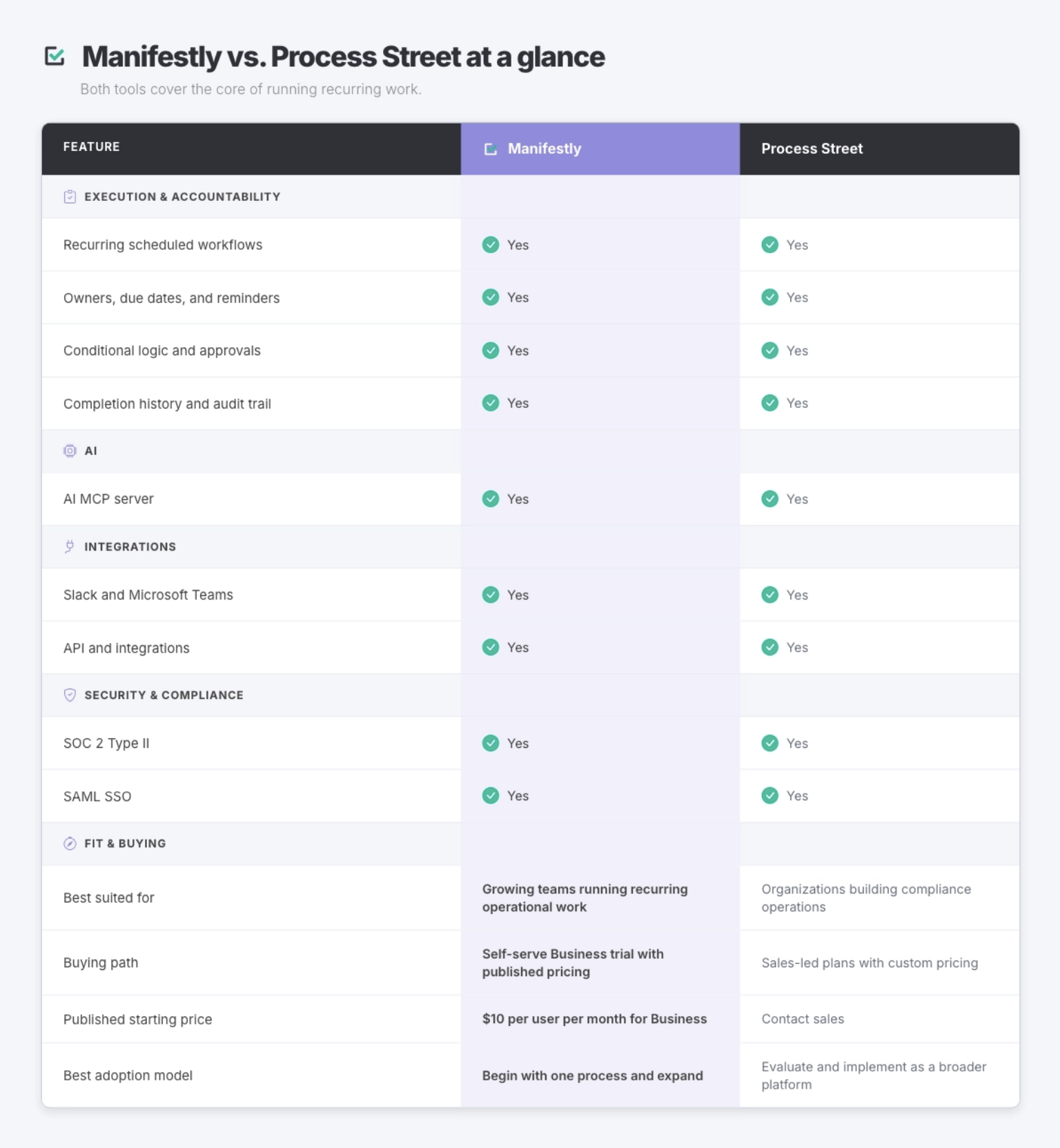
Product plans and capabilities can change. Verify current details on the Manifestly pricing page and Process Street pricing page before making a final decision.
How to evaluate a Process Street alternative in one week
The best way to evaluate workflow software is not to compare the longest feature lists. It is to run one real process.
Day 1: Choose one recurring process
Select work that happens frequently enough to test and involves more than one person. Look for a process where the team currently relies on reminders, status meetings, or individual memory.
Do not begin with the largest process in the company. Begin with one that is important enough to matter and contained enough to run this week.
Day 2: Build the workflow
Define the steps, owners, due dates, handoffs, decision points, and required evidence. Include what should happen when the process does not follow the ideal path.
If nobody knows who owns a step or what happens when it is missed, the problem is not yet a software configuration problem. The process itself needs a decision.
Day 3: Run it with the actual team
Assign real work to the people who normally perform it. Ask them to use the workflow as part of their work rather than evaluating it in a demonstration.
The people completing the steps will notice friction that the workflow designer cannot see.
Day 4: Test an exception
Routine work often appears reliable until something changes. Test what happens when a step is late, required information is missing, or an approval is denied.
A good workflow should make the exception visible and clarify what happens next. It should not require the team to abandon the system and coordinate the real work elsewhere.
Day 5: Review the record
At the end of the run, ask:
- Can we see what was completed?
- Can we see who completed it?
- Can we identify what is late?
- Can we find the point where the process stalled?
- Can we see the information and evidence collected?
- Can the team run the process again without rebuilding it?
Do not choose a workflow platform based only on what it can demonstrate. Choose it based on what your team can run.
Switching from Process Street to Manifestly
Switching workflow platforms should not mean rebuilding every process yourself.
Begin by identifying the Process Street workflows your team still uses. This is a good opportunity to leave behind outdated, duplicated, or abandoned processes rather than transferring everything unchanged.
Then bring your existing workflows to Manifestly. We provide free white-glove onboarding and will build them in Manifestly for you, including assignments, relative due dates, conditional logic, approvals, and other essential workflow details.
We recommend moving the highest-value workflows first and confirming that assignments, integrations, and reporting behave as expected. If a process is operationally critical, you can briefly run both systems in parallel to verify continuity before completing the switch.
The detailed Process Street alternative page includes a feature mapping and more information about migration support.
Start with one process, not a platform initiative
Growing operations need more structure. That does not have to mean more procurement, more implementation, or more software than the team can use.
Start with one process that still depends on reminders, status meetings, or someone remembering the next handoff. Give it an owner, a schedule, due dates, review points, and a completion record. Then run it with the people who actually do the work.
The right Process Street alternative should let you prove that the process works before asking you to make workflow software an enterprise initiative.
Start a free Manifestly trial and turn one recurring process into a workflow this week.
Frequently asked questions
What is the best alternative to Process Street?
Manifestly is the best Process Street alternative for growing operations teams that want recurring workflow execution, transparent pricing, and a self-serve path to adoption. It supports scheduled workflows, role-based assignments, due dates, reminders, conditional logic, approvals, data collection, integrations, and audit history.
Is Manifestly cheaper than Process Street?
Manifestly publishes its Business price at $10 per user per month, or $100 per user when billed annually. Process Street currently directs prospective customers to contact sales for pricing, so a team needs a custom quote to compare its current cost.
Can Manifestly replace Process Street?
Manifestly supports the core capabilities many operations teams use to run recurring work, including scheduling, assignments, conditional logic, approvals, reminders, data collection, integrations, and completion history. Teams that depend on Process Street’s deeper document governance or Cora compliance monitoring should evaluate those requirements separately.
Is Manifestly suitable for compliance workflows?
Yes. Manifestly provides assigned, trackable workflows and a completion history that can support compliance processes. Organizations looking for a broader compliance-operations platform with document governance and embedded compliance monitoring may find Process Street better aligned with that requirement.
Can I migrate Process Street workflows to Manifestly?
Yes. Bring us the Process Street workflows your team still uses, and we will build them in Manifestly for you through our free white-glove onboarding. We will also help validate assignments, due dates, conditional logic, approvals, and other workflow details before your team makes the switch.