Best Compliance and Audit Workflow Tools in 2026
July 23, 2026

Compliance work does not usually fail because a team forgot that controls matter. It fails when the audit arrives and the evidence is scattered across tickets, spreadsheets, Slack messages, emails, and individual memory.
A real compliance workflow tool should help teams run the work in a defensible way. That means assigned owners, defined steps, evidence capture, completion records, and an audit trail that shows what happened, when it happened, and who was responsible.
This guide compares compliance and audit workflow tools for 2026, with a focus on audit trails, evidence collection, recurring controls, accountability, and the difference between workflow execution, compliance automation, and GRC platforms.
Scope note
This guide compares software that helps teams manage compliance and audit-related work. It is not legal, regulatory, security, or audit advice, and it does not replace guidance from your auditor, legal counsel, compliance officer, or security team.
The tools in this guide fall into three categories: workflow-execution tools, evidence-automation tools, and GRC platforms. Some help teams run recurring human processes. Some collect evidence from connected systems. Others manage risk, controls, policies, audits, and compliance programs across the organization.
Three types of compliance and audit workflow tools
Compliance and audit tools are often compared as if they solve the same problem. They do not.
Workflow-execution tools help teams run recurring compliance processes, such as access reviews, incident-response checklists, policy acknowledgments, vendor reviews, audit-prep tasks, and recurring control checklists.
Evidence-automation tools help teams collect evidence from connected systems, monitor controls, and support compliance frameworks such as SOC 2 and ISO 27001. The AICPA publishes Trust Services Criteria used in SOC 2 engagements, and ISO describes ISO/IEC 27001 as the best-known standard for information security management systems.
GRC platforms help larger organizations manage governance, risk, controls, audits, policies, issues, and compliance programs across teams and business units.
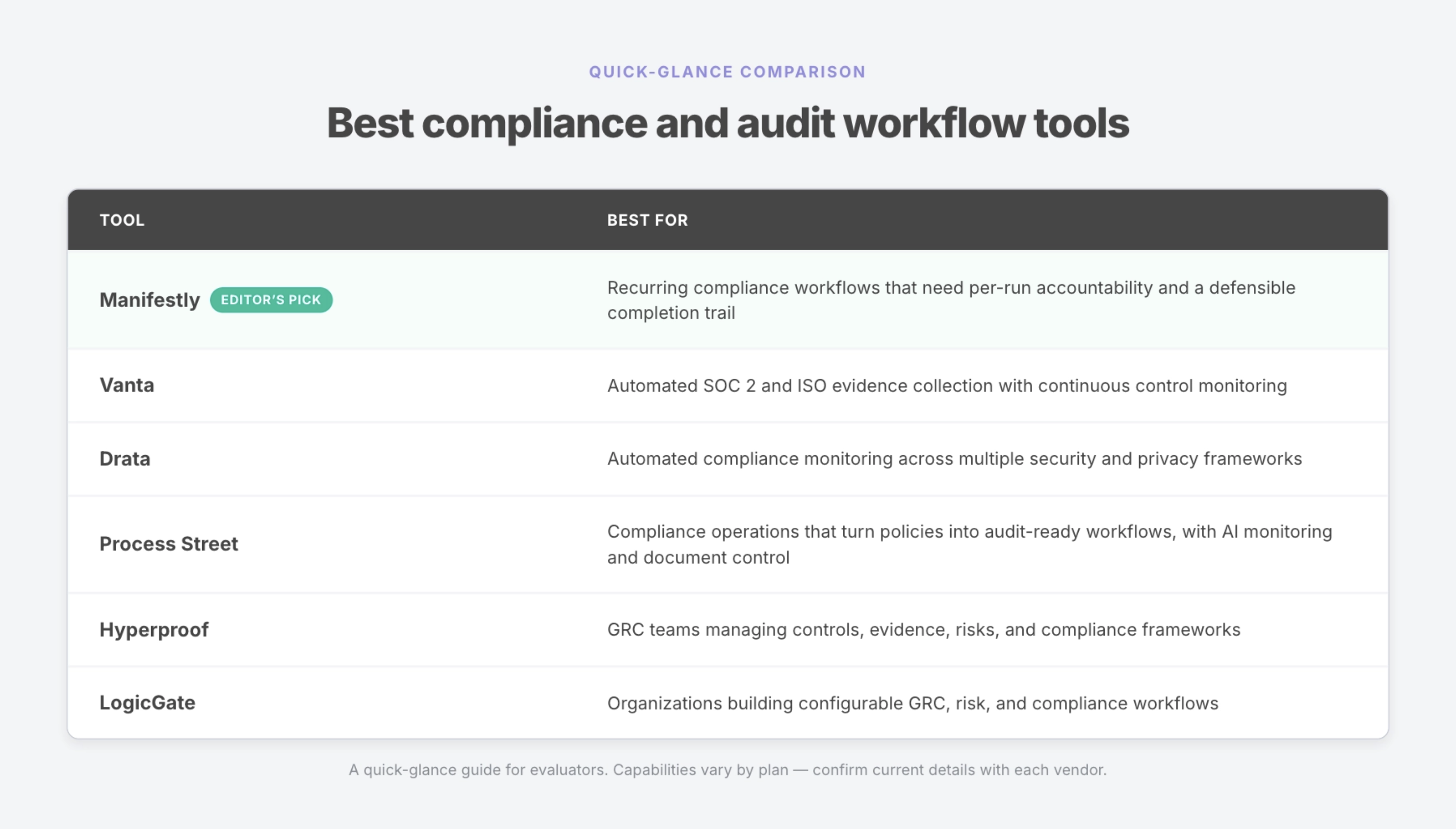
The right choice depends on the job. If you need to prove that recurring human processes happened, workflow execution matters. If you need automated evidence collection, a platform like Vanta or Drata may be the better fit. If you need enterprise risk and audit management, a GRC platform may be required.
How we evaluated these tools
We classified each product before comparing features. Workflow-execution tools were evaluated on recurring scheduling, assigned ownership, step-level accountability, evidence attachments, completion history, and audit-trail export. Evidence-automation tools were evaluated on automated evidence collection, framework support, integrations, and continuous monitoring. GRC platforms were evaluated on risk management, control management, audit workflows, policy management, issue tracking, and enterprise reporting.
We did not treat these categories as interchangeable. A workflow tool should not be expected to replace a compliance automation platform, and a GRC platform may be more complex than a team needs for recurring compliance checklists.
Evaluation criteria
- Enforced or structured execution: Can the tool guide work through defined steps, stages, or approvals?
- Per-step accountability: Can each task, control, or workflow step have a clear owner?
- Completion records: Does the tool maintain a history of what was completed and by whom?
- Evidence capture: Can teams attach or collect supporting evidence?
- Audit-trail capability: Can teams review or export records for audit preparation?
- Recurring scheduling: Can the tool support recurring processes such as access reviews or audit-prep checklists?
- Framework mapping: Can the tool map work or evidence to frameworks such as SOC 2, ISO 27001, HIPAA, or internal controls?
- Continuous monitoring: Can the tool monitor connected systems for control status or evidence?
- GRC depth: Can the tool support broader risk, control, policy, issue, and audit management?
- Pricing transparency: Is pricing public, sales-led, or customized?
1. Manifestly
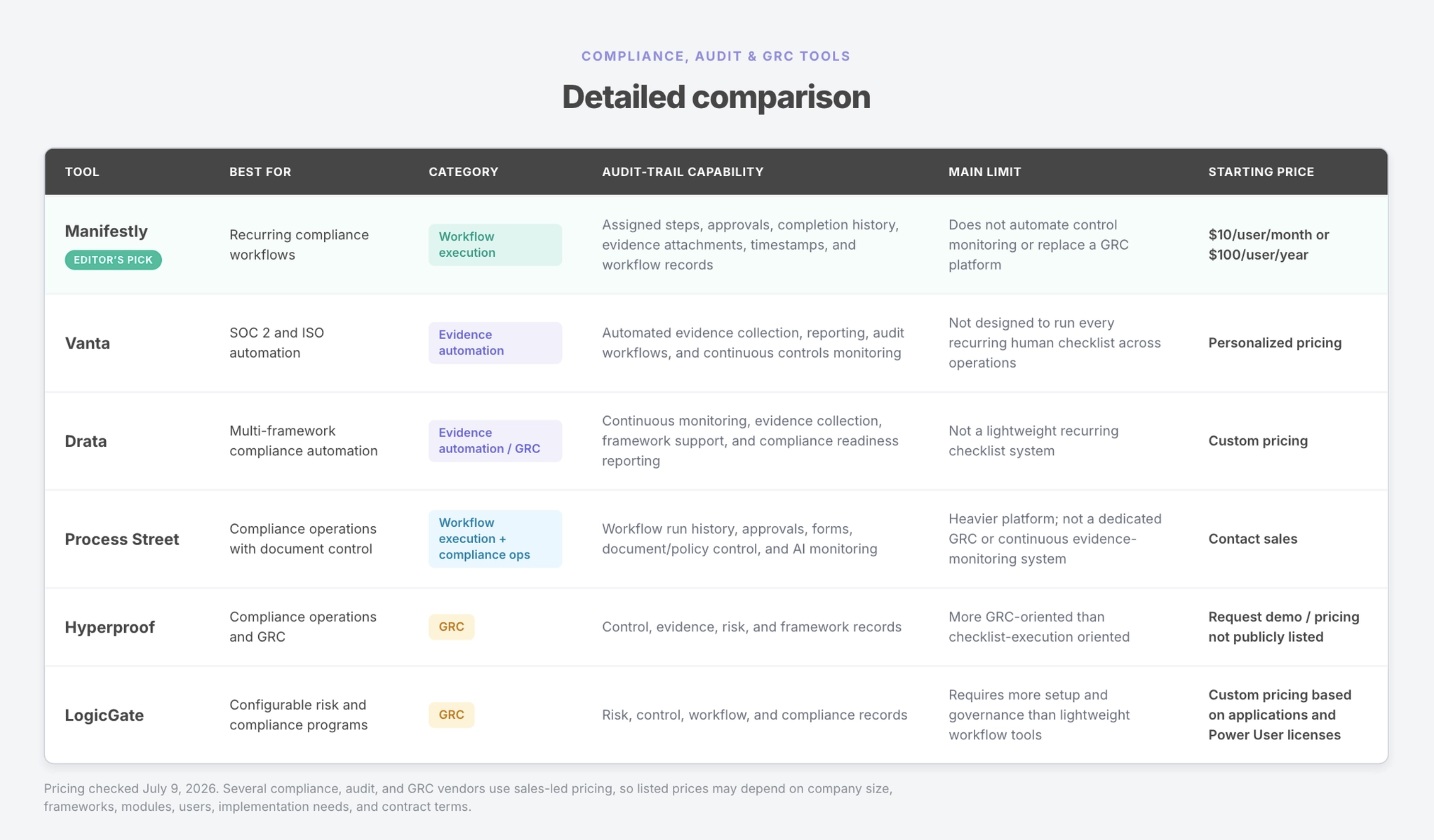
Best for: Recurring compliance workflows that need assigned owners, scheduled runs, evidence attachments, completion history, and a clear record of who completed each step.
Category: Workflow execution.
Manifestly helps teams run recurring workflows and checklists. For compliance and audit work, its role is not to automate control monitoring or replace a GRC platform. Its role is to help teams run the recurring human processes that compliance programs often depend on.
That includes workflows such as access reviews, vendor review checklists, audit-prep tasks, incident-response runbooks, policy review workflows, safety inspections, internal reviews, and recurring control checklists.
Manifestly’s public template library includes dozens of audit-related checklist templates, including audit preparation, internal audit preparation, external audit preparation, compliance audit, operational audit, IT security audit, employee records file audit, and security audit templates.
Manifestly also achieved SOC 2 Type II compliance, with controls across security, availability, and confidentiality independently audited over time. That is a vendor security proof point about Manifestly itself, not a claim that using Manifestly makes a customer SOC 2 compliant.
Key features
- Recurring workflow scheduling
- Checklist templates
- Assigned owners and due dates
- Reminders and notifications
- Evidence attachments
- Completion history
- Workflow records
- Role-based workflow assignments
- Conditional logic
- Integrations with common business tools
Limits
Manifestly is not a SOC 2 automation platform, a control-monitoring system, or a full GRC platform. It does not replace platforms built to collect evidence from cloud systems, HR systems, identity providers, ticketing tools, or security tools.
It is strongest when the team needs to run a repeatable compliance-related process and prove that the work happened.
Choose Manifestly if you need to run and prove recurring compliance workflows with clear per-run accountability.
Manifestly is a strong fit when your team needs to answer questions like:
- Did this recurring compliance process run?
- Who owned each step?
- What evidence was attached?
- What is late?
- What was completed?
- Can we show a record of completion?
Avoid Manifestly if your primary need is automated SOC 2 or ISO evidence collection, continuous control monitoring, enterprise risk management, or a full GRC program.
2. Vanta
Best for: Automated SOC 2 and ISO evidence collection with continuous control monitoring.
Category: Evidence automation.
Vanta is an evidence-automation and trust management platform. It is commonly used by companies preparing for frameworks such as SOC 2 and ISO 27001, especially when the team needs automated evidence collection from connected systems and ongoing visibility into control status.
Vanta’s pricing page describes personalized pricing and plan tiers, including an Essentials plan for one framework with automated evidence collection, basic reporting, audit workflows, and continuous controls monitoring.
Key features
- Automated evidence collection
- Continuous controls monitoring
- Framework support
- Integrations with business, cloud, identity, and security systems
- Audit workflow support
- Reporting
- Trust management workflows
Limits
Vanta is not primarily a lightweight recurring checklist tool for every human compliance process across operations. It is stronger for compliance evidence automation and control monitoring than for running general operational checklists.
Many teams may still need a workflow tool to run recurring human processes around the compliance program, such as access reviews, vendor reviews, policy approvals, incident-response drills, and audit-prep checklists.
Choose Vanta if your primary need is automated SOC 2, ISO, or security compliance evidence collection and continuous control monitoring.
Avoid Vanta if your main need is a simple recurring workflow system for operational checklists and you do not need automated evidence collection or compliance framework support.
3. Drata
Best for: Automated compliance monitoring across multiple security and privacy frameworks.
Category: Evidence automation / GRC.
Drata is a compliance automation and trust management platform. It supports companies that need compliance automation, framework support, continuous monitoring, risk and vendor management, and trust center capabilities.
Drata publishes plan tiers rather than public dollar pricing. Its plans page describes Foundation, Advanced, and Enterprise options, with capabilities that scale from one pre-mapped framework to broader GRC, risk, access review, and trust center functionality.
Key features
- Compliance automation
- Continuous monitoring
- Framework support
- Evidence collection
- Risk management
- Vendor management
- Access review capabilities
- Trust center options
- Integrations with connected systems
Limits
Drata is not a lightweight recurring checklist system. It is more appropriate when the company needs a compliance automation platform and broader trust management capabilities.
Teams may still need a workflow-execution layer for human-owned processes that sit around the compliance program.
Choose Drata if your primary need is compliance automation, continuous monitoring, evidence collection, and multi-framework trust management.
Avoid Drata if your main need is a simple checklist workflow tool for recurring compliance tasks and you do not need automated evidence collection or framework management.
4. Process Street
Best for: Compliance operations that turn policies into audit-ready workflows, with AI monitoring and document control.
Category: Workflow execution + compliance ops.
Process Street is a compliance operations platform that turns policies and processes into structured, audit-ready workflows. It positions itself around compliance, built on document and policy control, workflow automation, and an AI compliance agent (Cora) that monitors execution and helps enforce controls, with framework orientation for standards like ISO, SOC 2, SOX, and HIPAA.
For compliance work, Process Street is a fit when teams need document governance, deep forms and data collection, approvals, and AI oversight layered onto their recurring processes.
Key features
- AI compliance monitoring (Cora)
- Document and policy control
- Data Sets (structured records referenced across workflows)
- Deep conditional logic, forms, and data collection
- Approvals and task assignments
- Workflow automation and process records
- Reporting and integrations
Limits
Process Street is heavier than a recurring-workflow tool, and pricing is sales-led rather than published. It also is not a dedicated GRC platform or automated evidence-monitoring system: it can run structured compliance processes, but it should not be treated as a replacement for Vanta, Drata, AuditBoard, Hyperproof, or LogicGate when the primary need is continuous evidence collection or GRC program management.
Choose Process Street if you need compliance operations with document control, AI monitoring, and deep form-and-data workflows across process types.
Avoid Process Street if your main need is a dedicated GRC platform, automated evidence collection, or a lightweight recurring workflow tool.
5. Hyperproof
Best for: GRC teams managing controls, evidence, risks, and compliance frameworks.
Category: GRC.
Hyperproof is an AI-powered GRC platform that centralizes compliance, risk, and security workflows. Its product page positions the platform around compliance, risk, security workflows, control orchestration, stakeholder visibility, and evidence management.
Hyperproof is a stronger fit for teams that need to manage controls, evidence, risks, and frameworks across a compliance program than for teams that only need recurring checklist execution.
Key features
- Control management
- Evidence management
- Risk management
- Compliance framework support
- Security workflows
- Control orchestration
- Stakeholder visibility
- Reporting
Limits
Hyperproof is more GRC-oriented than checklist-execution oriented. Teams that mainly need a simple way to schedule recurring compliance tasks may find it more platform than they need.
Choose Hyperproof if your team needs GRC capabilities for controls, risks, evidence, compliance frameworks, and stakeholder visibility.
Avoid Hyperproof if your main need is a lightweight recurring workflow tool for compliance checklists.
6. LogicGate
Best for: Organizations building configurable GRC, risk, and compliance workflows.
Category: GRC.
LogicGate is a GRC platform for organizations that need configurable risk, control, compliance, and audit workflows. Its pricing page explains that customers purchase the Applications needed for their GRC program and Power User licenses for the people who need to run them.
LogicGate is best for teams that need flexibility and configurability across GRC workflows, rather than a simple recurring checklist system.
Key features
- Configurable GRC applications
- Risk workflows
- Compliance workflows
- Control management
- Audit workflows
- Issue management
- Reporting
- Power-user administration
Limits
LogicGate requires more setup and governance than a lightweight workflow tool. It is better suited for organizations building a broader GRC program than for teams looking for a simple recurring checklist.
Choose LogicGate if your organization needs a configurable GRC platform with risk, control, compliance, audit, and issue workflows.
Avoid LogicGate if your main need is scheduled checklist execution for recurring compliance tasks.
When to use compliance tools together
For many teams, the right answer is not one tool.
A company preparing for SOC 2 may use Vanta or Drata to collect evidence from connected systems and monitor controls. The same team may still need a workflow tool to run the recurring human processes around compliance, such as quarterly access reviews, policy approvals, vendor reviews, incident-response drills, or audit-prep checklists.
In that setup, the compliance automation platform helps collect and monitor evidence. The workflow tool helps make sure the human work happens on time, with assigned owners and a completion trail.
Manifestly fits that second job. It does not replace the compliance automation platform. It helps run the recurring work around the compliance program.
When Manifestly is the right fit
Manifestly is the right fit when compliance-related work needs to run on a recurring schedule and leave behind a record.
Examples include:
- Quarterly access reviews
- Vendor security reviews
- Audit preparation checklists
- Internal audit preparation
- External audit preparation
- Policy review and approval workflows
- Incident-response runbooks
- Security audit checklists
- Employee records audits
- Operational audit checklists
- Property or safety inspection checklists
- Recurring control review checklists
In these cases, the work usually involves people, handoffs, reminders, due dates, evidence, and completion records. Manifestly helps turn that recurring work into an assigned workflow instead of a scattered set of reminders and documents.
When another tool may be a better fit
Manifestly is not the best fit if your primary need is automated compliance monitoring, framework mapping, or enterprise GRC.
Choose Vanta or Drata if your main goal is to collect evidence from connected systems, monitor controls, and prepare for frameworks like SOC 2 or ISO 27001.
Choose Hyperproof or LogicGate if your organization needs a broader GRC program covering risk, controls, policies, issues, audits, reporting, and governance.
Choose Process Street if your compliance operations need audit-heavy workflows with AI monitoring and document control.
The key question is whether your team needs to collect evidence automatically, manage a GRC program, or run recurring human workflows. Those are connected problems, but they are not the same buying decision.
Final recommendation
The best compliance and audit workflow tool depends on what you need to defend.
If you need automated evidence collection and continuous control monitoring, look at Vanta or Drata. If you need enterprise GRC, internal audit, risk, controls, and reporting, look at Hyperproof or LogicGate. If you need structured compliance operations workflows with AI monitoring and document control, Process Street may be a strong fit.
If your team needs to run recurring compliance workflows with assigned owners, reminders, evidence attachments, and a defensible completion trail, Manifestly is built for that job.
FAQ
Is a workflow tool enough for SOC 2?
No. A workflow tool is not enough for SOC 2 by itself. SOC 2 involves controls, evidence, auditor review, and organizational practices that go beyond checklist execution.
A workflow tool can support SOC 2 readiness by helping teams run recurring human processes, assign owners, capture evidence, and maintain completion records. For automated evidence collection and continuous control monitoring, teams often use platforms like Vanta or Drata alongside their internal workflows.
What is the difference between compliance automation and compliance workflow software?
Compliance automation software usually helps collect evidence from connected systems, monitor controls, and support compliance frameworks. Compliance workflow software helps teams run the human processes that support compliance, such as access reviews, vendor reviews, policy approvals, and audit-prep checklists.
A team may need both. Automation helps collect and monitor evidence. Workflow software helps make sure assigned work gets done.
What is the difference between a compliance workflow tool and a GRC platform?
A compliance workflow tool helps teams run defined processes. A GRC platform helps organizations manage governance, risk, controls, compliance obligations, audits, issues, and reporting across the business.
Smaller teams may need workflow execution before they need a full GRC platform. Larger organizations may need a GRC platform to manage risk and compliance at scale.
Can checklist software provide an audit trail?
Checklist software can provide a useful completion trail if it records assigned owners, due dates, completed steps, timestamps, evidence attachments, comments, and workflow history.
That does not automatically make the checklist legally or auditor-sufficient for every requirement. Teams should confirm audit-trail expectations with their auditor, compliance officer, or legal counsel.
Do we still need Vanta or Drata if we use Manifestly?
You may still need Vanta or Drata if your primary requirement is automated evidence collection, continuous control monitoring, and compliance framework support.
Manifestly plays a different role. It helps teams run recurring compliance-related workflows with assigned owners, reminders, evidence attachments, and completion records. For many teams, Manifestly is complementary to compliance automation software rather than a replacement.
Can Manifestly help with access reviews or recurring control checklists?
Yes. Manifestly can be used to create recurring workflows for access reviews, recurring control checklists, audit preparation, vendor reviews, policy reviews, and other compliance-related processes.
The specific workflow should be designed around your organization’s control requirements and reviewed by the appropriate compliance or audit owner.
What should compliance teams look for in an audit workflow tool?
Compliance teams should look for assigned ownership, due dates, reminders, evidence capture, completion history, approval steps, recurring scheduling, exportable records, permissions, and integrations with the systems where evidence and work already live.
They should also decide whether they need workflow execution, automated evidence collection, or a full GRC platform before choosing a tool.
What is the best compliance workflow tool for small teams?
For small teams that need to run recurring compliance tasks, Manifestly can be a strong fit because it focuses on scheduled workflows, assigned owners, reminders, and completion records.
For small teams preparing for SOC 2 or ISO 27001, a compliance automation platform like Vanta or Drata may be more appropriate for evidence collection and control monitoring. The right choice depends on whether the main gap is workflow execution or compliance automation.