



Best Workflow Software for Property Management: 9 Tools Compared (2026)
November 26, 2026
A tenant gives notice to vacate. Your property management software records the move-out date. Maintenance schedules repairs, leasing prepares the next listing, and accounting handles the security deposit.
Each team has software to do its job. But who makes sure the entire turnover happens?
That’s the challenge property management workflow software is meant to solve.
Some applications specialize in maintenance, inspections, or resident communications. Others help teams coordinate recurring processes, with clear assignments, deadlines, approvals, and records of completed work.
The right choice depends on where your work gets stuck and what software you already use.
This guide compares nine property management workflow tools, explains what each does well, and helps you decide whether you need a specialized application, a broader operations platform, or a dedicated way to execute recurring work across your existing systems.
What is property management workflow software?
Property management workflow software helps teams organize, automate, and track the steps required to complete operational processes such as lease renewals, unit turnovers, inspections, owner onboarding, maintenance, and monthly reporting.
Depending on the software, it can help you:
- Start processes automatically or on a recurring schedule.
- Assign responsibilities and deadlines to the right people.
- Coordinate work across departments.
- Collect information, documents, and approvals.
- Send reminders when work is due or overdue.
- Track progress and retain records of completed work.
The important distinction is between managing property information and executing the work around it.
A property management platform might record a lease expiration date. A task management application might remind someone to review it. A recurring workflow coordinates the full renewal process, from reviewing terms and obtaining owner approval to sending the offer and recording the outcome.
These capabilities overlap, and many applications offer more than one. But they solve different operational needs.
If your challenge is maintenance requests, specialized maintenance software may be the right place to start. If you’re coordinating several recurring processes across leasing, accounting, maintenance, and management, you may benefit from dedicated workflow software.
The 9 best workflow software tools for property management
Here’s how the nine applications compare based on their primary strengths.
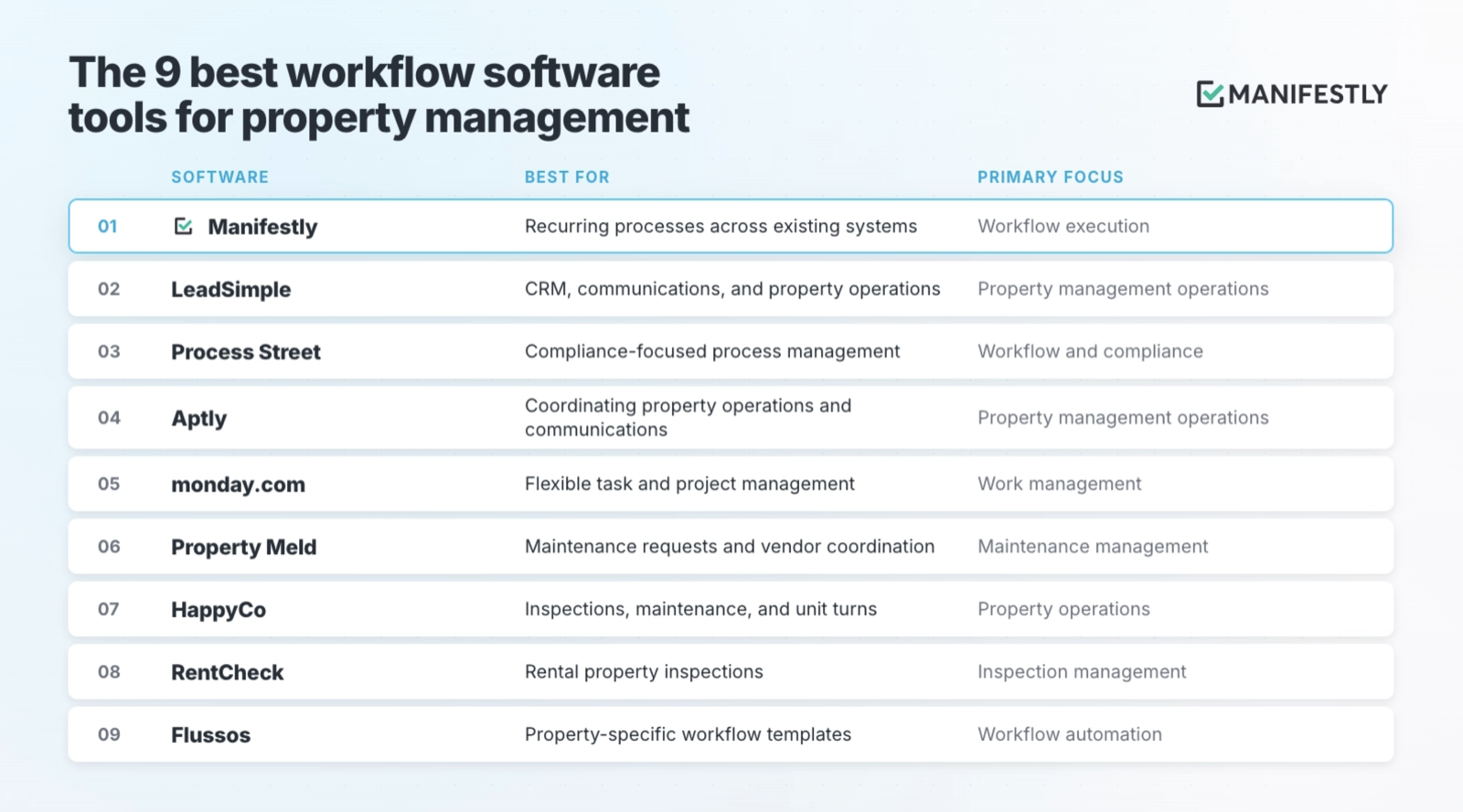
These aren’t nine versions of the same product. Some handle a specific part of property management. Others help teams coordinate broader operational processes. A property management company might use several of them together.
The question is which part of your operation needs better coordination.
1. Manifestly — Best for recurring process execution across your existing software
Manifestly helps property management teams turn recurring processes into workflows that people can reliably execute.
Instead of managing each lease renewal, inspection, or turnover through a combination of spreadsheets, email reminders, and individual task lists, you can define a repeatable process and run it whenever the work needs to happen.
Each workflow includes the steps, instructions, assignments, deadlines, and review requirements needed to complete the process.
For example, a unit turnover workflow might assign the move-out inspection to maintenance, the repair review to the property manager, and the final listing preparation to leasing.
Everyone can see what needs to happen next, what’s complete, and which steps still need attention.
Key capabilities
- Recurring and scheduled workflows.
- Role-based task assignments and due dates.
- Conditional logic and approval steps.
- Automated reminders and overdue task visibility.
- Data collection, file attachments, and completion history.
- API, webhook, and integration options.
- Reusable workflow templates for property management operations.
How Manifestly fits your property management software
Manifestly is designed to complement the software your team already uses.
Your property management platform can continue managing leases, tenants, properties, and accounting. Maintenance and inspection applications can continue handling their specialized work.
Manifestly provides a place to coordinate the recurring processes that involve those systems and the people who use them.
Through APIs and integration platforms, teams can connect Manifestly to other applications where supported. For example, property information could initiate a workflow through a configured integration, while Manifestly manages the assignments, approvals, and follow-up.
Not every process requires an integration. Routine inspections, monthly reporting, and preventive maintenance can run on recurring schedules directly in Manifestly.
What to consider
Manifestly isn’t a property management accounting platform, tenant CRM, or dedicated maintenance ticketing system.
Its focus is recurring process execution. If you need deep property management functionality in those other areas, you’ll still use the appropriate applications.
Connecting systems may also require configuration, depending on your property management platform’s API access and integration options.
Who should consider Manifestly?
Growing property management teams that already have software for managing properties but need a consistent way to execute recurring work across departments and applications.
Manifestly is particularly relevant when processes involve several owners, repeated follow-up, approvals, or a need to document what happened during each cycle.
Explore Manifestly’s property management workflows or learn about its API and integration capabilities.
2. LeadSimple — Best for property management CRM and communications
LeadSimple combines CRM, communications, and operational workflow capabilities in a platform built for property management companies.
It helps teams manage relationships with leads, owners, and residents while coordinating the processes associated with those relationships.
For example, a property management company might use LeadSimple to track prospective owners, manage onboarding communications, and coordinate operational follow-up after a management agreement is signed.
LeadSimple also integrates with major property management systems, including AppFolio, Buildium, Rent Manager, and Rentvine.
Key capabilities
- CRM and lead management.
- Shared communications and inbox tools.
- Property management process automation.
- Task assignments and workflow tracking.
- Property and contact information through supported integrations.
- Reporting across communications and operational activity.
Where LeadSimple fits
LeadSimple is useful when the work and the conversations around it need to stay closely connected.
For a property management company handling large volumes of owner inquiries, leasing activity, and resident communication, bringing CRM, messaging, and processes together can reduce the need to switch between tools.
Its property management focus also means teams can work with processes designed around familiar activities such as owner onboarding, renewals, and maintenance.
What to consider
LeadSimple offers a broader set of capabilities than a dedicated recurring-workflow tool.
If your team already has applications it likes for CRM, communications, and property management, adopting another platform with overlapping features may be more than you need.
The important question is whether you’re trying to consolidate communications and operational software or improve how recurring work gets completed across the systems you already have.
For teams whose main need is process execution, Manifestly provides a more focused approach.
Read our LeadSimple alternative comparison for a closer look at the differences.
3. Process Street — Best for compliance-focused workflow management
Process Street is a workflow and compliance operations platform that helps organizations manage repeatable processes, documents, approvals, and operational controls.
Like Manifestly, Process Street supports recurring workflows, assignments, conditional logic, approvals, integrations, and process histories.
Property management teams can use these capabilities to organize inspections, turnovers, renewals, onboarding, and other recurring procedures.
Process Street also offers broader compliance and document governance capabilities, including its Cora AI compliance agent.
Key capabilities
- Recurring workflow execution and automation.
- Task assignments, forms, and conditional logic.
- Approvals and process histories.
- Document control and governance features.
- AI-assisted compliance monitoring.
- Integrations with other business applications.
Where Process Street fits
Process Street may be a good fit for larger organizations that need to manage recurring processes alongside formal compliance programs, controlled documentation, and broader governance requirements.
For example, a company managing multiple operational teams might need standardized procedures as well as formal review and control over policy documents.
Process Street brings these capabilities into a broader platform.
What to consider
Manifestly and Process Street overlap considerably in their core workflow capabilities.
The decision often comes down to the scope of the platform and the effort required to adopt it.
If your immediate goal is to make recurring property management processes more reliable, evaluate how quickly your team can begin, how easily workflows can be maintained, and what the full cost of adoption looks like.
Manifestly offers a self-service starting point, published pricing, and the core capabilities growing operations teams need to run recurring work.
Process Street may be better suited to organizations seeking its broader compliance and governance functionality.
For a detailed comparison, see The Best Process Street Alternative for Growing Operations Teams and our Manifestly vs. Process Street comparison.
4. Aptly — Best for property management operations and communication workflows
Aptly is a property management operations platform designed to coordinate communications, tasks, and workflows alongside existing property management software.
Its approach brings property information, operational processes, and communication activity together.
Aptly can connect with major property management platforms and uses that information to support activities such as leasing, renewals, resident communication, and maintenance coordination.
Key capabilities
- Property management workflow automation.
- Operational boards and task coordination.
- Unified communications.
- Connections to property management platforms.
- AI-assisted communication and operational tools.
- Workflows for leasing, maintenance, and resident services.
Where Aptly fits
Aptly is relevant to teams that want more of their day-to-day property operations and communications managed through one connected workspace.
A leasing process, for example, involves conversations with applicants, scheduling, reviewing information, and coordinating next steps. Aptly is designed around connecting these activities.
What to consider
Aptly has increasingly positioned itself as a broader AI-enabled operations platform rather than only a task or workflow application.
That makes it important to compare its overall scope with your current software.
If you want to consolidate communications, AI assistance, and operational coordination, Aptly deserves consideration.
If you primarily need repeatable procedures with clear assignments and completion records across existing applications, compare a dedicated workflow tool such as Manifestly.
5. monday.com — Best for flexible task and project management
monday.com is a general-purpose work management platform that teams can configure for many kinds of projects and operational activities.
Property management teams can use it to track leasing tasks, maintenance projects, marketing activities, onboarding, and other work.
Its visual boards, automations, and reporting features make it particularly useful for teams that want a flexible way to organize tasks across departments.
Key capabilities
- Configurable project and task boards.
- Assignments, deadlines, and status tracking.
- Workflow automations.
- Dashboards and reporting.
- Templates for property management activities.
- Integrations with other business applications.
Where monday.com fits
monday.com works well for teams managing a mix of ongoing projects, individual tasks, and operational work.
For example, a property management company could use it to coordinate a renovation, track marketing for several listings, or manage a software implementation.
Those activities benefit from flexible boards and shared visibility.
What to consider
Recurring processes have somewhat different requirements from projects.
A renovation has a defined beginning and end. A monthly reporting process repeats every month, with a new set of responsibilities, deadlines, and completion records.
monday.com can support recurring work through automations and configuration. The question is how much setup and ongoing maintenance your team wants to manage.
If repeatable operational processes are your primary use case, a dedicated workflow platform may provide a more direct starting point.
6. Property Meld — Best for maintenance coordination
Property Meld specializes in property maintenance operations.
It helps property management companies coordinate maintenance requests, scheduling, vendor communication, repairs, and resolution.
Maintenance is one of the most coordination-intensive parts of property management. A request might involve a resident, property manager, maintenance coordinator, contractor, and property owner before the issue is resolved.
Property Meld focuses on making that process easier to manage.
Key capabilities
- Maintenance request management.
- Scheduling and vendor coordination.
- Resident and contractor communications.
- Repair progress tracking.
- Maintenance-related automation.
- Visibility into outstanding maintenance activity.
Where Property Meld fits
Property Meld is a strong category fit when maintenance requests are the primary operational challenge.
Instead of coordinating repairs through disconnected emails and phone calls, teams can manage the maintenance process in a dedicated system.
What to consider
Maintenance is only one part of property operations.
A company might also need recurring workflows for lease renewals, owner onboarding, monthly reporting, staff training, or inspections.
Property Meld can remain the place where maintenance work is managed, while a broader workflow platform coordinates recurring processes outside maintenance.
The two types of software address different operational needs.
7. HappyCo — Best for inspections, maintenance, and unit turns
HappyCo provides software for property inspections, maintenance operations, and make-ready coordination.
It is particularly relevant to property management teams that need to document property conditions and coordinate the work required to prepare units for occupancy.
A unit turnover can involve an inspection, maintenance requests, vendors, cleaning, and final readiness checks. HappyCo provides tools designed around these activities.
Key capabilities
- Digital property inspections.
- Property condition documentation.
- Maintenance work coordination.
- Make-ready and unit turnover management.
- Tasks and project tracking.
- Operational reporting.
Where HappyCo fits
HappyCo is useful for teams with significant inspection, maintenance, and unit readiness requirements.
Its specialized capabilities can help field and property operations teams manage the details associated with inspecting and preparing units.
What to consider
HappyCo covers more than inspections alone, so it should be evaluated according to the field and maintenance operations your company actually needs.
If those activities are the main source of operational friction, a specialized platform may be appropriate.
If you also need consistent workflows for owner onboarding, lease renewals, recurring reporting, and other departments, evaluate how those broader processes will be coordinated.
A general workflow system may complement HappyCo rather than replace it.
8. RentCheck — Best for rental property inspections
RentCheck focuses on rental property inspections and condition documentation.
It helps property management teams manage move-in, move-out, and other inspections while collecting the information needed to understand a property’s condition.
RentCheck also supports resident-led inspections, allowing residents to participate in documenting property conditions.
Key capabilities
- Digital rental inspections.
- Move-in and move-out inspection workflows.
- Resident-led inspection options.
- Photos and condition documentation.
- Inspection scheduling and tracking.
- Integrations with supported property management and maintenance systems.
Where RentCheck fits
RentCheck is particularly useful for teams trying to standardize inspections and maintain consistent property condition records.
A property manager can use it to organize inspections across units, collect documentation, and compare inspection results over time.
What to consider
An inspection often leads to additional work.
A finding may require maintenance, an owner decision, a vendor assignment, or a follow-up inspection.
RentCheck provides integrations with other property management and maintenance tools, so some of these activities can be coordinated through connected systems.
The question is whether your requirements stay primarily within inspection management or extend into broader recurring processes.
For those broader processes, a dedicated workflow platform may be useful alongside the inspection system.
9. Flussos — Best for property-specific workflow templates
Flussos is a workflow automation platform designed specifically for property management businesses.
It offers prebuilt workflows covering common property management activities and helps teams standardize how those processes are executed.
Its approach is similar to dedicated workflow software, with a stronger emphasis on processes already familiar to property management operators.
Key capabilities
- Property management workflow templates.
- Workflow automation.
- Task assignments and progress tracking.
- Standardized operating processes.
- Integration options for property management operations.
- Reusable processes across the team.
Where Flussos fits
Flussos may appeal to property managers who want to begin with processes already structured around the industry.
Its library of more than 30 property management workflow templates can help teams get started without building every procedure from scratch.
What to consider
Prebuilt templates are useful starting points, but property management companies still need to adapt them to their operations.
Review how easily workflows can be changed, how responsibilities are assigned, what integrations are available, and how completed work is documented.
Manifestly also offers property management templates, with the flexibility to build and run recurring workflows across departments and other business functions.
The choice depends on how much industry-specific structure you want and how broadly you need to use the platform.
Do you need workflow software if you already use AppFolio, Buildium, Rent Manager, or Rentvine?
Before adding another application, review what your existing property management platform already provides.
AppFolio, Buildium, Rent Manager, and Rentvine support important operational workflows as well as core property management functions.
They aren’t simply databases for property records.
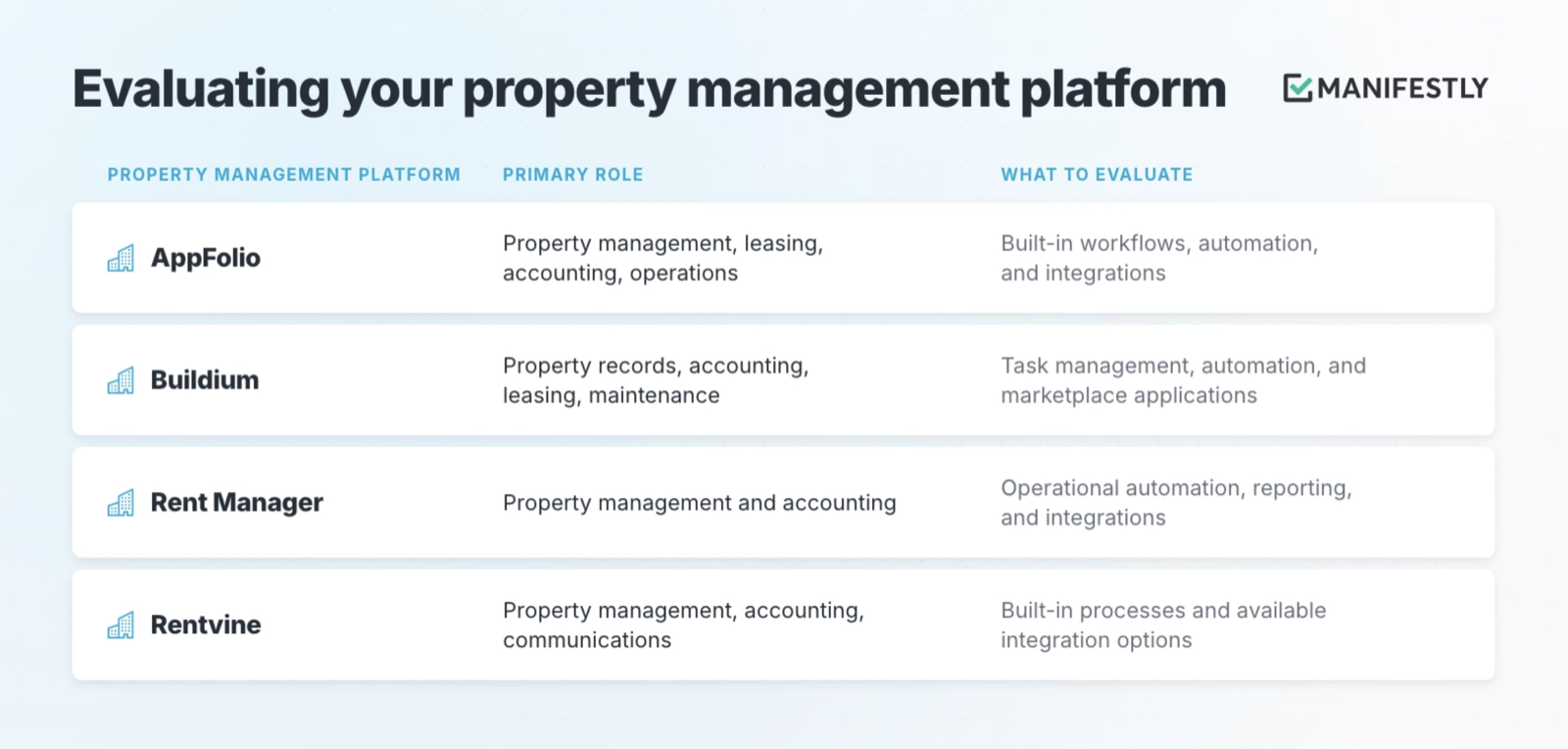
You may find that the workflow you need is already supported by your current platform.
For example, if the entire activity stays within maintenance management, an existing maintenance workflow may be sufficient.
But some recurring processes extend beyond the property management platform.
Consider owner onboarding. Your team may need to collect documents, configure property records, schedule inspections, obtain approvals, and coordinate communications across several applications.
Or consider monthly reporting. Accounting information may live in the property management system, while the review, approval, and distribution process involves several people.
This is where dedicated workflow software can help.
Your property management platform manages important business information. A process execution layer helps coordinate the recurring work that happens around it.
Manifestly can work alongside your existing systems through APIs and integration tools, while providing a consistent way to execute recurring processes.
You don’t necessarily need to replace your current software or move every activity into another platform.
For a closer look at how these applications work together, explore our guide to property management workflow automation and connecting your systems and processes.
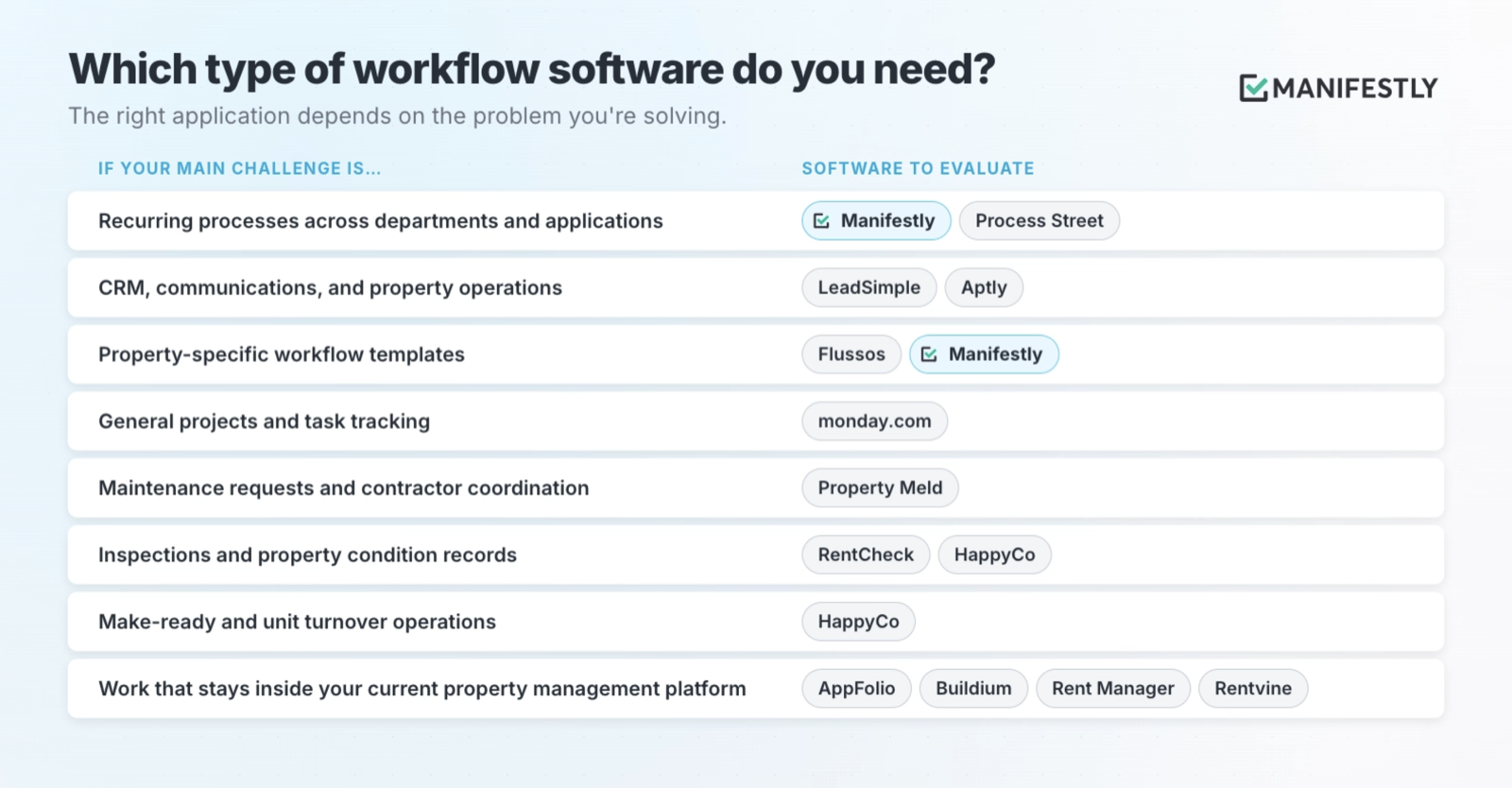
These applications aren’t always alternatives to one another.
A property management company might use AppFolio for property records, Property Meld for maintenance, RentCheck for inspections, and Manifestly for recurring operational processes.
Each tool has a defined role.
The goal is not to assemble the largest possible software stack. It’s to make sure the software you use supports the work your team needs to complete.
Five questions to ask before choosing property management workflow software
A feature comparison is useful, but it won’t tell you whether a tool fits the way your team actually works.
Start with the processes you’re trying to improve.
1. What type of work are you managing?
Is your biggest challenge coordinating repairs, conducting inspections, managing owner communications, or executing recurring processes?
A maintenance ticket and a monthly reporting workflow have different requirements.
Choose software designed for the work you need to manage.
2. Does the process stay inside one application?
Some activities can be handled entirely within your property management platform.
Others involve leasing, maintenance, accounting, managers, owners, and outside vendors.
When a process crosses several systems or teams, look at how the software coordinates those handoffs.
3. Who owns each step, and what happens when work is late?
Visibility into tasks is helpful, but knowing a task exists doesn’t necessarily tell you who is responsible for moving the process forward.
Look for clear assignments, deadlines, reminders, and a way to identify outstanding work.
If someone needs to approve a decision, make sure that requirement is part of the process.
4. Can you tell what happened during each completed process?
Recurring work needs more than a checklist that gets reused.
Each lease renewal, inspection, or turnover should have its own record of what was completed, when it happened, and what information or decisions were recorded.
That history can help managers review previous work, investigate problems, and improve the process over time.
A completion record documents what was submitted and approved. It doesn’t replace the professional judgment needed to verify the underlying work.
5. How much will it take to implement and maintain the software?
Consider more than the subscription price.
How long will it take to configure your first workflow? Can your operations manager update the process without technical assistance? Does your team need training? What happens when you add new properties, employees, or departments?
Also review the pricing structure.
Some platforms charge per user, others use property-based pricing, and some require a sales conversation before you can evaluate the full cost.
For a growing property management company, the ability to start with one process and expand as needed can be as important as the feature list.
Common property management workflows you can automate
Once you’ve chosen the right type of software, start with a process your team already runs.
Here are several common examples.
Unit turnovers
A turnover involves work across leasing, maintenance, vendors, management, and accounting.
A repeatable workflow can coordinate the inspection, repairs, cleaning, deposit-related tasks, and readiness for the next tenant.
Start with Manifestly’s move-out procedure checklist.
Lease renewals
Lease expiration dates may already live in your property management platform. The renewal process still requires someone to review terms, obtain approvals, communicate with the tenant, and record the result.
A recurring workflow helps coordinate those steps and keep outstanding actions visible.
Property inspections
Inspections need consistent procedures, assigned responsibilities, documented findings, and follow-up when issues are identified.
Specialized inspection applications can handle the fieldwork and condition records, while broader workflows can coordinate surrounding approvals and operational steps.
Owner and tenant onboarding
Onboarding involves collecting information, assigning responsibilities, configuring records, communicating expectations, and confirming that the required setup is complete.
A standardized workflow helps make those responsibilities clear each time a new property, owner, or tenant enters the process.
Explore Manifestly’s property management checklist library for additional templates.
Open house preparation
For property managers and real estate teams handling listings and showings, preparing for an open house is another repeatable process.
Cleaning, staging, photography, marketing materials, and a final walkthrough all need to happen before the event.
A workflow can assign these steps and set deadlines relative to the open house date.
Use Manifestly’s open house preparation checklist or start from the reusable open house checklist template.
Choose workflow software that fits the work
Property management teams rarely struggle because they have no software.
They already have applications for leases, accounting, maintenance, inspections, and communications.
The challenge is often making the recurring work across those systems reliable.
A specialized maintenance application can improve repair coordination. An inspection platform can standardize property condition records. A CRM can organize conversations and relationships.
Those are valuable capabilities, and you may need several of them.
But when your biggest challenge is coordinating recurring work across people, departments, and applications, look for software designed around process execution.
Manifestly helps teams turn recurring procedures into workflows with clear owners, deadlines, approvals, reminders, and completion records. It works alongside the systems your team already uses, with integrations where they help connect the process.
Start with one process your team runs every week or month. Give each step an owner, define what needs review, and make completion visible.
Then expand to the next process.
Explore Manifestly’s property management workflows and see how to make recurring work more reliable across your existing software.
Frequently asked questions about property management workflow software
What is the best workflow software for property management?
It depends on the work you’re trying to manage.
Manifestly and Process Street are options for recurring process execution. LeadSimple and Aptly combine property management operations with communications and workflow capabilities. Property Meld specializes in maintenance, while RentCheck and HappyCo offer specialized inspection and property operations tools.
Choose based on your operational requirements and the software you already use.
Can workflow software integrate with AppFolio or Buildium?
Yes, some workflow platforms can connect with AppFolio, Buildium, and other property management systems through supported integrations, APIs, and integration services.
Available connections vary by provider and subscription. Before choosing a platform, confirm whether the integration supports the specific data and actions your workflow requires.
Manifestly provides API and integration capabilities for connecting recurring workflows with other applications.
What’s the difference between property management software and workflow software?
Property management software typically manages property records, leases, tenants, accounting, maintenance, and related transactions.
Workflow software focuses on how work gets completed: the steps, assignments, deadlines, approvals, and completion records.
Many property management platforms include workflow features. Dedicated workflow software becomes useful when recurring processes need additional structure or span multiple people and applications.
Is LeadSimple a workflow management tool?
Yes. LeadSimple includes process management and workflow automation alongside CRM and communications capabilities.
It’s particularly relevant to property management companies that want these functions within a connected platform.
What’s the difference between Manifestly and Process Street?
Both products support recurring workflows, assignments, approvals, conditional logic, and process histories.
Manifestly emphasizes straightforward recurring process execution, self-service adoption, and published pricing.
Process Street offers a broader compliance operations platform, including document governance and AI-assisted compliance capabilities.
The decision depends on whether you primarily need reliable recurring execution or a broader set of compliance and governance tools.
Do small property management companies need dedicated workflow software?
Not always.
If your existing software handles your processes and everyone can see what needs to happen next, another application may not provide much value.
Dedicated workflow software becomes more useful when recurring work involves several people, repeated handoffs, approvals, or frequent follow-up to find out what’s complete.
Start by identifying one process that regularly requires manual coordination. That will tell you more about your software needs than a long feature checklist.