



Property Management Workflow Automation: Connect Your Systems and Processes
November 24, 2026
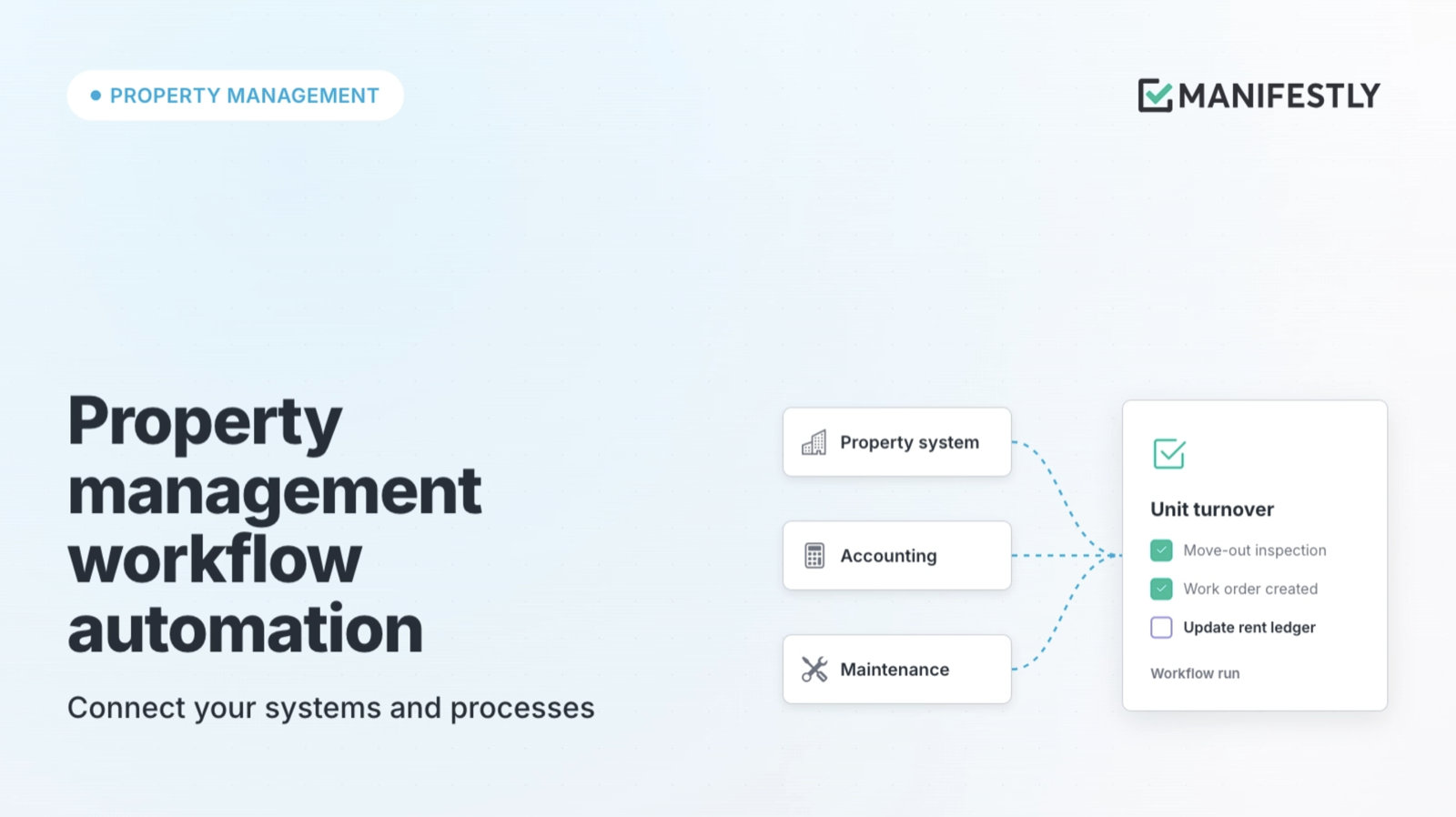
Your property management software knows when a lease expires. But who reviews the renewal terms, gets the owner’s approval, sends the offer, and follows up with the tenant?
AppFolio, Buildium, Rent Manager, and other property management platforms help teams manage properties, leases, tenants, maintenance, and financial records. They handle important parts of the business.
But much of the day-to-day work still happens between people and systems. Someone needs to assign the next task, follow up on an approval, coordinate a contractor, or confirm that a property is ready for its next tenant.
Even when the information is available, the process can get stuck.
Property management workflow automation connects the information in your existing software to the recurring work your team needs to complete. It gives each process clear steps, responsible people, deadlines, approvals, and a record of what happened.
Manifestly works alongside your property management software to coordinate that execution. You can connect systems through APIs and integration tools, schedule recurring processes, and give your team a shared view of what’s done and what needs attention.
You don’t need to replace the software your team already uses. You need a reliable way to get the work done across it.
What is property management workflow automation?
Property management workflow automation uses software to organize, assign, and track recurring processes such as lease renewals, unit turnovers, property inspections, owner onboarding, and monthly reporting.
Instead of relying on someone to remember every step, a workflow defines:
- What starts the process: A scheduled date, a new request, or an event in another application.
- Who owns each step: The person or role responsible for completing the work.
- When work is due: Deadlines, reminders, and follow-up requirements.
- What needs review: Approvals or checkpoints before the next step proceeds.
- How completion is recorded: A history of completed tasks, submitted information, and decisions.
Consider a tenant moving out.
Your property management software records the lease and move-out date. But preparing the unit for the next tenant involves several people. Leasing needs to coordinate the departure, maintenance needs to inspect the property, contractors may need to complete repairs, and accounting needs to handle the deposit.
A workflow connects those activities into a repeatable process.
The distinction matters because automating information and automating work are not quite the same thing.
An integration can send a move-out date from one application to another. A workflow defines what needs to happen because of that date, who is responsible, and how the team knows the process is complete.
Manifestly provides this process execution layer. Explore the property management workflow use cases to see how teams can standardize recurring operations.
How does workflow automation fit into your property management tech stack?
Most property management companies already use several software applications to run their business.
Your property management platform might handle accounting and lease records. Another application manages maintenance requests. Your team may use email, messaging, or a CRM to communicate with owners, tenants, and vendors.
Together, these applications make up your property management tech stack.
Each serves a purpose, but the recurring work doesn’t always stay inside one application.
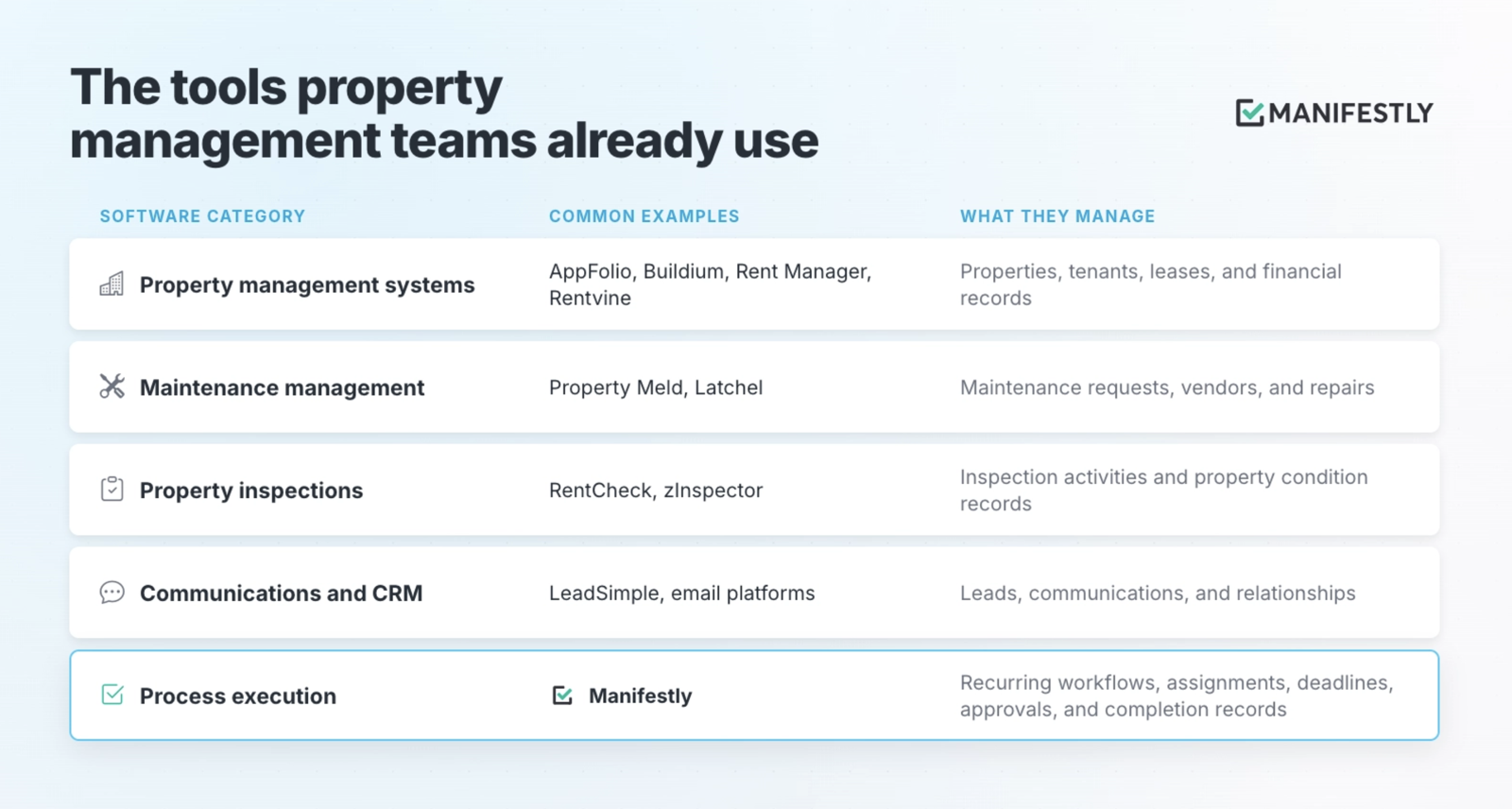
Some property management platforms already include features from several of these categories. You may not need a separate application for every function.
The question is whether your existing software gives the team a reliable way to coordinate recurring work across those functions.
The missing layer is often process execution
Imagine your team is preparing a lease renewal.
The expiration date is available in your property management software. The renewal offer may be prepared in a document tool. The owner’s approval arrives by email, and the tenant receives the offer through your communications platform.
Every application is doing its job.
But who makes sure the owner responds? Who follows up with the tenant? What happens if the approval is late? How does the property manager know the renewal is complete?
Without a defined process, those responsibilities often depend on individual reminders, inboxes, and status checks.
Connected applications don’t automatically create a connected process.
Manifestly adds a shared workflow around that work. Each renewal can follow the same sequence, with assigned responsibilities, due dates, reminders, and approval steps.
The property manager can see what’s complete, what’s waiting, and who owns the next action without gathering updates from several people.
The existing applications continue doing what they do best. Manifestly helps coordinate the work between them.
How does Manifestly connect with AppFolio, Buildium, Rent Manager, and Rentvine?
Manifestly can work alongside property management systems through its API, webhooks, and integration platforms.
These connections allow teams to use information from existing applications to initiate workflows, provide context for assigned work, and coordinate updates between systems.
The exact setup depends on the property management software, your subscription, and the API or integration access available.
Connecting property management systems through APIs
An API allows software applications to exchange information or request actions.
For example, a property management team could configure an integration that uses a lease expiration date to initiate a renewal workflow in Manifestly.
The workflow can then assign tasks to the leasing coordinator, request an approval from the property manager, and track the remaining steps.
If the integration supports it, information from the completed process can also be sent to another system.
Manifestly provides several ways to build these connections:
- REST API: Create and manage workflow data through a custom integration.
- Webhooks: Notify another application or integration service when supported workflow events occur.
- Zapier: Connect Manifestly with other applications using configured triggers and actions.
- Integration platforms: Use tools such as Workato or Tray.io to coordinate processes across systems.
Manifestly’s API is available on its plans, and its integration tools make it possible to connect workflows to existing applications without requiring every process to operate inside one platform.
Learn more about Manifestly’s API and integration capabilities.
What about API restrictions in property management software?
Not every property management platform provides the same level of API access.
AppFolio, Buildium, Rent Manager, and Rentvine have different integration options, access requirements, and partner ecosystems. Some connections may require a specific plan, an approved partner, or custom configuration.
Before building an integration, check three things:
- Does your property management platform provide access to the data or event you need?
- Can your integration read that information, write updates, or both?
- What should happen in Manifestly when the information becomes available?
For example, a lease renewal workflow might need only a property identifier and expiration date to start. It doesn’t necessarily need access to every tenant or financial record.
Start with the information required to execute the process, rather than trying to synchronize everything.
And remember that not every workflow requires an integration. Routine inspections, monthly reporting, and preventive maintenance can often be scheduled directly in Manifestly.
Three ways to automate recurring property management processes
Property management workflows generally begin in one of three ways: on a schedule, from an event, or from information in another system.
Most teams benefit from using a combination of all three.
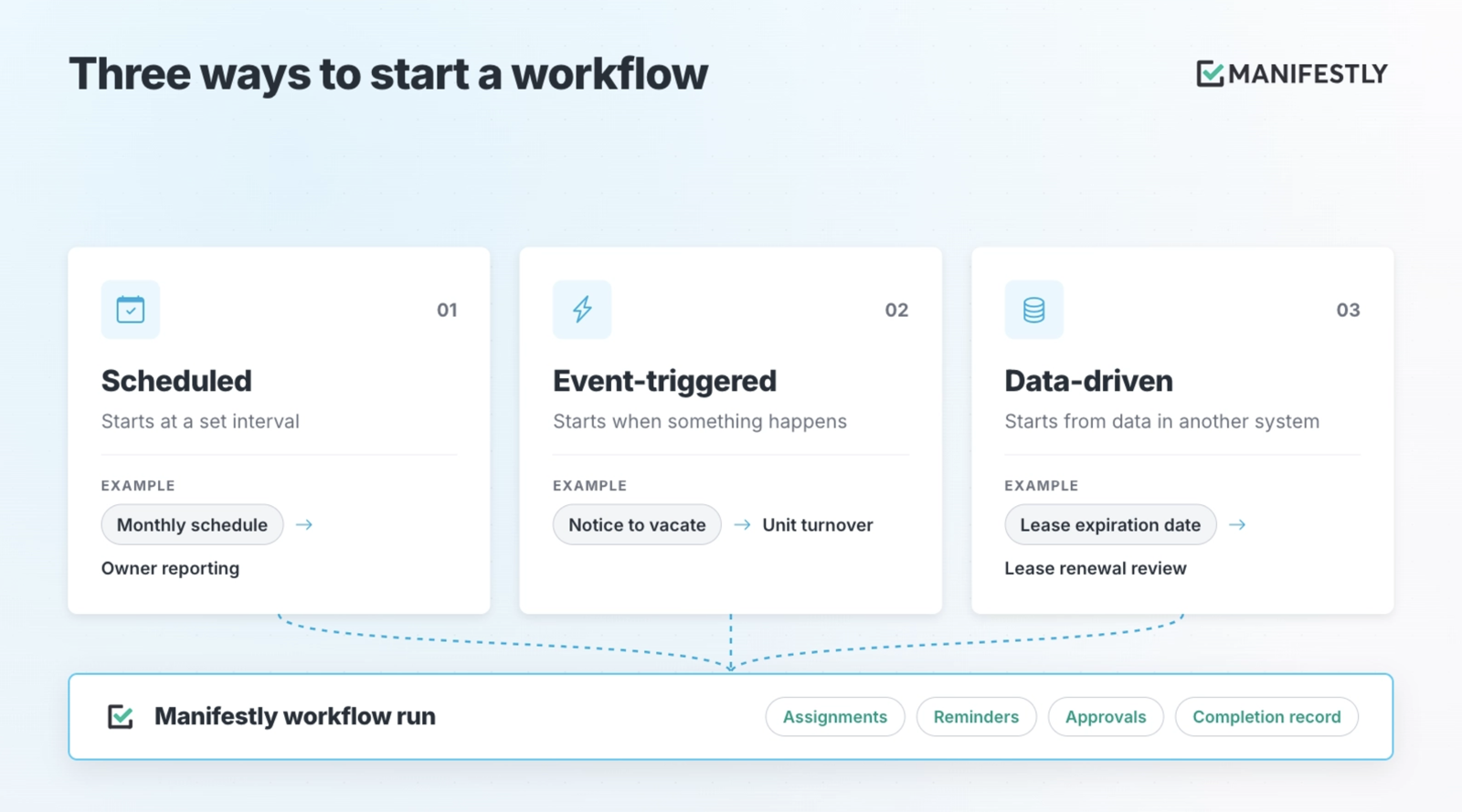
1. Scheduled workflows
Some work happens at predictable intervals.
Monthly reporting, quarterly inspections, seasonal maintenance, and annual reviews follow established schedules.
Manifestly can start these recurring workflows automatically, assign the necessary steps, and remind people when their work is due.
For example, a monthly owner reporting workflow might include reviewing transactions, preparing statements, requesting manager approval, and distributing reports.
The process repeats every month, but each cycle has its own assignments, status, and completion record.
2. Event-triggered workflows
Other processes begin when something happens.
A new management agreement starts owner onboarding. A notice to vacate starts a unit turnover. A new vendor request starts vendor onboarding.
With a configured integration, that event can initiate a Manifestly workflow and provide relevant information to the team.
Instead of someone having to remember to create a new checklist, the process begins when the triggering event is received.
3. Data-driven workflows
Some processes depend on information already maintained in your property management system.
Lease expiration dates, insurance renewals, and other important deadlines are examples.
An integration can use that information to start or inform a workflow, such as initiating a lease renewal review before the expiration date.
The workflow then coordinates the people, approvals, follow-up, and completion record.
These three approaches work together. A property management company might use scheduled inspections, event-triggered turnovers, and data-driven lease renewals without changing its core property management software.
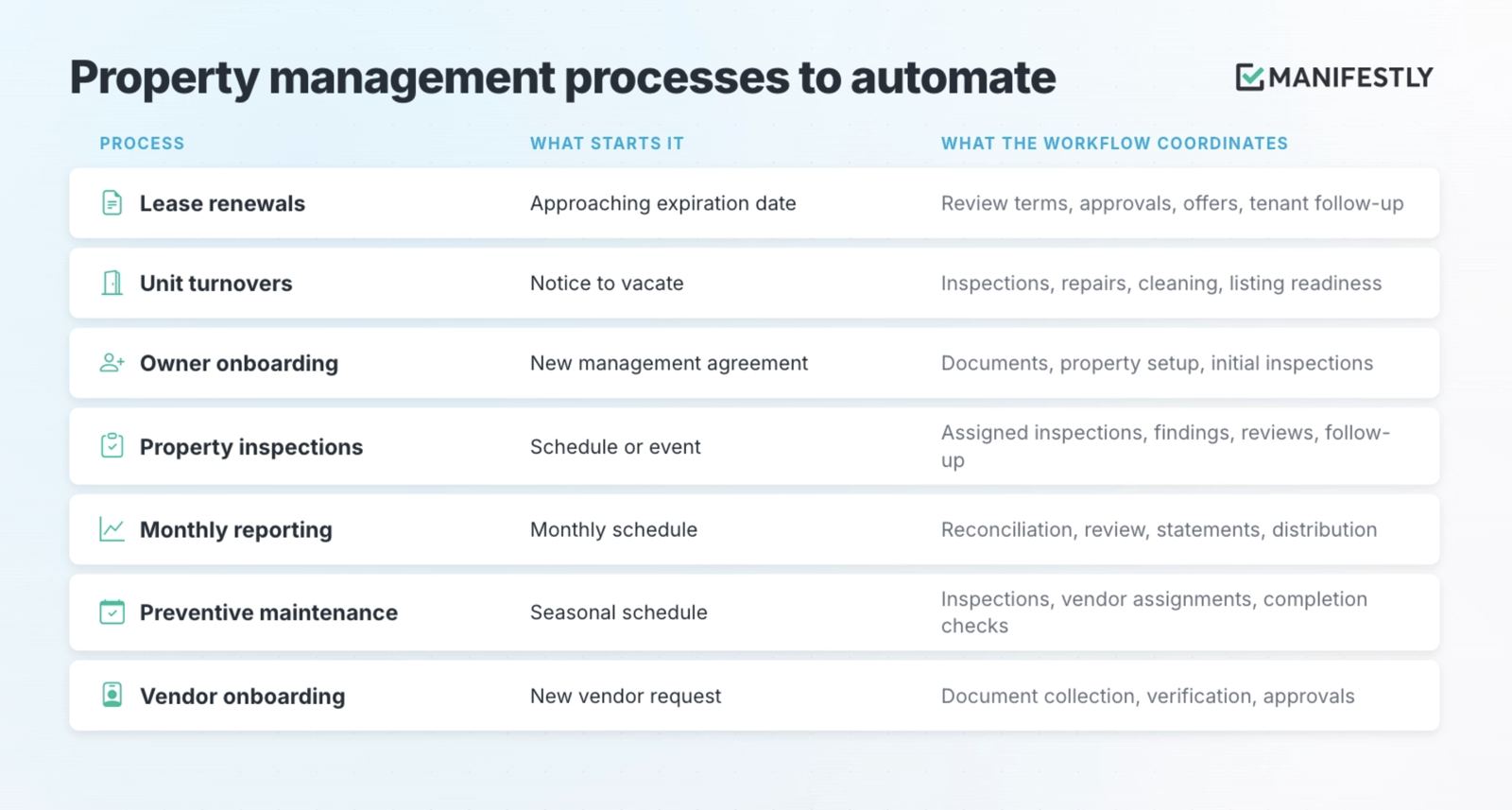
Which property management workflows should you automate first?
Start with processes that happen repeatedly, involve multiple people, or regularly require someone to check whether the work is finished.
These are often the places where a defined workflow can make the biggest operational difference.
You don’t have to automate every process at once.
Choose one that requires repeated coordination. Define the steps, identify the responsible people, and make the deadlines and approvals visible.
Once the process runs consistently, look at which parts would benefit from an integration.
Three examples of property management workflow automation
The value of workflow automation becomes clearer when we look at how it works in everyday property management.
Example 1: Lease renewals — From expiration date to completed agreement
A lease is approaching expiration.
The date is already recorded in AppFolio, Buildium, or another property management system. With an appropriate integration, that date can initiate a renewal workflow in Manifestly.
The workflow might look like this:
- The leasing coordinator reviews the expiration date and current terms.
- The property manager reviews proposed renewal terms.
- The owner approves the terms, where required.
- The leasing coordinator prepares and sends the renewal offer.
- The team follows up with the tenant before the response deadline.
- The completed agreement is recorded and the appropriate system records are updated.
Each step has an owner and due date.
If the owner hasn’t responded, the team can see that approval is outstanding. If the tenant hasn’t returned the offer, the next follow-up is already assigned.
The workflow also records the activity and decisions made during the process.
The value isn’t simply receiving an expiration reminder. It’s having a reliable process for everything that follows.
Example 2: Unit turnovers — Coordinating leasing, maintenance, and accounting
A tenant gives notice to vacate.
That starts a sequence of work involving leasing, maintenance, contractors, management, and accounting. Each team may use different applications, but the turnover still needs to happen in the right order.
A configured integration can start the turnover workflow in Manifestly when the notice is recorded.
The workflow assigns tasks such as confirming the move-out date, scheduling the inspection, identifying repairs, coordinating cleaning, reviewing any deposit deductions, and preparing the property for its next tenant.
The property manager can see which steps are complete and which are waiting on someone else.
If a repair is delayed, the outstanding work remains visible. If the final inspection requires approval, that review can be included in the workflow.
Every turnover follows a consistent process, while individual properties can have different requirements and exceptions.
Manifestly’s move-out procedure checklist provides a starting point for building this workflow.
Example 3: Property inspections — A repeatable process across properties
Property inspections are recurring work, but each property can have different conditions, maintenance needs, and follow-up requirements.
A property manager might keep an inspection schedule in a spreadsheet or property management system. The schedule identifies when the inspection is due, but the team still needs to conduct it, document findings, and follow up.
With Manifestly, routine inspections can run on a recurring schedule.
Each inspection receives its own workflow, with assigned tasks, instructions, and deadlines. The person conducting the inspection can record observations, collect information, and attach supporting documents.
If an issue requires review, the workflow can assign that checkpoint to the appropriate person.
Managers can see which inspections are complete and which still require attention. They can also review previous workflow records rather than reconstructing the process from emails and separate files.
A completed checklist doesn’t establish that every underlying issue has been resolved. It provides a record of the work performed and any findings that still require follow-up.
Start with Manifestly’s property inspection checklist and adapt it to your properties.
Other property workflows you can standardize
Not every recurring process depends on lease data or an event in your property management platform.
Many operational routines are good candidates for a shared workflow because they require the same sequence of work each time.
Consider open house preparation.
A real estate team may need to coordinate cleaning, staging, repairs, photography, marketing materials, and a final walkthrough before an open house.
The team may already use several applications to manage listings and communications. But someone still needs to make sure the property is ready before visitors arrive.
A repeatable workflow gives each step an owner and deadline. The same process can be used for every property, with adjustments for individual listings.
Manifestly offers an open house preparation checklist and a ready-to-use open house checklist template.
The same approach works for seasonal maintenance, vendor onboarding, property listing preparation, and routine property checks.
The goal isn’t to create more checklists. It’s to make sure those checklists become recurring processes that people can reliably execute.
Manifestly vs. LeadSimple: Which approach fits your property management team?
LeadSimple and Manifestly both help property management teams organize and automate work, but they approach the problem from different starting points.
LeadSimple combines CRM, communications, and process management capabilities in a platform designed for property management companies.
That can be valuable for teams looking to manage leads, customer communications, and operational workflows within a broader system.
Manifestly focuses on recurring process execution.
It helps teams define repeatable workflows, assign responsibilities, manage approvals and deadlines, and track completion. Through APIs and integrations, those workflows can work alongside the property management and communications applications a team already uses.
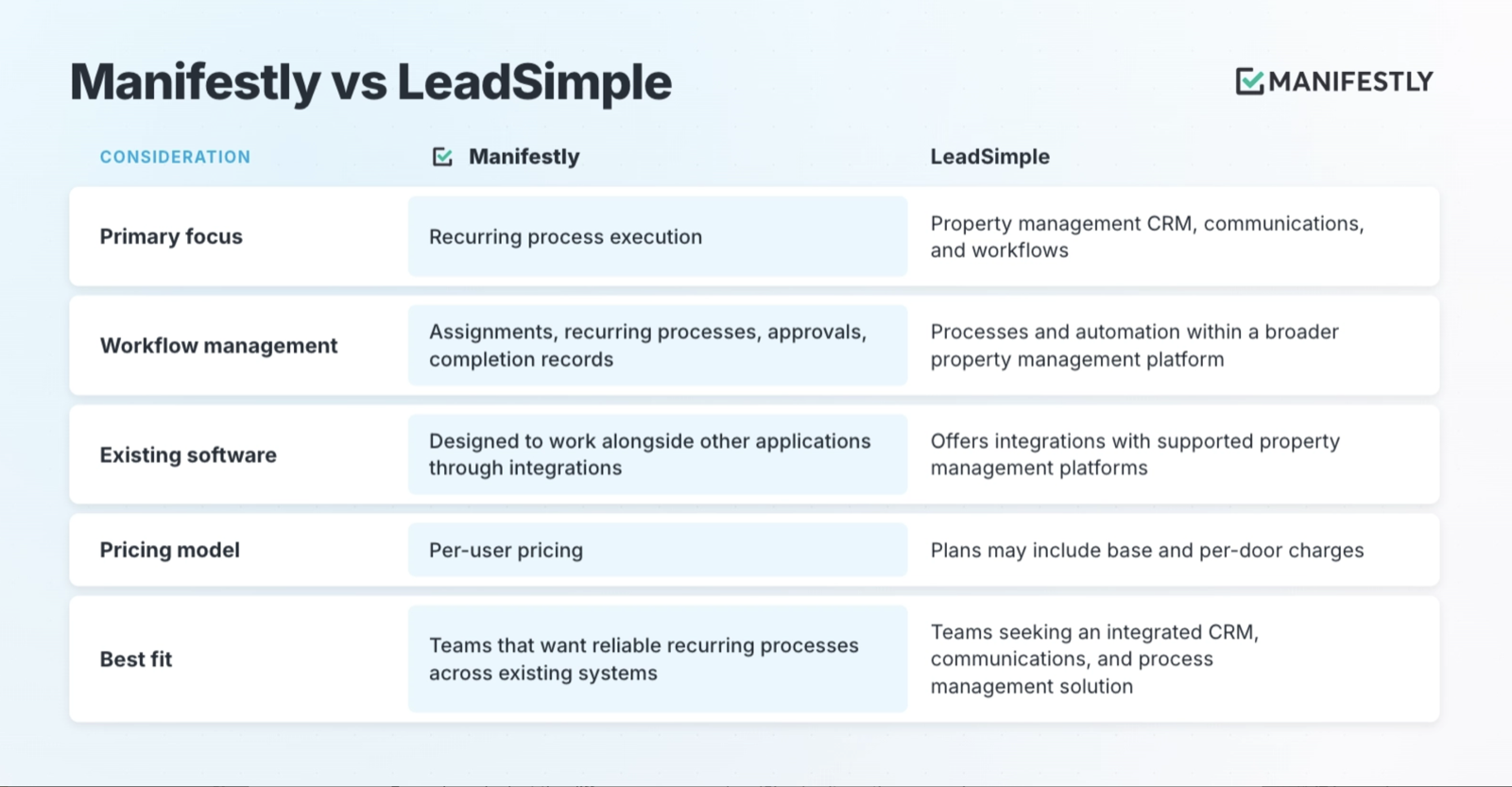
The choice depends on what your team needs.
If you want a combined CRM and communications platform with property management-specific workflows, LeadSimple may be a good fit.
If you already have applications for managing properties, tenants, maintenance, and communications, but need a consistent way to execute the processes between them, Manifestly offers a focused alternative.
For a closer look at the differences, see our LeadSimple alternative comparison.
How to choose the right property management workflow automation approach
Before adding another application or building an integration, look at the work your team already performs.
Five questions can help identify where workflow automation will provide the most value.
1. Which recurring processes require the most coordination?
Think about the last few times work was delayed or someone had to chase an update. Was it a renewal approval, a maintenance handoff, or a missing inspection?
Look for processes that repeatedly depend on someone remembering what happens next.
2. Which applications hold the information needed to start the work?
Identify where the relevant dates, records, requests, or events already live.
This helps determine whether a workflow should begin on a schedule, manually, or through an integration.
3. Where do assignments and approvals happen today?
If responsibilities are scattered across emails, spreadsheets, and individual task lists, the team may have difficulty seeing the full process.
A shared workflow can bring those responsibilities into one place.
4. Which steps actually need an integration?
Not every process needs live access to property data.
Use integrations where they remove repeated data entry, eliminate unnecessary manual starts, or make information available to the people completing the work.
5. How will you know the process is complete?
A task being marked complete is useful, but some work also requires supporting information, a review, or an approval.
Decide what needs to be recorded and who needs to confirm completion before the next cycle begins.
These questions help separate software requirements from process requirements, so you can improve how work gets done without replacing tools that already serve your team well.
Make your existing property management software work together
Most property management teams don’t need another place to store the same information.
They need a reliable way to coordinate the recurring work that happens around it.
Your property management platform can remain the system of record for properties, leases, tenants, and transactions. Your maintenance, inspection, and communications tools can continue handling their specialized work.
Manifestly helps connect those activities through repeatable processes with clear ownership, deadlines, approvals, and completion records.
Start with one process your team runs regularly, such as a lease renewal, unit turnover, or property inspection. Define the steps, assign the owners, and decide which integrations would help the work move forward.
Once the process is running, you have a foundation for automating more of the work around your existing systems.
Explore Manifestly’s property management workflows and start building a more reliable process for the work your team does every day.
Frequently asked questions
Can Manifestly connect with AppFolio and Buildium?
Yes. Manifestly can be connected with property management systems such as AppFolio and Buildium using APIs and integration platforms, subject to the access and capabilities available in the property management system.
The connection may require configuration rather than a native, one-click integration. Check your current platform’s API access and integration options before deciding on an approach.
How do you automate lease renewals across property management software?
Start by defining the renewal process: review terms, obtain any required approvals, prepare the offer, follow up with the tenant, and record the outcome.
Then connect the workflow to the lease information in your property management software, where API access permits.
With Manifestly, the renewal process can have assigned tasks, due dates, reminders, approvals, and a completion record.
Can you automate property management workflows without an API?
Yes. Many recurring processes can run without a direct connection to property management software.
Monthly reporting, routine inspections, preventive maintenance, and staff onboarding can start on schedules or be initiated manually.
APIs become useful when the process depends on information or events in another application, such as a lease expiration date or a new management agreement.
What’s the difference between property management software and workflow automation software?
Property management software typically handles business records and transactions related to properties, tenants, leases, maintenance, and accounting.
Workflow automation software coordinates repeatable work, including assignments, deadlines, approvals, and completion tracking.
There is overlap between these categories. Manifestly complements existing property management software by providing a dedicated place to execute recurring processes, including work that spans several applications.
How is Manifestly different from LeadSimple?
LeadSimple combines CRM, communications, and workflow features for property management companies.
Manifestly focuses on recurring workflow execution and can connect with the systems your team already uses.
The right choice depends on whether you need a broader communications and CRM platform or a dedicated way to standardize and track recurring operations.
Do you need a developer to connect your property management applications?
Not always.
Manifestly supports Zapier and other integration platforms that can reduce or eliminate the need for custom code.
However, the connection still depends on the capabilities and access offered by your property management software. Some API integrations require technical setup or developer support.
You can also start using Manifestly for scheduled and manually initiated processes before connecting other applications.